Syllabus: Social Studies (New NCERT) for Class 6

In Class 6 Social Studies, you will study the three main branches of Social Studies: history, geography and civics. The syllabus includes topics such as ancient civilisations, maps and locating places, the Indian system of government, our natural environment and basic economics. Knowing the syllabus helps you understand how chapters connect and what you are expected to learn at this level. Let us explore these topics and see how they fit together.

Theme A - India and the World: Land and the People
This theme introduces the basic features of the Earth's surface and ways to represent them on maps. Beyond using modern digital maps, the theme explains how natural features such as oceans, mountains and rivers have shaped human life and the development of societies, including those in the Indian subcontinent.
Chapter 1: Locating Places on the Earth
- Types of maps: A physical map shows natural features (mountains, rivers, plains); a political map shows boundaries of countries, states and cities; a thematic map highlights specific information such as rainfall, population or vegetation.
- Map components: A scale shows the relationship between distance on the map and distance on the ground; a direction indicator or compass rose shows cardinal directions (North, South, East, West); a legend explains symbols used on the map.
- Latitude and longitude: Latitude are horizontal lines (parallels) used to measure distance north or south of the Equator; longitude are vertical lines (meridians) used to measure distance east or west of the Prime Meridian. Together they give the precise location of any place on Earth.
- Time zones: The Earth is divided into 24 time zones, each about 15° of longitude wide. Time changes as we move east or west; the International Date Line marks the place where the date changes when crossed.
Chapter 2: Oceans and Continents
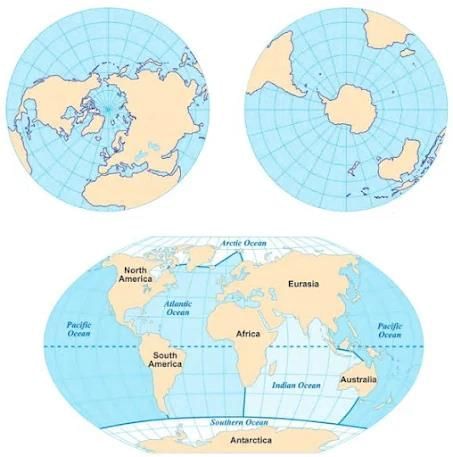
- Earth's surface: The surface is divided into continents (large landmasses) and oceans (vast bodies of salt water). Continents and oceans together form the major physical divisions of the planet.
- Indian Navy motto: Remember the motto "Sam noh Varunah" (from the Rigveda), reflecting India's long maritime connection.
- Distribution of land and water: The Northern Hemisphere has a larger proportion of land, while the Southern Hemisphere has more ocean area. This affects climate and human settlement patterns.
- Major oceans: There are five major oceans - the Pacific, Atlantic, Indian, Southern (or Antarctic) and Arctic - and these oceans play a key role in climate, trade and biodiversity.
- Why seawater is salty: Rivers carry dissolved salts and minerals from rocks into the sea; over long time periods evaporation leaves salts behind, making ocean water salty.
- Ocean-related disasters: Tsunamis are large sea waves usually caused by undersea earthquakes; cyclones are powerful storm systems formed over warm oceans and may cause heavy rain, storm surge and wind damage.
- Islands: Islands are areas of land surrounded by water. Greenland is the largest island in the world and islands vary greatly in size, origin and ecology.
- Environmental impact: Oceans influence weather and climate, support marine life and human livelihoods, but face threats from pollution, overfishing and climate change.
Chapter 3: Landforms and Life
- Landforms: The Earth's surface has a variety of landforms such as mountains, plateaus and plains. These shapes influence climate, vegetation and human activities.
- Mountains: Mountains are elevated landforms. They can be young (steep, high, e.g., the Himalayas) or old (gently worn down, e.g., the Aravalli Range). Types include fold, block and volcanic mountains. Mountains create unique environments and affect rainfall and river systems.
- Plateaus: Plateaus are flat elevated areas. They may be formed by lava flows (lava plateaus) or by faulting and erosion. Many plateaus are rich in minerals and have special vegetation.
- Plains: Plains are low, flat lands suitable for farming and settlement. Floodplains near rivers are often very fertile and support dense populations.
- Historical and cultural aspects: Landforms feature in ancient literature and local beliefs; mountains and rivers often have sacred significance in many cultures.
- Human adaptation: People adapt to different landforms by using suitable agriculture, housing and transport methods; each landform also brings environmental challenges such as soil erosion, landslides or flooding.
Theme B - Tapestry of the Past
This theme presents India's history as a connected story. Studying the past helps us understand our present and identity, and teaches lessons that can guide the future. We learn how people lived, how societies changed and what sources historians use to reconstruct earlier times.
Chapter 4: Timeline and Sources of History
- Earth's history: The Earth has a long history that affects present-day life and environments.
- Who studies the past: Different specialists study the past: geologists study rocks and Earth's structure, palaeontologists study fossils, archaeologists excavate and study material remains, and anthropologists study human cultures and societies.
- Measuring time: Modern history commonly uses the Gregorian calendar and the designations BCE (Before Common Era) and CE (Common Era).
- Timelines: Timelines help organise events in order and show when they happened relative to each other.
- Centuries and millennia: A century is 100 years and a millennium is 1,000 years; these terms help describe long periods.
- Traditional Indian calendars: Panchangas are traditional Indian almanacs that record lunar and solar dates, important festivals and astronomical events.
- Sources of history: Historians use written records, inscriptions, coins, artefacts, monuments and oral traditions to reconstruct the past.
- Early human history: Early humans used simple tools, lived as hunter-gatherers and gradually began farming and domesticating animals.
- The first crops: As the Ice Age ended and climates changed, people began cultivating plants, which led to settled villages and the growth of early societies.
Chapter 5: India, That Is Bharat
- Historical names of India: Ancient texts refer to the subcontinent by names like Sapta Sindhava, Bhäratavarsha and Jambudvipa.
- Evolution of the name 'Bharat': The name Bhärata appears in early literature and became a common name for this region over time.
- Names given by foreigners: Peoples from outside the subcontinent used different names, for example Hind (Persian), Indoi (Greek), and Yintu (Chinese).
- Hindustan: The term Hindustan has been used historically in various contexts to refer to parts of the subcontinent.
- Xuanzang's journey: The Chinese traveller Xuanzang visited India in the 7th century CE; his records give important information about social, religious and political life in that period.
Chapter 6: The Beginnings of Indian Civilisation
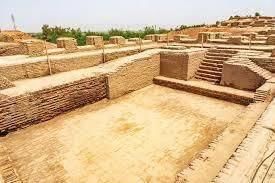
- Harappan Civilisation: Often called the Indus Valley Civilisation, it had well-planned cities, organised public works and craft specialisations.
- Traits of civilisations: Civilisations develop features like organised governance, trade networks, writing systems and specialised crafts.
- Development from villages to cities: As agriculture produced surplus food, some villages grew into towns and then into cities with complex social organisation.
- City planning: Many Harappan cities had grid patterns for streets, brick houses, drains and systems for water supply indicating advanced planning.
- Diet and trade: People grew grains, kept animals and traded goods such as pottery, beads and metals across long distances.
- Decline and legacy: The decline of the Harappan Civilisation may have involved environmental changes, shifting rivers and other factors; its achievements influenced later cultures.
Theme C - Our Cultural Heritage and Knowledge Traditions
India's long history has produced many cultural traditions and bodies of knowledge. This theme examines ideas, literature, arts and practices that shape Indian society, and how traditional knowledge can be relevant in solving contemporary problems.
Chapter 7: India's Cultural Roots
- Unity in diversity: India's identity is shaped by many different languages, religions, foods and customs that together form a shared national culture.
- Diverse landscapes and cultures: Different regions have distinct climates, crops, clothing and festivals, yet common customs often connect communities.
- Staple foods: Grains such as rice, wheat and barley are staple foods across different parts of India.
- Traditional clothing: Regions are known for particular textiles and styles, for example various types of sarīs and local weaving traditions.
- Festivals: Festivals are celebrated across communities and often share similar themes such as harvest, new year or thanksgiving, though local names and practices may differ.
- Literature and epics: Works such as the Ramayana and Mahabharata are important sources of shared stories, moral lessons and cultural references.
Chapter 8: Unity in Diversity, or 'Many in the One'
- Concept of unity in diversity: The chapter explains how many different identities, languages and customs coexist and contribute to national unity.
- Geographical and cultural variety: Differences in environment lead to varied food habits, clothing and ways of life across the country.
- Staple foods and spices: Common food grains and a rich variety of spices form an important part of India's culinary traditions.
- Textiles and clothing: Regional textile crafts, weaving styles and traditional garments show local creativity and identity.
- Festivals and literature: Festivals, local tales and epic literature bind diverse communities through shared cultural expressions.
Theme D - Governance and Democracy
Governance and democracy explain how societies organise decision-making and public life. This theme focuses on the structure of government, the role of citizens and the ways people participate in democracy, especially in India - the world's largest democracy.
Chapter 9: Family and Community
- Importance of families and communities: Families and local communities provide emotional support, care and a sense of belonging.
- Types of families: Common forms include joint families (extended members living together) and nuclear families (parents and children).
- Family roles: Each member has responsibilities - parents look after children, grandparents may care for the young and pass on traditions.
- Community functions: Communities manage common resources, maintain local customs and organise collective activities such as festivals and public works.
- Real-life examples: Examples include local initiatives for cleanliness, education or shared water management that show how communities work together.
Chapter 10: Grassroots Democracy - Part 1: Governance
- Levels of government: India has three main levels of government - local, state and central (or national) - each with its responsibilities.
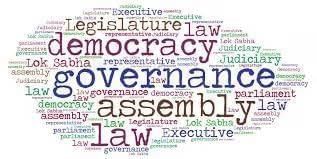
- Democracy: In a democracy, citizens choose their representatives through regular elections and can participate in public life.
- Dr. A.P.J. Abdul Kalam: A notable Indian scientist and former President who contributed significantly to India's space and missile programmes; he is often cited as an example of public service and national development.
Chapter 11: Grassroots Democracy - Part 2: Local Government in Rural Areas
- Panchayati Raj system: Local rural governance works through three tiers - the Gram Panchayat (village level), the Panchayat Samiti (block level) and the Zila Parishad (district level). Each tier has elected representatives and specific functions.
- Key figures: The Sarpanch is the elected head of a Gram Panchayat; many local leaders have organised efforts to improve water, schools and sanitation.
- Child-friendly initiatives: Some villages involve children in planning and local decision-making through special programmes to make governance more inclusive.
- Importance: Grassroots democracy empowers people to solve local problems, improves accountability and brings government closer to citizens.
Chapter 12: Grassroots Democracy - Part 3: Local Government in Urban Areas
- Urban governance: Cities are managed by local bodies that plan and provide services such as water supply, roads and waste management.
- Types of urban bodies: These include Municipal Corporations in large cities, Municipal Councils in smaller cities and various local committees.
- Functions: Urban local bodies build and maintain infrastructure, manage public health and sanitation and oversee local development projects.
- Citizen role: Residents can participate by voting in local elections, attending meetings and following community rules to improve city life.
Theme E - Economic Life Around Us
This theme looks at how people and societies meet their basic needs for food, clothing and shelter. It introduces simple economic ideas such as what money is, how people earn income, and how resources are managed at local and national levels.
Chapter 13: The Value of Work
- Economic activities: Activities that involve earning money or producing goods and services, such as farming, manufacturing and services (shops, transport, health, education).
- Non-economic activities: Actions that do not involve payment but are socially important, for example volunteering, caring for family members and household chores.
- Value addition: The process of increasing the worth of a product through processing, packaging and marketing. For example, milk becomes cheese, which sells at a higher value than raw milk.
After understanding the value of work, the syllabus examines how different economic activities are organised and related to one another.
Chapter 14: Economic Activities Around Us
- Economic sectors: The economy is commonly divided into primary (agriculture, fishing, mining), secondary (manufacturing, construction) and tertiary or services (transport, education, health). Each sector is important for livelihoods and national development.
- Interdependence: Sectors depend on each other: for example, dairy processing depends on dairy farming for raw milk; factories need raw materials and workers; services support production and distribution.
FAQs on Syllabus: Social Studies (New NCERT) for Class 6
| 1. What are the key chapters covered in the Class 6 Social Studies syllabus according to NCERT? |  |
| 2. How is the evaluation done in Class 6 Social Studies? | |
| 3. What are some important skills students develop through the Class 6 Social Studies syllabus? | |
| 4. How can students effectively prepare for their Social Studies exams in Class 6? | |
| 5. Why is it important for students to study Social Studies in Class 6? | |


