Unit Test (Solutions): Magnetic Effects of Electric Current

Time: 1 hour
M.M. 30
Attempt all questions.
- Question numbers 1 to 5 carry 1 mark each.
- Question numbers 6 to 8 carry 2 marks each.
- Question numbers 9 to 11 carry 3 marks each.
- Question number 12 & 13 carry 5 marks each.
Q1: What is meant by magnetic field? (1 Mark)
Ans: Magnetic field is the region around a magnet or a current-carrying conductor in which a magnetic force can be detected on another magnet or magnetic material.
Q2: The strength of magnetic field inside a long current carrying straight solenoid is (1 Mark)
(a) minimum in the middle
(b) found to increase from one end to the other
(c) same at all points
(d) more at the ends than at the centre
Ans: (c)
Explanation: Inside a long solenoid the magnetic field is nearly uniform because the field lines are parallel and equally spaced. This makes the magnetic field strength approximately the same at all points well inside the solenoid, away from the ends.
Q3: The phenomenon of electromagnetic induction is (1 Mark)
(a) the process of generating a magnetic field due to current passing through a coil.
(b) the process of charging a body.
(c) producing induced current in a coil due to relative motion between a magnet and the coil.
(d) the process of rotating a coil of an electric motor.
Ans: (c)
Explanation: Electromagnetic induction is the production of an induced current in a coil when there is a change in magnetic flux through it. Such a change can occur by moving a magnet relative to the coil or by changing the current in a nearby coil.
Q4: Choose the wrong statement from the following regarding magnetic lines of the field (1 Mark)
(a) Magnetic field lines are closed curves.
(b) The north pole of a magnetic compass is used to determine the direction of the magnetic field at a particular location.
(c) If magnetic field lines are parallel and equidistant, they represent zero-field strength.
(d) The degree of closeness of the field lines indicates the relative strength of the magnetic field.
Ans: (c)
Explanation: Statement (c) is incorrect. Parallel and equidistant field lines represent a uniform magnetic field with a constant, non-zero strength. Zero field strength would be shown by the absence of field lines. The closeness of field lines indicates how strong the field is in that region.
Q5: A circular loop, when placed in a plane perpendicular to the plane of the paper, may carry a current when the key is ON. The current, as seen from points A and B (in the plane of the paper and on the axis of the coil), is anticlockwise and clockwise, respectively. The magnetic field lines point from B to A. The North pole of the resultant magnet is on the face close to (1 Mark)
(a) A
(b) B
(c) B when the current is small and A if the current is large
(d) A if the current is small, and B if the current is large.
Ans: (a)
Explanation: Using the right-hand thumb (or right-hand grip) rule for a current loop: curl the fingers in the direction of current; the thumb points towards the north pole. The directions given mean that magnetic field lines emerge from the face near A and enter near B, so the face close to A is the north pole.
Q6: (a) If field lines of a magnetic field are crossed at a point, what does it indicate?
(b) Mention two parameters that are necessary to describe a magnetic field completely. (2 Marks)
Ans:
(a) If field lines are shown crossing at a point, this would be impossible physically because the magnetic field at any point has a single definite direction. A crossing would imply two directions at the same point, which cannot occur.
(b) Two parameters required to describe a magnetic field completely are: 1. The magnitude (strength) of the magnetic field at the point. 2. The direction of the magnetic field at the point.
Q7: A straight conductor that is carrying current is put close to a compass needle. Give your opinion in each of the following situations, along with your justifications. (2 Marks)
(a) The magnitude of electric current is increased.
(b) The compass needle is displaced away from the conductor.
Ans:
(a) If the current in the conductor is increased, the magnetic field produced around the conductor becomes stronger (magnetic field B ∝ current I). As a result, the compass needle will be deflected more.
(b) If the compass needle is moved farther from the conductor, the magnetic field strength at the needle decreases (field falls with distance from a straight wire). Hence the deflection of the needle will decrease.
Q8: List the properties of magnetic field lines. (2 Marks)
Ans: The properties of magnetic field lines are as follows:
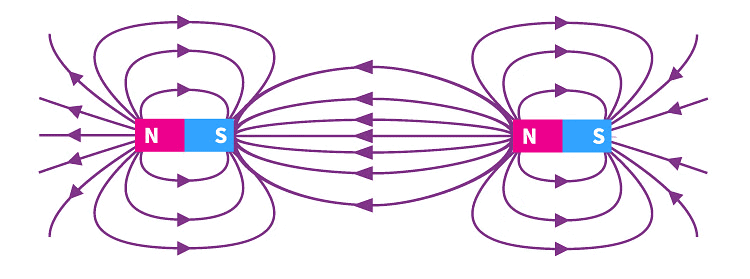
- Magnetic field lines do not intersect; there is a unique direction of the field at any point.
- Outside a magnet, field lines emerge from the north pole and enter the south pole.
- Inside the magnet, field lines run from the south pole to the north pole, making closed continuous loops.
- The closer the field lines are to each other, the stronger the magnetic field in that region.
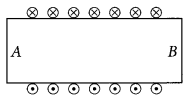
Q9: Diagram shows the lengthwise section of a current carrying solenoid. ⦻ indicates current entering into the page, ⨀ indicates current emerging out of the page. Decide which end of the solenoid A or B, will behave as north pole. Give reason for your answer. Also draw field lines inside the solenoid. (3 Marks)
Ans:
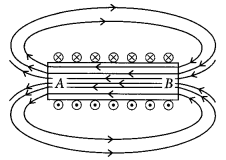
Using the right-hand grip rule for a solenoid: curl the fingers in the direction of the current in the turns; the thumb points along the axis toward the north pole. From the currents shown (⦻ and ⨀), the resultant magnetic field inside the solenoid points from B toward A, so magnetic field lines emerge from end A. Therefore, end A behaves as the north pole and end B as the south pole. Inside the solenoid the field lines are nearly straight, parallel lines indicating a uniform field.
Q10: Give a reason for the following. (3 Marks)
(i) There is either a convergence or a divergence of magnetic field lines near the ends of a current carrying a straight solenoid.
(ii) The current-carrying solenoid, when suspended, freely rests along a particular direction.
Ans:
(i) A current-carrying straight solenoid produces a magnetic field similar to that of a bar magnet. Near the ends the field lines either converge (at the north pole) or diverge (from the south pole) because the ends act like magnetic poles where field lines begin or end in the external region.
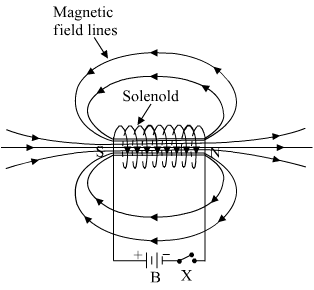
Q11: Two circular coils P and Q are kept close to each other, of which coil P carries a current. What will you observe in the galvanometer connected across the coil Q
(a) if current in the coil P is changed?
(b) if both the coils are moved in the same direction with the same speed?
Give reason to justify your answer in each. (3 Marks)
Ans:
(a) If the current in coil P is changed, the magnetic flux through coil Q changes. This change in magnetic flux induces a current in coil Q and the galvanometer will show a momentary deflection. The direction of the induced current depends on whether the flux through Q is increasing or decreasing (Lenz's law).
(b) If both coils are moved together in the same direction with the same speed, the relative magnetic flux through coil Q due to coil P does not change. Since there is no change in flux, no induced current flows and the galvanometer shows no deflection.
Q12:
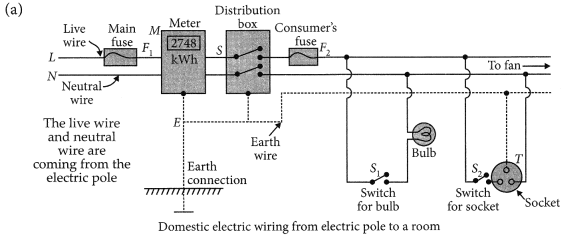
(a) Draw a schematic diagram of a common domestic circuit showing provision of
(i) Earth wire
(ii) Main fuse
(iii) Electricity meter and
(iv) Distribution box.
(b) Distinguish between short circuiting and overloading. (5 Marks)
Ans:
(a)
(b) Overloading: Overloading occurs when too many appliances are switched on at the same time on the same circuit, causing the total current to exceed the circuit's rated capacity. This produces excessive heating and may trip the fuse or circuit breaker.
Short circuiting: Short circuiting happens when the live wire comes into direct contact with the neutral (or earth) wire, creating a very low-resistance path. This causes a sudden surge of very large current which can damage wiring and may cause sparks or fire unless the fuse or breaker operates.
Q13: A current carrying conductor is placed in a magnetic field. Now answer the following. (5 Marks)
(i) List the factors on which the magnitude of force experienced by conductor depends.
(ii) When is the magnitude of this force maximum?
(iii) State the rule which helps, in finding the direction of motion of conductor.
(iv) If initially this force was acting from right to left, how will the direction of force change if:
(a) direction of magnetic field is reversed ?
(b) direction of current is reversed?
Ans:
(i) The magnetic force experienced by a current-carrying conductor in a magnetic field depends on:
- The current (I) in the conductor.
- The magnetic field strength (B).
- The length (l) of the conductor within the magnetic field.
- The angle (θ) between the conductor (direction of current) and the magnetic field.
(ii) The force is maximum when the conductor (or the current direction) is perpendicular to the magnetic field, i.e., θ = 90°, since force ∝ I × B × l × sin θ and sin 90° = 1.
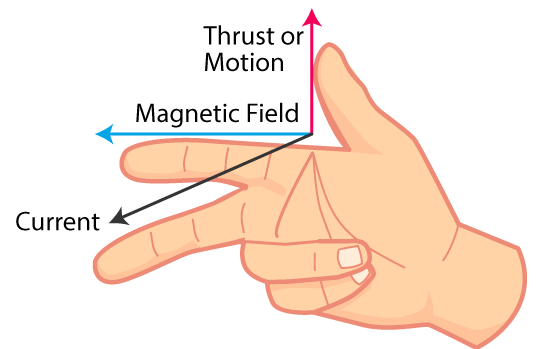
(iii) Fleming's left-hand rule is used to find the direction of force (motion) on a current-carrying conductor in a magnetic field. Stretch the thumb, forefinger and middle finger of the left hand at right angles: the forefinger shows the magnetic field (N to S), the middle finger shows the current (I), and the thumb gives the direction of force (motion) on the conductor.
(iv) If initially the force acts from right to left:
(a) If the direction of the magnetic field is reversed, the direction of force reverses and will act from left to right.
(b) If the direction of current is reversed, the direction of force also reverses and will act from left to right.
FAQs on Unit Test (Solutions): Magnetic Effects of Electric Current
| 1. What are the applications of magnetic effects of electric current in hobbies? |  |
| 2. How can I use the principles of magnetic effects of electric current to build a simple motor for my hobby projects? | |
| 3. What materials are commonly used to build electromagnets for hobby purposes? | |
| 4. How can I incorporate the magnetic effects of electric current into my hobby of model train building? | |
| 5. Can I use the principles of magnetic effects of electric current to enhance the sound quality of my DIY speakers for my hobby projects? | |




