Important Formulas: Fractions


- Fraction: A fraction represents a part of a whole. When a whole object (for example, a pizza) is divided into equal parts, each part is a fraction of that whole.
- Fractional unit: A fractional unit is one equal part of the whole after it has been divided.
Example:In the fraction 1/5, the fractional unit is one part out of five equal parts of the whole.
Reading fractions
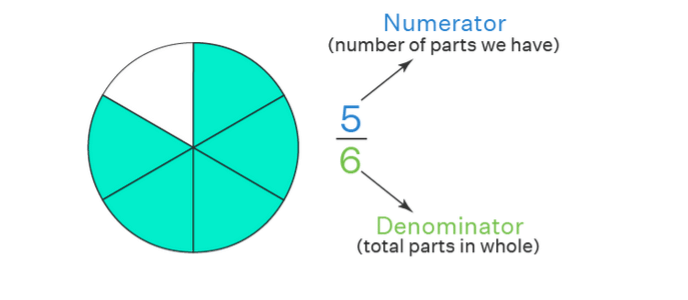
- Numerator: The number on top of the fraction. It tells how many parts of the whole we have.
- Denominator: The number at the bottom of the fraction. It tells into how many equal parts the whole is divided into.
Number line
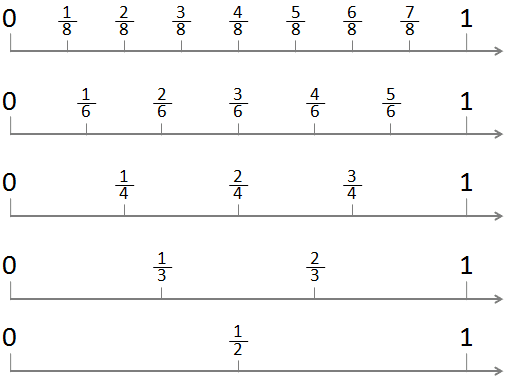
- A number line shows where fractions lie between whole numbers. The segment between 0 and 1 is divided into equal parts according to the denominator.
- Every fraction corresponds to a point on the number line.
Example,
1/2 is halfway between 0 and 1
3/4 is three of the four equal parts from 0 towards 1.
Mixed fractions
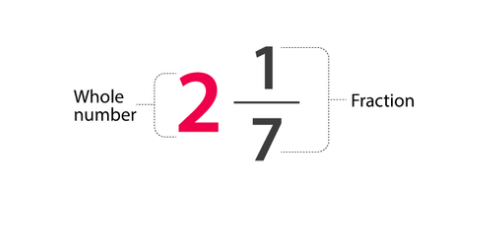
A mixed fraction (or mixed number) is a combination of a whole number and a proper fraction.
Example: means 2 whole units and 1 part out of 7 equal parts of another unit.
Equivalent fractions
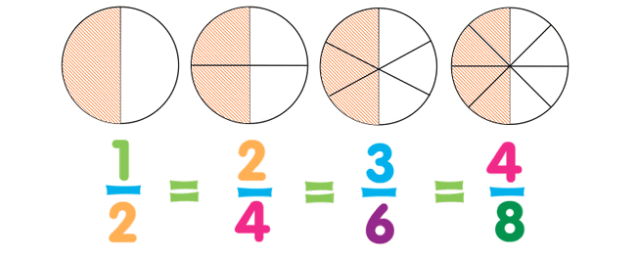
- Equivalent fractions are different fractions that represent the same part of a whole.
- Method: Multiply or divide both numerator and denominator by the same non-zero number to get an equivalent fraction.
- Example: 1/2 is equivalent to 2/4 because 1 × 2 = 2 and 2 × 2 = 4.
Try yourself: Which option gives an equivalent fraction of 13/25?
Simplest form
- A fraction is in its simplest form when the numerator and denominator have no common factor other than 1.
- Method: Divide the numerator and the denominator by their greatest common divisor (GCD) to simplify the fraction.
- Example: To simplify 6/9, divide numerator and denominator by 3 to get 2/3.
Comparing fractions
- Method 1: Convert the fractions to a common denominator and compare the numerators.
- Method 2: Use a number line to see which fraction is located further to the right (that fraction is greater).
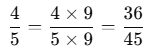
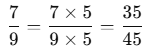
Example: Compare 4/5 and 7/9.
(i) Find a common denominator: The denominators are 5 and 9. The least common multiple (LCM) of 5 and 9 is 45.
(ii) Convert each fraction to denominator 45:
4/5 = (4 × 9)/(5 × 9) = 36/45
7/9 = (7 × 5)/(9 × 5) = 35/45
Since 36/45 > 35/45, we conclude that 4/5 > 7/9.
Addition of fractions
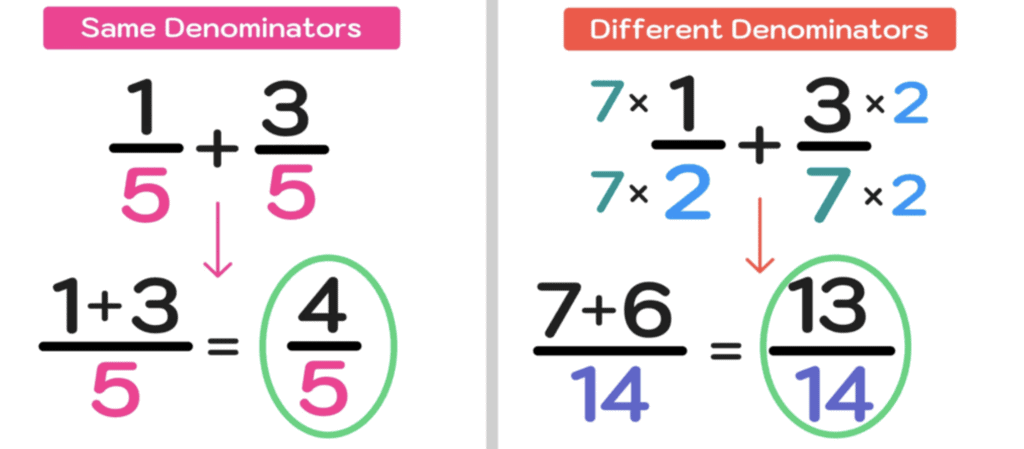
- If denominators are the same (like fractions), add the numerators and keep the denominator the same. Simplify the result if possible.
- If denominators are different (unlike fractions), first find the least common denominator (LCD), convert each fraction to an equivalent fraction with the LCD, then add the numerators.
Example: 1/4 + 1/4
Sol:
Both fractions have the same denominator (4).Add the numerators: 1 + 1 = 2.
Write the result over the common denominator: 2/4.
Simplify 2/4 by dividing numerator and denominator by 2 to get 1/2.
Example: +
+
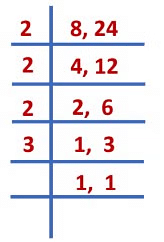
The given fractions are unlike fractions,
so we first find the LCM of their denominators.LCM of 8 and 24 = 2 × 2 × 2 × 3 = 24
Now, we convert the fractions into like fractions with denominator 24.
=
and
+
=


Subtraction of fractions
- If denominators are the same, subtract the numerators and keep the denominator the same. Simplify the result if possible.
- If denominators are different, first find the least common denominator (LCD), convert each fraction to an equivalent fraction with the LCD, then subtract the numerators.
- Example: For 3/4 - 2/4, subtract numerators: 3 - 2 = 1, so the answer is 1/4.
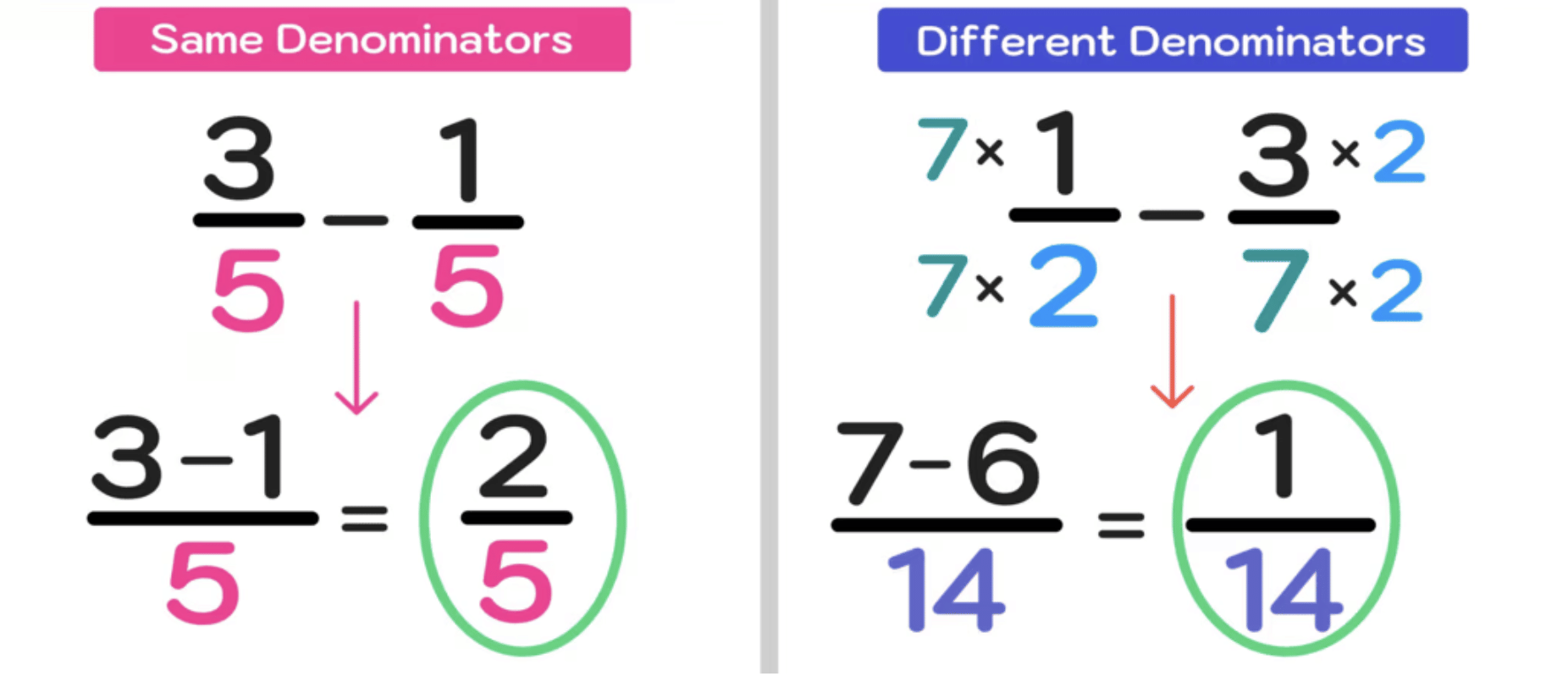
Example: Subtract 4/7 from 8/3.
Solution:
Identify the denominators: 3 and 7.
Find the LCM of 3 and 7:
LCM(3, 7) = 21.Convert 8/3 to an equivalent fraction with denominator 21:
8/3 = (8 × 7)/(3 × 7) = 56/21.Convert 4/7 to an equivalent fraction with denominator 21:
4/7 = (4 × 3)/(7 × 3) = 12/21.Subtract the numerators over the common denominator:
56/21 - 12/21
= (56 - 12)/21.Compute the difference in the numerator: 56 - 12 = 44.
The result is 44/21.
Answer: 8/3 - 4/7 = 44/21.
Additional notes and tips
- Always look for opportunities to simplify fractions early by cancelling common factors before performing addition or subtraction; this often makes arithmetic easier.
- When converting fractions to a common denominator, using the LCM keeps the numbers smaller than multiplying denominators together in many cases.
- Use a number line for intuitive understanding and quick comparison of simple fractions.
- Remember the terms: numerator (top) and denominator (bottom). Practice converting between improper fractions and mixed numbers.
FAQs on Important Formulas: Fractions
| 1. What are the basic formulas for adding and subtracting fractions with different denominators? |  |
| 2. How do I multiply fractions correctly using the standard formula? | |
| 3. What's the difference between proper fractions, improper fractions, and mixed numbers? | |
| 4. Why do I need to find the lowest common multiple when adding fractions, and how does it help? | |
| 5. How do I divide one fraction by another using the reciprocal formula? | |