Kinds of Constitution


There are two main types of constitutions based on how they are written: written and unwritten constitutions.
Written Constitution
- A written constitution is a formal document that outlines the structure of governance in a country.
- It is created in a systematic way, usually by a representative body called the constituent assembly after extensive discussions.
- Because of this process, it is also known as a codified or enacted constitution.
- The written constitution specifies the date of its enactment and is typically rigid, meaning it has a defined procedure for amendments that is different from ordinary legislation.
- Examples of written constitutions include the American Constitution and the Indian Constitution.
Unwritten Constitution
- An unwritten constitution is not contained in a single document.
- It is derived from various sources, including conventions, traditions, customs, Acts of Parliament, and common law.
- Because of this, it is also called a cumulative constitution.
- An unwritten constitution evolves over time, which is why it is also known as an evolved constitution.
- It is generally more flexible because the amendment process is simpler and usually does not differ from the procedure for making ordinary legislation.
- An example of an unwritten constitution is the British Constitution.
Despite the distinction, no constitution is entirely written or unwritten. For instance, while the British Constitution is largely unwritten, it is based on several written laws like the Magna Carta of 1215 and the Bill of Rights of 1689.
In India, certain conventions are followed outside the written Constitution. For example, while the Constitution states that the Speaker of the Lok Sabha must be a member of the Lok Sabha, there is an additional convention of choosing the Speaker from the majority party.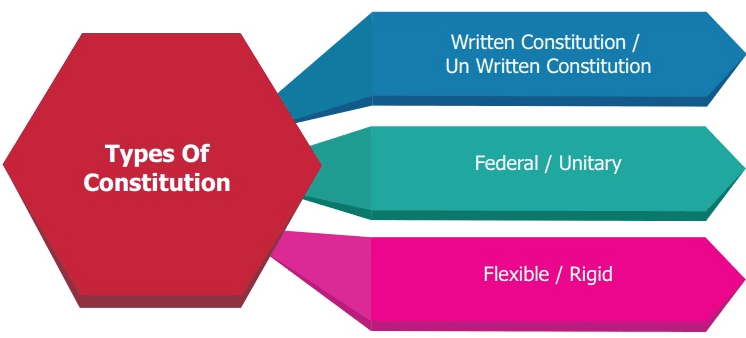
Flexible Constitution
- A Flexible or Elastic Constitution is one that can be easily changed. In this type of constitution, constitutional law can be amended in the same way as ordinary law.
- The Parliament has the authority to alter constitutional principles and establish new baselines for government action through ordinary legislative processes.
- Countries like the UK and Canada have flexible constitutions.
- Advantages of a flexible constitution include:
- Quick Adaptability: It can change swiftly in response to shifts in the social and political landscape.
- Emergency Response: It is beneficial in emergencies due to its ease of amendment.
- Dynamic Nature: Its ability to keep up with changing times reduces the likelihood of revolts.
- Continuous Development: It evolves over time, remaining up-to-date and popular.
- However, there are also disadvantages:
- Instability: It can be used by the ruling government for its own benefit, leading to instability.
- Unsuitability for Federation: In a federation, it can result in undesirable changes by the federal government or the governments of federating units.
Rigid Constitution
A Rigid or Inelastic Constitution is one that is not easily amended, usually a Written Constitution. It can only be changed through special amending procedures, not by ordinary legislation. If the constitution itself specifies the amendment process, then it can be amended accordingly.
Advantages of a rigid constitution include:
- Stability: It provides stability in administration.
- Continuity: It maintains continuity in administration.
- Prevention of Abuse: It prevents the constitution from being misused by the ruling party.
- Checks Autocracy: It checks against autocratic governance.
- Federal Suitability: It is ideal for federal systems.
Disadvantages of a rigid constitution include:
- Lack of Adaptability: It does not keep pace with rapid social changes.
- Impediment to Progress: It hinders social development due to its rigidity.
- Emergency Hindrance: Its inflexibility can be a drawback during emergencies.
- Potential for Revolts: Its inability to change easily can lead to public unrest.
- Conservativeness: It may promote overly conservative governance.
Federal Constitution
- A federal constitution features a division of powers between the central government and individual states or provinces, as outlined in the constituent document.
- Countries like the USA, Canada, Australia, Nigeria, Malaysia, Germany, and Switzerland exemplify federal constitutions.
- Key Characteristics of a Federal Constitution:
- Division of Power: Power is divided between the central government and constituent units, such as states or provinces, each having the authority to legislate on assigned subjects.
- Division of Sovereignty: Sovereignty is shared between the national and state units.
- Dual Citizenship: Citizens can enjoy rights from both national and state authorities, adhering to both constitutions.
- Dual Representation: A bicameral legislature is common, with one chamber representing federating units and the other representing the nation as a whole.
- Supremacy of Constitution: Both central and state governments must adhere to the constitution, which is paramount and does not allow for infringements.
- Rigid Constitution: Amendments to the federal constitution require special procedures, making it more rigid than ordinary laws.
Try yourself: What is a written constitution also known as?
Unitary Constitution
- A unitary constitution is found in a state formed by the union of two or more sovereign states, where the central government holds supreme authority. Administrative divisions exercise only the powers delegated by the central government.
- Examples include Tanzania (Zanzibar and Mainland Tanzania) and the United Kingdom (Scotland, Wales, Northern Ireland, and England).
Key Characteristics of a Unitary Constitution:
- Effective Governance: The unitary constitution is considered the most effective form, ensuring uniformity in law, policy, and administration across the country, fostering national harmony.
- Single Citizenship: Citizens enjoy single citizenship under a unitary constitution.
- Efficiency in Defense and Foreign Affairs: Clear and uniform policies in defense and foreign affairs can be implemented effectively.
- Centralized Government: There is only one central government with sovereign power in a unitary system.
- Flexibility: The unitary constitution can be easily modified to adapt to changing circumstances.
Difference between Unitary and Federal Constitution
- Meaning: A unitary constitution concentrates all government powers in the central authority, while a federal constitution shares power among the central government and state levels.
- Citizenship: In a unitary constitution, citizens enjoy single citizenship, whereas, in a federal constitution, citizens may have dual citizenship.
- Government Structure: A unitary constitution has a single central government with all powers and administrative authority, while a federal constitution has both central and state governments with specific powers.
- Amendment Process: A unitary constitution can be easily changed, while a federal constitution requires special circumstances for amendments.
- Codification: A unitary constitution is uncodified and evolves over time, whereas a federal constitution is coded in a specific document outlining the highest law of the land.
Republican Constitution
- A republican constitution establishes a government where the head of state and other officials are elected by citizens to represent them.
- These representatives govern according to the rules set out in the constitution, which limits the government's power.
- The government typically consists of three branches: executive, judicial, and legislative, to prevent any one branch from becoming too powerful.
Two key features of a constitutional republic are:
- Constitutional Limits on Government Power: The constitution restricts the government's authority, ensuring it operates within defined boundaries.
- Election of Officials: Citizens have the right to elect their leaders, including the head of state and other government officials, to represent their interests.
- Countries like the United States exemplify a constitutional republic, where the government is accountable to the people and operates under the rule of law.
Constitutional Monarchy
- A constitutional monarchy is a system where a monarch, usually a king or queen, serves as the head of state within the framework of a constitution, which may be written or unwritten.
- In this system, political power is divided between the monarch and a constitutionally organized government, such as a parliament.
- Unlike absolute monarchies, where the monarch holds all power, constitutional monarchies balance power between the monarch and elected officials.
- Countries like the United Kingdom, Canada, Sweden, and Japan exemplify modern constitutional monarchies.
Presidential Constitution
- In a presidential constitution, the head of the executive branch is also the head of state and is not directly accountable to the legislature.
- Examples of countries with presidential constitutions include Tanzania, Kenya, and Uganda.
Merits of Presidential System
- Separation of Powers: The independent functioning of the three government branches enhances administrative efficiency.
- Expert Government: The President can appoint experts from outside the legislature to lead various departments, ensuring knowledgeable leadership.
- Stability: The fixed term of the President reduces the risk of sudden government changes, providing stability.
- Less Party Influence: Political parties have less power to remove the government due to the fixed presidential term.
Demerits of Presidential System
- Less Responsible Executive: The lack of legislative control over the executive may lead to authoritarianism.
- Deadlocks: Strict separation of powers can cause conflicts between the executive and legislature, especially if they are from different political parties, reducing efficiency.
- Rigidity: Presidential systems are often seen as inflexible.
- Spoils System: The President's extensive patronage powers can lead to nepotism and favoritism in government appointments.
Parliamentary Constitution
- A parliamentary constitution is characterized by a Prime Minister who is a member of the legislature and accountable to it.
- Countries like the United Kingdom and Israel follow this system.
Features of the Parliamentary System
- Close Relationship: The Prime Minister and Council of Ministers form the executive, emerging from the legislature.
- Executive Accountability: The executive is collectively responsible to the legislature.
- Dual Executive: There is a nominal executive (head of state) and a real executive (Prime Minister).
- Secrecy of Procedure: Cabinet proceedings are confidential.
- Leadership of the Prime Minister: The Prime Minister is usually the leader of the majority party.
- Bicameral Legislature: Most parliamentary democracies have two legislative chambers.
- No Fixed Tenure: The government's term depends on majority support in the lower house.
Merits of Parliamentary System
- Coordination: Better coordination between executive and legislature due to their close relationship.
- Prevention of Authoritarianism: The executive's accountability to the legislature prevents concentration of power.
- Responsible Government: The legislature can scrutinize executive actions and ensure accountability.
- Diverse Representation: The system represents various groups, important for diverse societies.
- Flexibility: Changing the Prime Minister is easier, allowing for adaptability.
Conclusion
- Types of Constitution: There are two main types of constitutions: written and unwritten. A written constitution is a formal document that outlines the governance structure of a country, while an unwritten constitution is based on various sources, including conventions and customs.
- Flexible Constitution: A flexible constitution can be easily amended through ordinary legislative processes, allowing for quick adaptations to social and political changes.
- Rigid Constitution: A rigid constitution is difficult to amend and requires special procedures for changes, providing stability and preventing abuse of power.
- Federal Constitution: A federal constitution divides powers between the central government and individual states or provinces, ensuring a clear distribution of authority.
- Unitary Constitution: A unitary constitution centralizes power in the national government, with administrative divisions exercising only delegated powers.
- Republican Constitution: A republican constitution establishes a government where officials are elected by citizens to represent them.
FAQs on Kinds of Constitution
| 1. What's the difference between written and unwritten constitutions, and which type does India have? |  |
| 2. How do rigid and flexible constitutions differ, and why does this matter for CLAT PG exams? | |
| 3. What exactly is a federal constitution, and how does India's constitutional framework reflect federalism? | |
| 4. Can a constitution be both codified and flexible at the same time? | |
| 5. How do I distinguish between monarchical and republican constitutional systems for exam preparation? | |