Registration of Marriage, Judicial separation and Divorce


Registration of Marriage (Section 8)
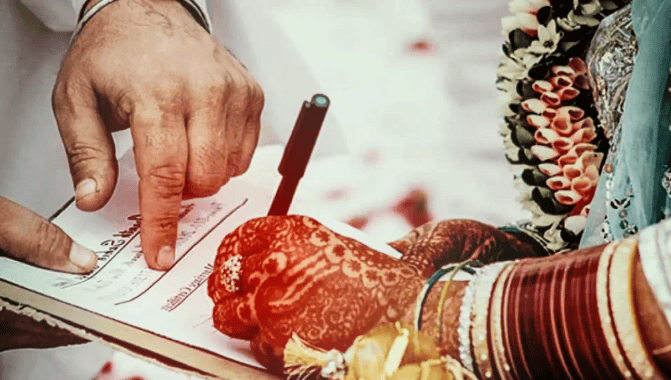
Section 8 deals with the provision for registration of marriages and the role of the State in facilitating a formal record of marriages among Hindus. The provision contemplates rule-making by the State Government to provide a reliable proof of marriage and to prescribe procedure, fees and the functions of a marriage registrar. The rules framed under this provision are to be placed before the State Legislature in the manner provided by law.
- Purpose. To provide a statutory mechanism for maintaining an official record of marriages and to help establish proof of matrimonial status.
- Role of State Government. Empowered to make rules regarding registration, the appointment of registrars, inspection and certification, and the collection of prescribed fees.
- Function of Registrar. A marriage registrar has authority to receive returns of marriage, inspect relevant records within a reasonable time and issue certified copies on payment of the prescribed fee.
Seema v. Ashwani Kumar, AIR 2006 S.C. 1158
- The Supreme Court directed State Governments and the Central Government that marriages of persons who are citizens of India and belong to various religious denominations should be made compulsorily registrable in the State where such marriages are solemnised.
- The Court further observed that when the Central Government enacts a comprehensive statute for marriage registration, the same should be placed before the Court for scrutiny.
Void and Voidable Marriages
Void Marriages (Section 11)
A marriage solemnised after the commencement of the Act which contravenes any of the provisions of the Act (to the extent specified by the Act) may be treated as void. A void marriage has no legal status and is unenforceable.
Voidable Marriages (Section 12)
A marriage (whether solemnised before or after the commencement of the Act) may be voidable at the option of one of the parties and may be annulled by a decree of nullity on certain grounds. If annulled, the marriage is treated as never having been valid.
Common grounds (as set out in the source material):
- Impotency. Where there has been no consummation of the marriage owing to the impotence of a spouse.
- Contravention of Section 5(ii). Where the marriage contravenes the statutory age requirement applicable at the time (i.e., where a party has not attained the age prescribed by law).
- Lack of consent. Where consent was not freely given, for example, where consent was obtained by force or fraud.
- Pregnancy by another man. Where the respondent was pregnant by some person other than the petitioner at the time of the marriage.
- Other statutory grounds. Other limited grounds specified in the Act which render a marriage voidable may be asserted in a petition for annulment.
Consummation of Marriage
- Consummation of marriage ordinarily means full and normal sexual intercourse between the spouses, involving penetration by the male genital organ into the female genital organ.
- Legal significance: Consummation (or failure to consummate) can be relevant to petitions for annulment where impotence or inability to consummate is relied upon.
- Evidence: Partial, imperfect or transient intercourse is generally not sufficient to constitute consummation; medical evidence may be admissible to prove or disprove consummation.
- Irrelevant factors: The degree of sexual satisfaction or the subjective assessment of the parties is not determinative of consummation.
Impotency
- Impotency denotes the inability to have complete and normal sexual intercourse such that consummation of the marriage is practically impossible.
- Causes: Impotency may arise from organic physical defects or psychogenic causes producing an effective inability to consummate.
- Sterility distinguished: Sterility (inability to procreate) is not the same as impotency; sterility alone does not necessarily amount to impotency for legal purposes.
- Proof: Occasional incomplete intercourse does not necessarily establish impotency; the test is practical impossibility of consummation and may require medical evidence.
- Sexual functioning: Legal consideration may include the presence of healthy semen in men and functional sexual organs in women; anatomical absence of reproductive organs sufficient to preclude intercourse may amount to impotency.
Matrimonial Reliefs under the Hindu Marriage Act
- Restitution of Conjugal Rights: Section 9
- Judicial Separation: Section 10
- Void Marriages: Section 11
- Voidable Marriages (Nullity): Section 12
- Divorce: Section 13
Restitution of Conjugal Rights (Section 9)
Concept: A decree for restitution of conjugal rights is a judicial order directing that a spouse who has withdrawn from the society of the other without reasonable cause shall resume cohabitation. The remedy seeks to prevent unjustified desertion and promote reconciliation of the marital relationship.
Essentials to be proved (three elements):
- The respondent has withdrawn from the society of the petitioner (i.e., has ceased to live with the petitioner).
- The withdrawal is without any reasonable or lawful excuse.
- The statements and evidence in the petition are true and the court is satisfied of the petitioner's entitlement to relief.
Sushil Kumari Dang v. Prem Kumar
- In this instance the husband filed for restitution of conjugal rights alleging adultery by the wife and subsequently filed for judicial separation. The Delhi High Court set aside a decree of restitution granted earlier by the trial court, illustrating that the facts and subsequent conduct of the parties may affect the grant of restitution.
Constitutional Validity of Section 9
- T. Saritha Vengata Subbiah v. State - Section 9 was struck down by a court on the ground that it infringed on the wife's right to privacy by compelling her to cohabit against her will.
- Harvinder Kaur v. Harminder Singh - A later judicial pronouncement upheld Section 9 and restored the position that restitution of conjugal rights is valid.
- Saroj Rani v. Sudarshan Kumar - The Supreme Court upheld the constitutionality of Section 9, holding that the provision serves an important social purpose in attempting to prevent the breakdown of marriage.
- Itwari v. Asghari (AIR 1960 All. 684) - The court held that even absent direct proof of cruelty, a decree for restitution should not be granted where the circumstances make it unjust and inequitable to compel the wife to live with the husband.
Judicial Separation (Section 10)
- Nature: Judicial separation is a decree that allows spouses to live apart legally without dissolving the marriage. It suspends certain marital obligations while the marriage itself remains intact.
- Grounds: A petition for judicial separation may be presented on the same grounds as a petition for divorce under Section 13 (subject to statutory limitations and the court's discretion).
- Effect: After a decree of judicial separation the spouses are freed from the obligation to live together; they remain legally married and may resume cohabitation if they choose.
- Revocation and rescission: The decree may be rescinded or varied on petition of either spouse if circumstances permit reconciliation.
- Consequences for divorce. If cohabitation does not take place for one year or more after judicial separation, either party may apply for divorce on the appropriate grounds.
- Limitations: Conversion and absence for seven or more years (presumption of death) are grounds for divorce but are not grounds for judicial separation under the Act.
Divorce (Section 13) - Grounds and Principles
Section 13 sets out the recognised statutory grounds on which a decree of divorce may be granted. The following headings summarise the principal grounds as reflected in the source material and leading case law.
- Adultery: Voluntary sexual intercourse by a spouse with a person other than the other spouse is a ground for divorce. Proof of adultery can also support other reliefs such as judicial separation.
- Cruelty: Conduct-mental or physical-such as to endanger life, limb or health, or otherwise make continued cohabitation intolerable, can amount to cruelty and justify divorce.
- Desertion: If one spouse deserts the other for a continuous period of at least two years, the deserted spouse may petition for divorce on the ground of desertion. Two elements are essential: the fact of desertion (factum) and the intention to desert (animus deserendi).
- Conversion: If one spouse converts to another religion, the other spouse may seek a divorce. Conversion itself does not automatically dissolve the marriage but is a recognised ground for divorce.
- Mental disorder: A spouse suffering from an incurable mental disorder such that the petitioner cannot reasonably be expected to live with the respondent may be a ground for divorce.
- Leprosy: Historically included as a ground where it was virulent and incurable; legislative reform proposals (noted in the source) such as the Personal Laws (Amendment) Bill, 2018 would affect the availability of this ground in light of medical advances and changing social attitudes.
- Venereal disease: A spouse afflicted with an easily communicable and incurable venereal disease may be a ground for divorce (e.g., severe sexually transmitted diseases).
- Renunciation: If a spouse renounces the world by entering a religious order, the other spouse may seek divorce.
- Not heard alive for seven years: If a person has not been heard of as being alive for a continuous period of seven years by those who would naturally be expected to hear of them, they may be presumed dead and the other spouse may seek divorce in order to remarry.
Adultery - Selected Case
- Hirachand Srinivas Managaonkar v. Sunanda: Where adulterous conduct is established, the court may grant relief such as judicial separation or divorce depending on the facts and the degree of proof.
Cruelty - Leading Case: Dastane v. Dastane
The courts apply a multi-factor test to determine whether conduct amounts to legal cruelty. The following criteria are illustrative:
- The acts alleged as cruelty must be proved according to the usual standards of evidence.
- The petitioner must have a genuine apprehension of real injury or ill-treatment arising from the respondent's conduct.
- The apprehension and the conduct must be assessed reasonably, taking into account the socio-economic and psycho-physical conditions of the parties.
- The petitioner must not be abusing their position or using the allegation as a means of harassment.
- The petitioner must not have condoned or acquiesced in the conduct which is later relied upon as a ground for divorce.
- Suman Singh v. Sanjay Singh (Supreme Court): Isolated past incidents condoned by the petitioner, especially where the parties have compromised, may not amount to cruelty sufficient for dissolution.
- Mrs. Christine Lazarus Menezes v. Mr. Lazarus Peter Menezes (Bombay High Court): The Court observed that fabrication of criminal proceedings by a spouse which intentionally causes arrest and detention of the other may constitute cruelty.
Desertion
- Elements: (i) The factum of desertion - that the spouse has left; (ii) the animus - the intention to desert permanently or for an indefinite period.
- Period: A continuous period of at least two years is the threshold ordinarily relied upon for divorce based on desertion.
Conversion
- Conversion by a spouse to another religion entitles the other spouse to seek a decree of divorce; conversion itself does not automatically dissolve the marriage but is actionable.
- Suresh Babu v. Leela: The Court clarified that conversion does not ipso facto dissolve the marriage; it simply renders the aggrieved spouse entitled to seek dissolution.
Mental Disorder
- Pankaj Mahajan v. Dimple: The Supreme Court granted divorce where the respondent was shown to be suffering from schizophrenia and the petitioner could not reasonably be expected to live with the respondent.
Leprosy
- Earlier case law treated a virulent and incurable form of leprosy as a ground for divorce. Legislative proposals (for example the Personal Laws (Amendment) Bill, 2018, as noted in the source material) addressed removal or modification of this ground in light of medical developments and social considerations.
- Swarajya Lakshmi v. G.G. Padma Rao: The Court discussed leprosy as a ground and granted a decree where the disease was proved to be virulent and incurable in the facts before it.
Venereal Disease
- Severe, communicable and incurable venereal disease (including certain sexually transmitted diseases) can amount to a ground for divorce where public health and risk of transmission are material considerations.
- Mr. X v. Hospital ZLyl (as cited): The facts described a situation where a doctor disclosed a communicable condition to a fiancée; the Court held the disclosure did not amount to a wrongful invasion of privacy in the public interest and confirmed that such communicable conditions can justify avoidance of the marital tie or dissolution.
Renunciation
- When a spouse renounces worldly life by entering a recognised religious order, the other spouse may seek divorce on that ground.
Not Heard Alive (Presumed Death)
- If a person has not been heard of as being alive for a continuous period of seven years by those who would naturally be expected to hear of them, they may be presumed dead and the survivor may obtain a decree of divorce if they wish to remarry.
Differences between Judicial Separation and Divorce
- Effect on marital bond: Judicial separation suspends cohabitation obligations but leaves the marriage legally intact; divorce dissolves the marriage and terminates the marital status permanently.
- Time limits: For divorce jurisdiction, generally a suit is not maintainable until one year after marriage except in cases of extreme hardship; no analogous statutory minimum waiting period applies to judicial separation.
- Available grounds:Most grounds of Section 13 are available for divorce; judicial separation may be granted on several of those grounds, but conversion and the seven-year absence (presumption of death) are not available as grounds for judicial separation in the same way as for divorce.
- Opportunity for reconciliation: Judicial separation expressly contemplates the possibility of reconciliation and resumption of cohabitation; divorce ends the relationship and removes that status.
- Consequences: After judicial separation the parties remain husband and wife for all legal purposes except those obligations suspended by the decree; after divorce the legal relationship is ended and parties are free to remarry.
FAQs on Registration of Marriage, Judicial separation and Divorce
| 1. What is the significance of Section 8 in the Registration of Marriage under the Hindu Marriage Act? |  |
| 2. What distinguishes void marriages from voidable marriages under the Hindu Marriage Act? | |
| 3. How does the Hindu Marriage Act address the issue of impotency in relation to marriage? | |
| 4. What is the concept of restitution of conjugal rights as provided in Section 9 of the Hindu Marriage Act? | |
| 5. What are the key differences between judicial separation and divorce under the Hindu Marriage Act? | |