Unit Test (Solutions): Some Applications of Trigonometry

Time: 1 hour
M.M. 30
Attempt all questions.
- Question numbers 1 to 5 carry 1 mark each.
- Question numbers 6 to 8 carry 2 marks each.
- Question numbers 9 to 11 carry 3 marks each.
- Question number 12 & 13 carry 5 marks each.
Q1: _______________________ is drawn from the eye of an observer to the targeted object. (1 Mark)
(a) A parallel line
(b) Line of sight
(c) Elevation line
(d) Depression line
Ans: (b)
Explanation: A line of sight is the straight line joining the eye of an observer to the object being observed. It is used to form angles such as the angle of elevation or the angle of depression.
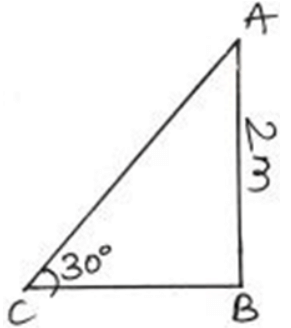
Q2: A slope is built against a wall which makes an angle 30° with the ground and the height of the wall is 2 meters. Find the length of the slope in meters. (1 Mark)
a) 2
b) 4
c) 1
d) 3
Ans: (b)
Sol:
Let the wall height BC = 2 m and AC be the length of the slope (hypotenuse) in right ∆ABC.
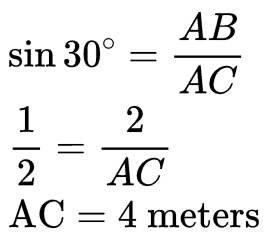
Angle at the base = 30°, so sin 30° = BC/AC.
sin 30° = 1/2 = 2/AC.
Therefore AC = 2 × 2 = 4 m.
Thus the length of the slope is 4 m.
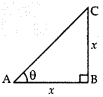
Q3: The shadow of a tower is equal to its height at 10-45 a.m. The sun's altitude is (1 Mark)
(a) 30°
(b) 45°
(c) 60°
(d) 90°
Ans: (b)
Sol:
Let the height of the tower BC = x m and the length of its shadow AB = x m.
In right ∆ABC, tan θ = BC/AB = x/x = 1.
So tan θ = 1 = tan 45°.
Hence θ = 45°.
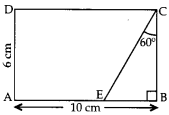
Q4: In given figure, the value of CE is (1 Mark)
(a) 12 cm
(b) 6 cm
(c) 9 cm
(d) 6√3 cm
Ans: (a)
Sol:
In right ∆EBC, cos 60° = adjacent/hypotenuse = BC/CE.
cos 60° = 1/2 and BC = 6 cm, so 1/2 = 6/CE.
Therefore CE = 6 × 2 = 12 cm.
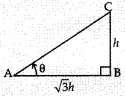
Q5: When the length of shadow of a vertical pole is equal to √3 times of its height, the angle of elevation of the Sun's altitude is __________________________. (1 Mark)
Ans: 30°
Sol:
Let the height of the pole BC = h and its shadow AB = √3 h.
Let the angle of elevation be θ.
In right ∆ABC, tan θ = height/shadow = h/(√3 h) = 1/√3 = tan 30°.
Therefore θ = 30°.
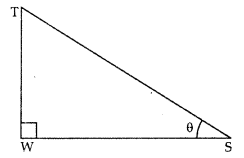
Q6: The ratio of the height of a tower and length of its shadow on the ground is √3 : 1 what is the angle of elevation of the sun? (2 Marks)
Ans: 60°
Sol:
Let the tower height = √3 units and shadow = 1 unit.
Then tan θ = (height)/(shadow) = √3/1 = √3.
So θ = 60°.
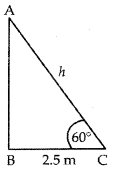
Q7: A ladder, leaning against a wall, makes an angle of 60° with the horizontal. If the foot of the ladder is 2.5 m away from the wall, find the length of the ladder. (2 Marks)
Ans: 5 m
Sol:
Let AC be the ladder of length h and the foot C is 2.5 m from the wall, so BC = 2.5 m.
cos 60° = adjacent/hypotenuse = BC/AC = 2.5/h.
cos 60° = 1/2, hence 1/2 = 2.5/h.
Therefore h = 2.5 × 2 = 5 m.
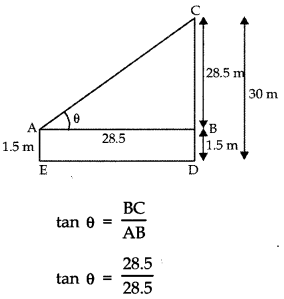
Q8: An observer 1.5 m tall is 28.5 m away from a tower of height 30 m. Find the angle of elevation of the top of tower from his eye. (2 Marks)
Ans: In right ∆ABC,
Q9: A moving boat is observed from the top of a 150 m high cliff moving away from the cliff. The angle of depression of the boat changes from 60° to 45° in 2 minutes. Find the speed of the boat in m/h. (3 Marks)
Ans: 1902 m/h.
Sol: Let C & D be two positions of the boat,& AB be the cliff & let speed of boat be xm/ min.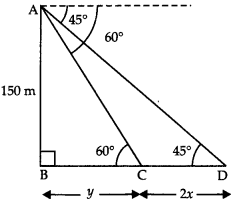 Let BC = y
∴ CD = 2x (∵ Distance = speed × time) 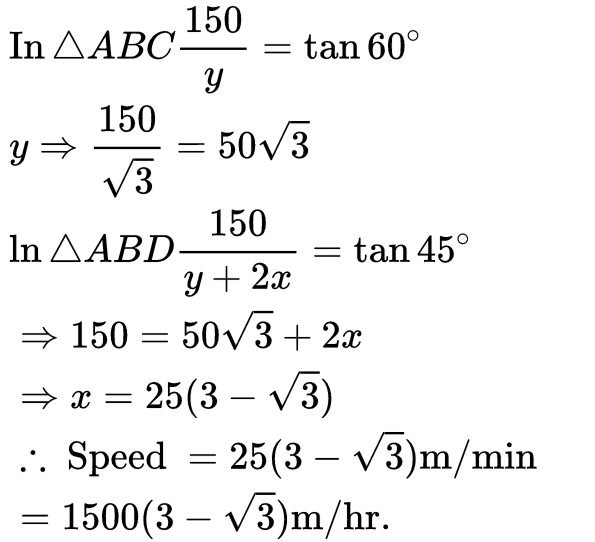
Approximate value: √3 ≈ 1.732, so speed ≈ 4500 - 2598 = 1902 m/h.
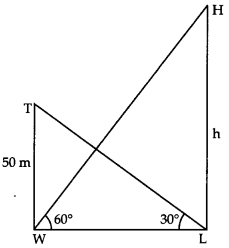
Q10: The angle of elevation of the top of a hill at the foot of a tower is 60° and the angle of elevation of the top of the tower from the foot of the hill is 30°. If height of the tower is 50 m, find the height of the hill. (3 Marks)
Ans: 150 m
Sol:
Let the horizontal distance between the foot of the tower and the foot of the hill be d.
Height of tower = 50 m.
From the foot of the tower, angle of elevation of top of hill = 60°: tan 60° = height of hill / d ⇒ √3 = h/d ⇒ h = d√3. (1)
From the foot of the hill, angle of elevation of top of tower = 30°: tan 30° = 50/d ⇒ 1/√3 = 50/d ⇒ d = 50√3. (2)
Substitute (2) into (1): h = 50√3 × √3 = 50 × 3 = 150 m.
Q11: A man standing on the deck of a ship, which is 10 m above water level, observes the angle of elevation of the top of a hill as 60° and the angle of depression of the base of hill as 30°. Find the distance of the hill from the ship and the height of the hill. (3 Marks)
Ans: 40 m
Sol: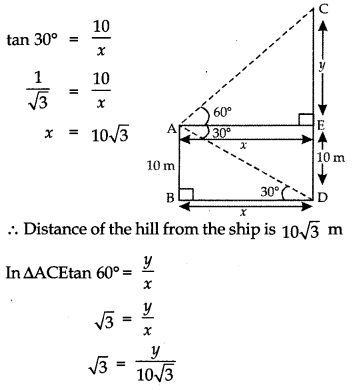
Now, CD = x + y
⇒ CD = 30 + 10 = 40 m
∴ The height of the hill is 40m.
Q12: At the foot of a mountain the elevation of its summit is 45°, after ascending 1000 m towards the mountain up a slope of 30° inclination, the elevation is found to be 60°. Find the height of the mountain. (5 Marks)
Ans: 1366 m
Sol: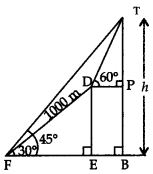 Let F be the foot and T be the summit of the mountain TFH such that ∠TFH = 45°
∴ In right ∆TBF,
∠BTF = 90° - 45° = 45°
Let height of mountain be h i.e., TB = h
since ∠TFH = ∠BTF = 45° ⇒ BF = BT = h
∠DFE = 30° and FD = 1000 m, ∠TDP = 60°
Draw DE ⊥BF and DP ⊥ BT
In right ∆DEF,
cos 30° = FE/DF = √3/2 = FE/1000
⇒ FE = 500√3 m
Also sin 30° = DE/DF = 1/2 = DE/1000
⇒ DE = 500 m
∴ BP = DE ⇒ BF = 500 m
Now TP = TB - BP = h - 500
In right ∆TPD, 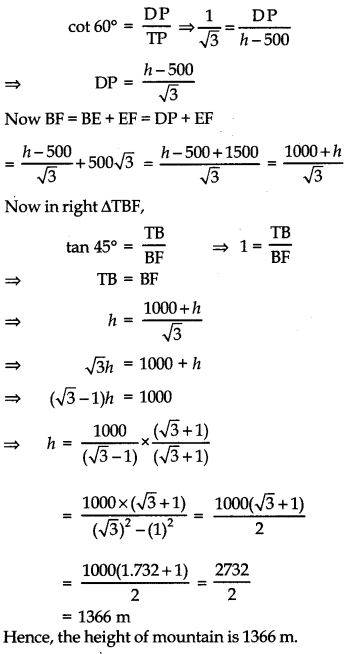
Q13: The angles of elevation and depression of the top and the bottom of a tower from the top of a building, 60 m high, are 30° and 60° respectively. Find the difference between the heights of the building and the tower and the distance between them. (5 Marks)
Ans: 20√3 m.
Sol: In right ∆ABE, 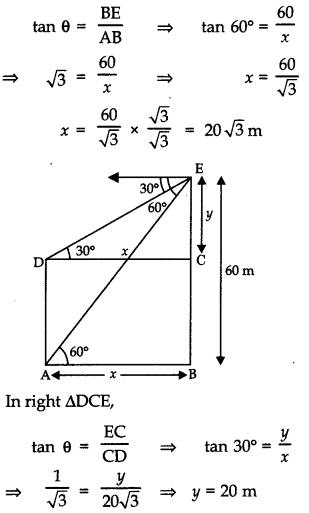
∴ Difference between heights of the building and tower = y = 20 m
Distance between tower and building = x
= 20√3 m
FAQs on Unit Test (Solutions): Some Applications of Trigonometry
| 1. What are some real-life applications of trigonometry in hobbies? |  |
| 2. How can trigonometry help in navigation for outdoor hobbies? | |
| 3. What role does trigonometry play in designing models for hobbies like model building? | |
| 4. Can trigonometry be used in digital hobbies such as gaming or animation? | |
| 5. How does trigonometry enhance the experience in outdoor activities like climbing or cycling? | |




