1. If the ratio of volume of two spheres is 1:8, then find the ratio of their surface area.
Solution:
Sol: Given, ratio of volumes = (1:8)
For spheres,
Volume ∝ r³
r₁³ / r₂³ = 1 / 8 ⇒ r₁ / r₂ = 1 / 2
Surface area of a sphere ∝ r²
Ratio of surface areas = 1² : 2² = 1:4
Ans: 1:4
2. Two cubes each of volume 64 cm3 are joined end to end. Find the surface area of the resulting cuboid.
Solution:
Sol: Volume of each cube = 64 cm³
Let side of cube = a
a³ = 64 ⇒ a = 4 cm
Two cubes joined end to end → dimensions of cuboid:
l = 8 cm, b = 4 cm, h = 4 cm
Surface area of cuboid:
= 2(lb + bh + hl)
= 2(8×4 + 4×4 + 8×4)
= 2(32 + 16 + 32) = 2×80 = 160
Ans: 160 cm²
3. Find the length of the longest rod that can be kept in a room of dimensions 12 cm × 9 cm × 8 cm. Hint: [Diagonal of Cuboid]
Solution:
Sol: Dimensions of room: 12 cm, 9 cm, 8 cm
Space diagonal:
d = √(l² + b² + h²)
= √(12² + 9² + 8²)
= √(144 + 81 + 64)
= √289
= 17
Ans: 17 cm
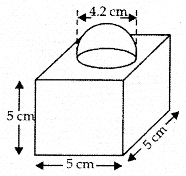
4. The decorative block shown in fig. is made of two solids-a cube and a hemisphere. The base of the block is a cube with edge 5 cm and the hemisphere fixed on the-top has a diameter of 4.2 cm. Find the total surface area of the block. [take π = 22/7]
Solution:
Sol: Cube edge = 5 cm
Surface area of cube:
= 6a² = 6×5² = 150 cm²
Hemisphere diameter = 4.2 cm
r = 2.1 cm
Area of circular base (covered part):
= πr²
Curved surface area of hemisphere:
= 2πr²
Total surface area of block:
= 150 - πr² + 2πr²
= 150 + πr²
Using π = 22/7, r = 2.1
πr² = (22/7) × (2.1)²
= (22/7) × 4.41
= 13.86
Total surface area = 150 + 13.86 = 163.86
Ans: 163.86 cm²
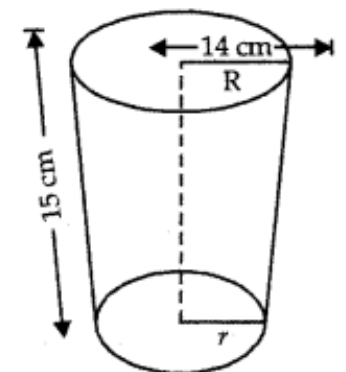
5. The radii of the circular ends of a bucket of height 15 cm are 14 cm and r cm (r < 14 cm). If the volume of bucket is 5390 cm3. Find the value of r. [Use π = 22/7]
Solution:
Sol: Height (h) = 15 cm
R = 14 cm, r = r (r < 14 cm)
Volume = 5390 cm³
Volume of frustum of cone:
V = (1/3) πh (R² + r² + Rr)
5390 = (1/3) × (22/7) × 15 × (14² + r² + 14r)
5390 = (1/3) × (22/7) × 15 × (196 + r² + 14r)
5390 = 110 × (196 + r² + 14r)
196 + r² + 14r = 5390 / 110 = 49
r² + 14r + 196 = 49
r² + 14r + 147 = 0
(r + 7)(r + 21) = 0
r = -7 or -21
Since radius cannot be negative,
Ans: r = 7 cm
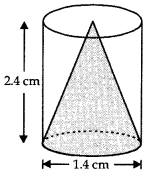
6. From a solid cylinder whose height is 2.4 cm and diameter 1.4 cm, a conical cavity of the same height and same diameter is hollowed out. Find the total surface area of the remaining solid.
Solution:
Sol: Height (h) = 2.4 cm
Diameter = 1.4 cm ⇒ r = 0.7 cm
Slant height of cone:
l = √(h² + r²)
= √(2.4² + 0.7²)
= √(5.76 + 0.49)
= √6.25 = 2.5 cm
Total surface area = Curved surface area of cylinder + Area of base of cylinder + Curved surface area of cone
7. If the surface area of a sphere is 144 p cm2, then what is its radius?
Solution:
Sol: Surface area of sphere = 4πr²
4πr² = 144π
Divide both sides by 4π:
r² = 144π / 4π = 36
r = √36 = 6 cm
Ans: Radius = 6 cm
8. The radii of bases of cylinder and a cone are in the ratio 3 : 4 and their heights are in the ratio 2:3 then ratio between the volume of cylinder to volume of cone is?
Solution:
Sol: Radii ratio (cylinder : cone) = 3 : 4
Heights ratio (cylinder : cone) = 2 : 3
Volume of cylinder = πr²h
Volume of cone = (1/3)πr²h
Required ratio:
= π(3)²(2) : (1/3)π(4)²(3)
= π × 9 × 2 : (1/3)π × 16 × 3
= 18π : 16π
= 18 : 16 = 9 : 8
Ans: 9 : 8
9. If two identical cubes of side 'a' are joined end to end. Then the total surface area of resulting cuboid is ______.
Solution:
Sol: Two identical cubes of side a joined end to end
Dimensions of cuboid:
l = 2a, b = a, h = a
Total surface area of cuboid:
= 2(lb + bh + hl)
= 2(2a×a + a×a + 2a×a)
= 2(2a² + a² + 2a²)
= 2(5a²) = 10a²
Ans: 10a²
10. A well of diameter 4 m is dug 21 m deep. The earth taken out of it has been spread evenly all around it in the shape of a circular ring of width 3 m to form an embankment. Find the height of the embankment.
Solution:
Sol: Diameter of well = 4 m ⇒ radius r₁ = 2 m
Depth of well = 21 m
Volume of earth dug out (cylinder):
= πr₁²h
= π × 2² × 21
= 84π m³
Earth is spread as a circular ring
Width of ring = 3 m
Outer radius r₂ = 2 + 3 = 5 m
Let height of embankment = h
Volume of ring:
= π(r₂² - r₁²)h
= π(5² - 2²)h
= π(25 - 4)h
= 21πh
Since volumes are equal:
21πh = 84π
h = 84π / 21π = 4 m
Ans: Height = 4 m
11. The sum of the radius of base and height of a solid right circular cylinder is 37 cm. If the total surface area of the solid cylinder is 1628 sq. cm, find the volume of the cylinder, (use π=22/7)
Solution:
Sol: Given: r + h = 37 cm
Total surface area = 1628 cm²
Total surface area of cylinder:
= 2πr(r + h)
1628 = 2 × (22/7) × r × 37
1628 = (44/7) × 37 × r
1628 = (1628/7) r
Multiply both sides by 7:
11396 = 1628r
r = 7 cm
h = 37 - 7 = 30 cm
Volume of cylinder:
= πr²h
= (22/7) × 7² × 30
= (22/7) × 49 × 30
= 22 × 7 × 30
= 4620 cm³
Ans: Volume = 4620 cm³
12. A right circular cone of radius 3 cm, has a curved surface area of 47.1 cm2. Find the volume of the cone, (use π = 3.14)
Solution:
Sol: Radius r = 3 cm
Curved surface area = 47.1 cm²
Curved surface area of cone = πrl
47.1 = 3.14 × 3 × l
47.1 = 9.42 l
l = 47.1 / 9.42 = 5 cm
Height of cone:
l² = r² + h²
5² = 3² + h²
25 = 9 + h²
h² = 16 ⇒ h = 4 cm
Volume of cone:
= (1/3) π r² h
= (1/3) × 3.14 × 3² × 4
= (1/3) × 3.14 × 9 × 4
= (1/3) × 113.04
= 37.68 cm³
Ans: 37.68 cm³
13. If the total surface area of a solid hemisphere is 462 cm², find its volume.
Solution:
Sol: Total surface area of hemisphere = 462 cm²
Total surface area = 3πr²
3πr² = 462
Using π = 22/7:
3 × (22/7) × r² = 462
(66/7) r² = 462
r² = (462 × 7) / 66 = 49
r = 7 cm
Volume of hemisphere:
= (2/3) π r³
= (2/3) × (22/7) × 7³
= (2/3) × (22/7) × 343
= (2/3) × 22 × 49
= (44/3) × 49
= 2156 / 3
= 718.67 cm³ (approx)
Ans: 718.67 cm³
14. A 5 m wide cloth is used to make a conical tent of base diameter 14 m and height 24 m. Find the cost of cloth used at the rate 25 rupees/ meter.
Solution:
Sol: Diameter = 14 m ⇒ r = 7 m
Height h = 24 m
Width of cloth = 5 m
Slant height:
l = √(r² + h²)
= √(7² + 24²)
= √(49 + 576)
= √625 = 25 m
Curved surface area of cone (cloth needed):
= πrl
= (22/7) × 7 × 25
= 22 × 25 = 550 m²
Cloth is 5 m wide, so length required:
= Area / width = 550 / 5 = 110 m
Cost at ₹25 per meter:
= 110 × 25 = 2750 rupees
Ans: ₹2750
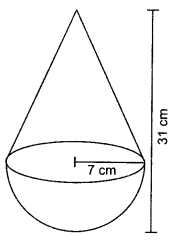
15. A toy is in the form of a cone mounted on a hemisphere of same radius 7 cm. If the total height of the toy is 31 cm, find its total surface area.
Solution:
Sol: Radius r = 7 cm
Total height of toy = 31 cm
Height of hemisphere = r = 7 cm
Height of cone:
h = 31 - 7 = 24 cm
Slant height of cone:
l = √(r² + h²)
= √(7² + 24²)
= √(49 + 576)
= √625 = 25 cm
Total surface area = Curved surface area of cone + Curved surface area of hemisphere
shortcuts and tricks, study material, mock tests for examination, Free, ppt, MCQs, Summary, practice quizzes, Objective type Questions, Viva Questions, Sample Paper, Exam, past year papers, Extra Questions, video lectures, Practice Questions: Surface Areas and Volumes, Previous Year Questions with Solutions, Important questions, Practice Questions: Surface Areas and Volumes, pdf , Practice Questions: Surface Areas and Volumes, Semester Notes;