Unit Test: Surface Areas and Volumes

Time: 1 hour
M.M. 30
Attempt all questions.
- Question numbers 1 to 5 carry 1 mark each.
- Question numbers 6 to 8 carry 2 marks each.
- Question numbers 9 to 11 carry 3 marks each.
- Question number 12 & 13 carry 5 marks each.
Q1: Two identical solid cubes of side a are joined end to end. Then the total surface area of the resulting cuboid is (1 Mark)
(a) 12a2
(b) 10a2
(c) 8a2
(d) 11a2
Q2: A right circular cylinder of radius r cm and height h cm (h>2r) just encloses a sphere of diameter (1 Mark)
(a) r cm
(b) 2r cm
(c) h cm
(d) 2h cm
Q3: If we join two hemispheres of same radius along their bases, then we get a; (1 Mark)
(a) Cone
(b) Cylinder
(c) Sphere
(d) Cuboid
Q4: The radius of the top and bottom of a bucket of slant height 35 cm are 25 cm and 8 cm. The curved surface of the bucket is _________________________________. (1 Mark)
Q5: If a cone is cut parallel to the base of it by a plane in two parts, then the shape of the top of the cone will be a: (1 Mark)
(a) Sphere
(b) Cube
(c) Cone itself
(d) Cylinder
Q6: 2 cubes each for the volume of 64 cm3 are joined end to end. Find out the surface area of the resulting cuboid. (2 Marks)
Q7: A cubical block of the side 7 cm is surmounted with a hemisphere. What is the greatest diameter the hemisphere could have? Find out the surface area of the solid. (2 Marks)
Q8: Two cones have their heights in the ratio of 1 : 3 as well as radii in the ratio of 3: 1. What is the ratio for their volumes? (2 Marks)
Q9: Water is flowing at the rate of 15 km/h passing through a pipe of the diameter of 14 cm into a cuboidal pond which is 50 m long and 44 m wide. At what time will the level for the water in the pond rise by 21 cm? (3 Marks)
Q10: A heap of rice is in the form for the cone of diameter of 9 m and height of 3.5 m. Find out the volume of the rice. How much canvas cloth is required to cover the heap only? (3 Marks)
Q11: Rasheed gets a playing top (lattu) as his birthday present, in which, surprisingly, he found no colour on it. He wanted to colour it with his crayons. The top is shaped as like a cone surmounted with a hemisphere. The entire top of 5 cm in height, as well as the diameter of the top, is 3.5 cm. Find out the area he has to colour. (Take π = 22/7) (3 Marks)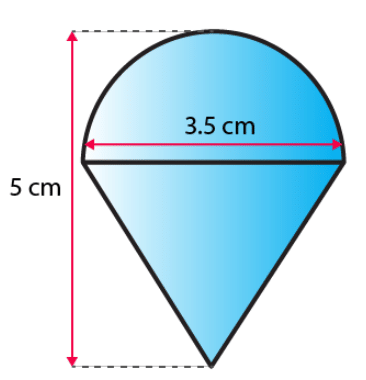
Q12: Water flows at the rate of 10m/minute and passes through a cylindrical pipe 5 mm in diameter. How long will it take to fill a conical vessel which has a diameter at the base is 40 cm and a depth of 24 cm? (5 Marks)
Q13: From a solid cylinder those height is 2.4 cm as well as diameter of 1.4 cm. A conical cavity for the same height as well as same diameter is hollowed out. Find out the total surface area of the remaining solid to the nearest cm2. (5 Marks)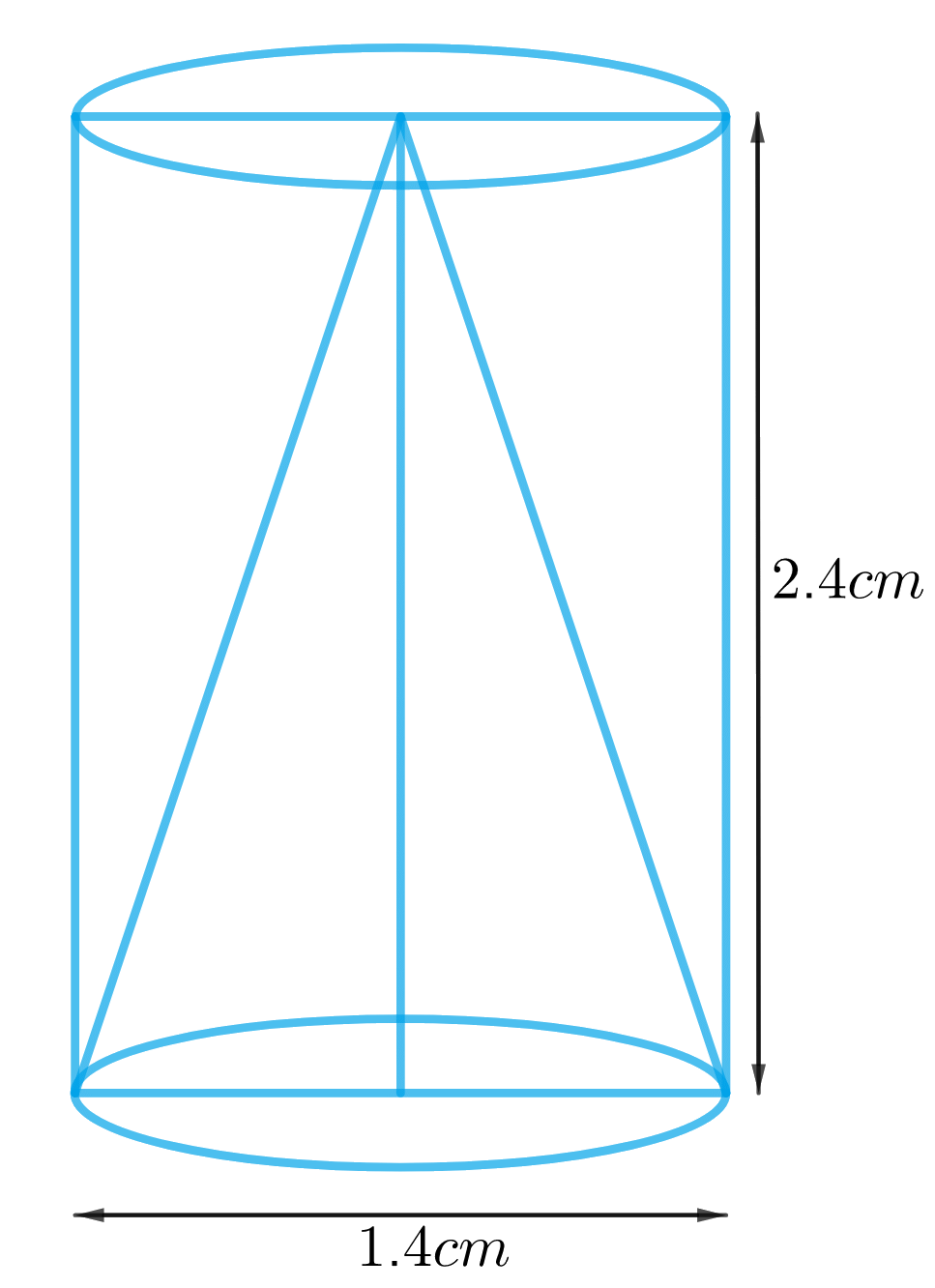
You can find the solutions of this Unit Test here: Unit Test (Solutions): Surface Areas and Volumes
FAQs on Unit Test: Surface Areas and Volumes
| 1. What is the formula for calculating the surface area of a sphere? |  |
| 2. How do you find the volume of a cylinder? | |
| 3. What is the difference between surface area and volume? | |
| 4. Can the surface area and volume formulas be used for irregular shapes? | |
| 5. Why is understanding surface area and volume important in real-life applications? | |





