Unit Test (Solutions): Force and Laws of Motion

Time: 1 hour
M.M. 30
Attempt all questions.
Question numbers 1 to 5 carry 1 mark each.
Question numbers 6 to 8 carry 2 marks each.
Question numbers 9 to 11 carry 3 marks each.
Question numbers 12 & 13 carry 5 marks each.
Q1: Which of the following objects is experiencing a balanced force?
(i) A book lying on a table
(ii) A ball rolling on the ground
(iii) A car accelerating on the highway
(iv) A stone falling freely from a height
Ans: (i) A book lying on a table
A book lying on a table is experiencing balanced forces, as the force of gravity is balanced by the normal force from the table.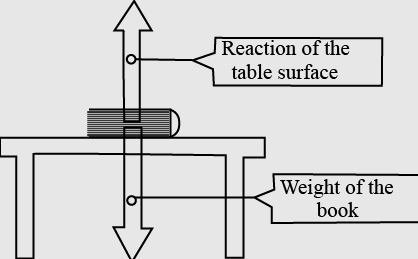
Q2: The SI unit of force is __________.
Ans: Newton
Newton is the SI unit of force.
Q3: When two objects interact, they apply forces on each other that are __________ in magnitude and __________ in direction.
(i) equal, opposite
(ii) equal, same
(iii) different, opposite
(iv) different, same
Ans: (i) equal, opposite
The forces are equal in magnitude and opposite in direction.
Q4: A car is moving in a straight line with a constant speed. Which of the following statements is true?
(i) The forces acting on the car are balanced
(ii) The car is accelerating
(iii) The car is experiencing a net force
(iv) The car is slowing down
Ans: (i) The forces acting on the car are balanced
The forces acting on the car are balanced, resulting in constant speed.
Q5: An object will continue in its state of rest or uniform motion unless acted upon by a __________.
Ans: Unbalanced force
An unbalanced force is required to change the state of rest or uniform motion.
Q6: Define force. Give one example of a force that can cause an object to start moving.
Ans: Force is a push or pull on an object that can cause it to change its state of motion or shape. It is measured in Newtons (N) and can be applied in various ways, such as through direct contact or at a distance. For example, pushing a stationary car can make it start moving, as the applied force overcomes the car's inertia, setting it into motion.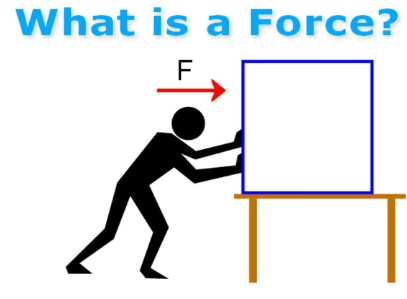
Q7: What happens to the direction of motion of an object when an unbalanced force acts on it? Give an example.
Ans: When an unbalanced force acts on an object, the direction of motion of the object changes, as the force causes a deviation from its original path or speed. The object's velocity may increase, decrease, or change direction depending on the force's magnitude and direction. For example, if you push a ball to the right, it will start moving to the right, as the applied force changes its motion from rest to movement in that direction.
Q8: Why is it easier to push a shopping cart when it is empty than when it is full?
Ans: It is easier to push an empty shopping cart because it has less mass, and thus, less force is required to overcome the inertia compared to when the cart is full and has more mass. The greater the mass, the more force is needed to initiate or change the motion of the cart, making it harder to push when loaded with items. This difference in required force highlights the direct relationship between mass and the effort needed to move an object.
Q9: State Newton's Third Law of Motion. Give two examples where this law is observed in daily life.
Ans: Newton's Third Law of Motion states that for every action, there is an equal and opposite reaction. This means that whenever one object exerts a force on another object, the second object exerts a force of equal magnitude but in the opposite direction on the first object.
Examples: i) Jumping Off a Boat: When you jump off a boat, you exert a force on the boat in the backward direction (action). In response, the boat exerts an equal and opposite force on you, propelling you forward. This is why the boat moves backward as you jump off.
ii) Recoil of a Gun: When a bullet is fired from a gun, the bullet moves forward due to the force exerted by the gunpowder explosion (action). At the same time, the gun experiences an equal and opposite force, causing it to recoil or move backward (reaction). This recoil is a direct result of Newton's Third Law. 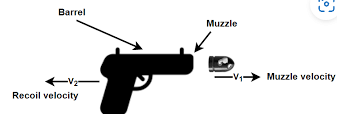
Q10: Explain how force can change the shape of an object with an example.
Ans: Force can change the shape of an object by causing it to deform, either temporarily or permanently. This deformation can occur through processes like stretching, compressing, bending, or twisting the object.
Example: Stretching a Rubber Band: When you apply force to a rubber band by pulling its ends apart, the rubber band stretches and its shape changes. This force causes the molecules within the rubber band to rearrange temporarily, elongating the band. Once the force is removed, the rubber band returns to its original shape, demonstrating elastic deformation. If the force were too great, the rubber band could snap, showing that excessive force can permanently alter an object's shape.
Q11: Differentiate between balanced and unbalanced forces with an example for each.
Ans: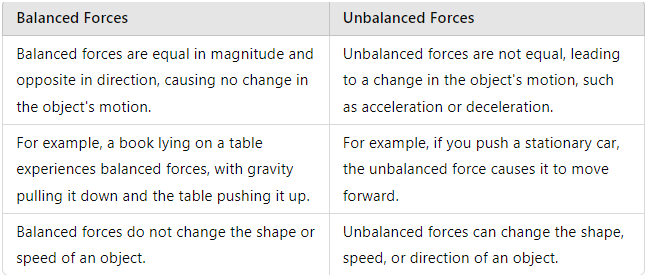
Q12: Derive the mathematical formulation of Newton's Second Law of Motion. Explain how this law helps us understand the relationship between force, mass, and acceleration with the help of an example.
Ans: Newton's Second Law of Motion states that the force acting on an object is equal to the mass of the object multiplied by its acceleration. This relationship can be expressed mathematically as:
Where:
i) F is the force applied to the object (in Newtons, N)
ii) m is the mass of the object (in kilograms, kg)
iii) a is the acceleration produced (in meters per second squared, m/s²)
Derivation:
i) Consider an object of mass : When a force is applied to it, the object accelerates at a rate .
ii) Proportionality: The acceleration a is directly proportional to the applied force , i.e.,
.
iv) Combining Both Proportions: Combining these, we get , or .
Example:
Suppose a car of mass 1000 kg is subjected to a force of 4000 N. According to Newton's Second Law: So, the car accelerates at a rate of 4 m/s² under the influence of this force.This law is crucial because it quantitatively describes how forces influence motion, allowing us to predict how objects will move under various forces. For instance, if the force is doubled while the mass remains constant, the acceleration will also double, illustrating the direct relationship between force and acceleration.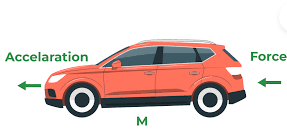
Q13: Explain the three laws of motion given by Newton with appropriate examples for each.
Ans: i) Newton's First Law (Law of Inertia): An object at rest stays at rest, and an object in motion stays in motion with the same speed and direction unless acted upon by an unbalanced force.
ii) For example, a soccer ball will not move until a player kicks it.
iii) Newton's Second Law (Law of Acceleration): The acceleration of an object depends on the mass of the object and the amount of force applied.
iv) Mathematically, it is expressed as F=ma, where F is force, m is mass, and a is acceleration.
v) For example, pushing a lighter object requires less force to achieve the same acceleration as a heavier object.
vi) Newton's Third Law (Action-Reaction Law): For every action, there is an equal and opposite reaction.
vii) For example, when you walk, your foot pushes backward against the ground, and the ground pushes your foot forward with equal force, allowing you to move forward.
FAQs on Unit Test (Solutions): Force and Laws of Motion
| 1. What are the three laws of motion formulated by Newton? |  |
| 2. How do forces affect the motion of an object? | |
| 3. What is the difference between mass and weight? | |
| 4. Can you explain the concept of inertia with an example? | |
| 5. How do action and reaction forces work in everyday life? | |




