Note: The questions provided in this document are similar to the questions that were asked in the actual Olympiad exam. So, we recommend you study these for your Olympiad preparation.
Logical Reasoning
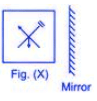
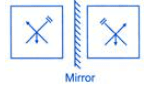
Q1: Which of the following options is the correct mirror image of Fig. (X)? (a) (b) (c) (d)
Solution:
Ans: (c)
Q2: In a line of boys, Kapil is 8th from the right and Nikunj is 12th from the left. When Kapil and Nikunj interchange their positions, Nikunj becomes 21st from the left. What will be the position of Kapil from the right?
(a) 8th (b) 17th (c) 21st (d) None of these
Solution:
Ans: (b) According to question, we have 11 + Nikunj + + Kapil + 7 New arrangement is 11 + Kapil + + Nikunj = 21 ⇒=21-13=8 So, position of Kapil =17th
Q3: M is older than R, Q is younger than R and N, N is not as old as M. Who is the eldest amongst all? (a) M (b) R (c) M or R (d) Data inadequate
Solution:
Ans: (a) Solution: The order from eldest to youngest is M, N or R, Q. So, M is the eldest.
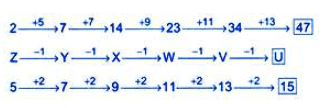
Q4: Which of the given options will complete the given pattern? 2Z5, 7Y7, 14X9, 23W11, 34V13, ? (a) 27U24 (b) 47V14 (c) 45U15 (d) 47U15
The seventh element from the right end in the sequence is #.
Counting three positions to the left of #, we find ?.
Thus, the answer is ?, which is the correct choice.
Q6: Select the one that does not belong to the group. (a) M23J (b) K27P (c) D15H (d) Q37T
Solution:
Ans: (c)
To solve this, we assign a number to each letter: A = 1, B = 2, C = 3, ..., Z = 26.
For M23J: M(13) + J(10) = 23, which is correct.
For K27P: K(11) + P(16) = 27, which is also correct.
For D15H: D(4) + H(8) = 12, which does not equal 15, making it the odd one out.
For Q37T: Q(17) + T(20) = 37, which is correct as well.
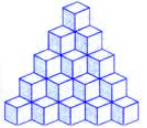
Q7: The model of a tower shown here is made up of unit cubes stacked on top of each other. How many unit cubes in all are used to form the tower? (a) 35 (b) 36 (c) 37 (d) 38
Solution:
Ans: (A)
Q8: Arrange the following in a meaningful order 1. Family 2. Community 3. Member 4. State 5. Country
Family: A group of members related by blood, marriage, or adoption.
Community: A group of families living in the same area and interacting with each other.
State: A larger political unit comprising multiple communities.
Country: A sovereign nation consisting of multiple states.
Establishing the Hierarchical Order:
Member (3): The smallest unit; an individual person.
Family (1): Comprises multiple members.
Community (2): Made up of multiple families.
State (4): Consists of multiple communities.
Country (5): Encompasses multiple states.
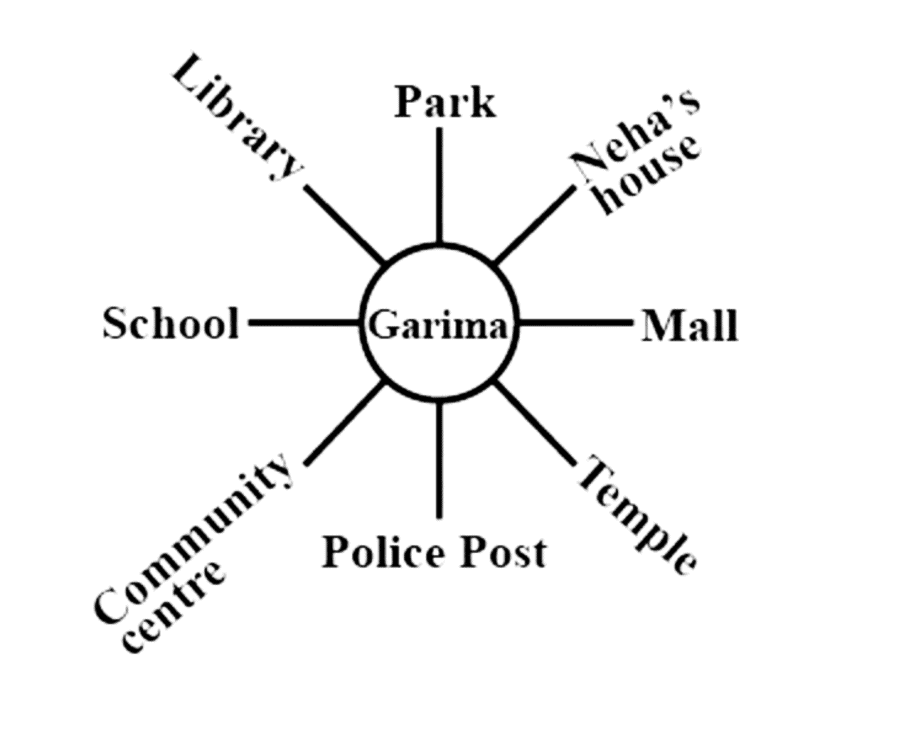
Q9: Garima is facing the community center. What will she be facing if she turns 90° clockwise? (a) Mall (b) School (c) library (d) Park
Solution:
Ans: (c)
Q10: Which of the following words cannot be created using the letters from the word MAGNIFICENCE? (a) ENGINE (b) MINING (c) MAGIC (d) ACCENT
Solution:
Ans: (d)
The word ACCENT includes the letter T, which is not found in the original word MAGNIFICENCE.
All other options, ENGINE, MINING, and MAGIC, can be formed using the letters available in MAGNIFICENCE.
Thus, ACCENT is the only word that cannot be constructed from the given letters.
Science
Q11: Refer to the given relationship and select the option that satisfies the same relationship. Cockroach : Spiracles (a) Dolphin : Lungs (b) Whale : Gills (c) Grasshopper : Moist skin (d) Tadpole : Body surface
Solution:
Ans: (a)
In this relationship, a cockroach uses spiracles for breathing.
Option A is correct because a dolphin breathes using lungs, just like the cockroach uses spiracles.
Options B, C, and D are incorrect because a whale breathes through lungs, not gills; a grasshopper breathes through spiracles, not moist skin; and a tadpole breathes through gills, not the body surface.
Q12: Which of the following statements is false? (a) Scales of reptiles are derived from epidermis. (b) Scales present over the body of fish are flexible and overlapping. (c) The body of insects is covered with a hard covering called scutes. (d) Spines present over the body of porcupine act as an armor to protect it from its enemies.
Solution:
Ans: (c)
Scutes are not the correct term for the hard covering of insects; instead, they are covered with a hard substance called cuticle.
Reptile scales indeed come from the epidermis, which is the outer layer of skin.
Fish scales are known to be flexible and overlapping, allowing for smooth movement in water.
Porcupines use their spines as a defense mechanism against predators, acting like an armor.
Q13: Unscramble the provided letters to find the name of an adaptation mechanism: NIRTMAOGI. Now, choose the correct statement about it. (a) It is a phenomenon wherein an organism resembles an object to an extent that they look alike. (b) It is a phenomenon that helps animals to escape from unfavorable conditions. (c) Due to this phenomenon, a prey may get unnoticed from its predator. (d) It is a phenomenon that helps an organism to blend with its environment.
Solution:
Ans: (b)
By unscrambling the letters, we find the word MIGRATION.
This term refers to an adaptation mechanism that allows animals to move to different areas to escape unfavorable conditions.
Option A describes mimicry, while options C and D relate to camouflage, which are different concepts.
Thus, the correct answer is that migration helps animals survive by moving away from harsh environments.
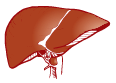
Q14: Which of the following body organs is responsible for cleaning our blood? (a) (b) (c) (d)
Solution:
Ans: (b) Organs shown in (b) is kidneys, which are responsible for purify our blood.
Q15: Supriya, a Class 5 student, appears very weak and pale. She also becomes fatigued quickly. What do you think is lacking in her diet? (a) Iodine (b) Iron (c) Vitamin A (d) Vitamin C
Solution:
Ans: (b)
Supriya is likely experiencing anaemia, which is primarily due to a lack of iron in her diet.
Individuals with anaemia often exhibit symptoms such as looking pale and feeling tired easily.
Iron is essential for producing hemoglobin, which carries oxygen in the blood.
Ensuring adequate iron intake can help improve her overall energy levels and health.
Q16: Select the odd one out based on the method of seed dispersal. (a) Hiptage (b) Dandelion (c) Geranium (d) Madar
Solution:
Ans: (c)
Hiptage, dandelion, and madar all use wind to disperse their seeds.
In contrast, Geranium seeds are spread through explosion, making it the odd one out.
This difference in the method of dispersal is what sets Geranium apart from the others.
Q17: Which of the following pairs of plants reproduces through their roots? (a) Onion, garlic (b) Radish, beetroot (c) Potato, carrot (d) Radish, Bougainvillea
Solution:
Ans: (b)
Radish and beetroot are known to reproduce vegetatively through their roots.
In contrast, onion and garlic reproduce via bulbs, while potato reproduces through tubers.
Bougainvillea reproduces through its stems.
Thus, the correct answer is the pair that includes radish and beetroot.
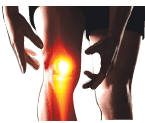
Q18: What type of joint is shown in the given figure? (a) Hinge joint (b) Ball & socket joint (c) Pivot joint (d) Gliding joint
Solution:
Ans: (a) Hinge Joint works like the hinges in the door. This kind of joint only allows back and forth movement. e.g., Bones in the knee, elbow, fingers, and toes have this type of joint.
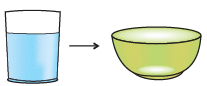
Q19: There is some water in a glass. If all the water is poured into an open hot bowl from the glass:
(a) Volume of water will change. (b) Shape of water will change. (c) Surface area of water will increase. (d) Both (b) and (c)
Solution:
Ans: (b) If the water is poured in to an open hot bowl from the glass, the shape of the water changes. It takes the shape of the container.
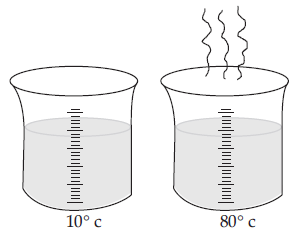
Q20: Look at the picture below:
How to understand the difference between the two beakers shown in the picture if a girl touches them. (a) its temperature (b) its content (c) its size (d) its smell
Solution:
Ans: (a) On the basis of temperature, the girl will identify the difference in glasses.
Q21: When a dry comb after combing the hair is brought near the tiny pieces of paper: (a) The paper pieces will get repelled due to magnetic force. (b) The paper pieces will get repelled due to electrostatic force. (c) The paper pieces will get attracted to comb due to friction force. (d) The paper pieces will get attracted and stick with comb due to electrostatic force.
Solution:
Ans: (d) The paper pieces will get attracted and stick with comb due to electrostatic force.
Q22:Select the correct pairing.
(a) Heart - Filters blood to produce urine
(b) Liver - Pumps blood throughout the body
(c) Kidney - Removes waste products from blood
(d) Lungs - Control body activities
Solution:
Ans: (c)
Heart: Pumps blood throughout the body (Incorrect pairing in Option a & b)
Liver: Processes nutrients and detoxifies the body (Incorrect pairing in Option b)
Kidney: Removes waste products from blood (Correct in Option c)
Lungs: Facilitate gas exchange (Incorrect pairing in Option d)
Thus, Option (c) is the only correct pairing among the choices provided.
Q23: What would occur if our body lacked bones?
I. Our organs will not be protected. II. Our body will not have shape. III. We will not be able to move. IV. We will feel nauseated. (a) I and III only (b) II and III only (c) II and IV only (d) I, II, and III only
Solution:
Ans: (d)
The skeletal system is essential as it provides a framework of bones that gives our body its shape and support.
Without bones, our internal organs would not be protected, leading to potential injuries.
Bones also serve as a structure for muscles to attach, enabling movement.
Feeling nauseated is not a direct consequence of lacking bones, making options I, II, and III the correct answer.
Q24: Select the option that illustrates the correct order of events related to global warming.
I. Carbon dioxide and harmful gases are released into the atmosphere. II. Temperature of the Earth increases. III. Fossil fuels are burnt. IV. Greenhouse gases trap the Sun's heat and prevent it from escaping into space.
(a) III, I, IV, II (b) I, III, II, IV (c) IV, III, II, I (d) III, II, I, IV
Solution:
Ans: (a)
The process of global warming begins with burning fossil fuels (III), which releases carbon dioxide and other harmful gases into the atmosphere (I).
These gases then act as greenhouse gases that trap the Sun's heat (IV), preventing it from escaping back into space.
As a result, the temperature of the Earth increases (II).
Thus, the correct sequence is III, I, IV, II.
Q25: Which of the following phases of the Moon comes right after the New Moon phase? (a) Waning Crescent (b) Waxing Crescent (c) Waning Gibbous (d) Waxing Gibbous
Solution:
Ans: (b)
The phase of the Moon that comes right after the New Moon is known as the waxing crescent.
During this phase, a small sliver of the Moon becomes visible as it starts to grow.
The term waxing means that the Moon is increasing in illumination.
This phase is important as it marks the beginning of the Moon's cycle towards being full.
Q26: Which of the following are characteristics of graphite? (i) Slippery (ii) Conducts electricity (iii) Translucent (iv) Non-magnetic (v) Conducts heat
(a) (i) and (iii) only (b) (ii), (iv) and (v) only (c) (i) and (iv) only (d) (i), (ii), (iv) and (v) only
Solution:
Ans: (d)
Graphite has several important properties:
It is slippery, which makes it useful as a lubricant.
Graphite can conduct electricity due to the movement of electrons between its layers.
It is non-magnetic and can also conduct heat effectively.
However, graphite is opaque, meaning it does not allow light to pass through.
Thus, the correct properties are (i), (ii), (iv), and (v), making option (d) the right choice.
Q27: Unscramble the provided letters to identify a material that is non-biodegradable: C S L P A T I. Choose the option that describes a characteristic of this material. (a) Magnetic (b) Conductor (c) Insulator (d) None of these
Solution:
Ans: (c)
Unscrambling the letters results in the word PLASTIC, which is known to be non-biodegradable.
Plastic is classified as an insulator, meaning it does not conduct heat or electricity well.
It is also a poor conductor, making it suitable for various applications where insulation is needed.
Additionally, plastic is generally non-magnetic, which means it does not attract magnets.
Q28: The term used to refer band of seven colours obtained through dispersion is : (a) Reflection (b) Refraction (c) Spectrum (d) Transparency
Solution:
Ans: (c) The band of seven colours obtained through dispersion is called spectrum.
Q29: Changes in seasons are caused by .............. (a) Rotation of Earth (b) Revolution of Earth (c) Revolution of Sun (d) None of these
Solution:
Ans: (b) Changes in seasons are caused by revolution of earth.
Q30: Which of the following represents a form of energy that a car has while it is in motion? (a) Potential energy (b) Hydro energy (c) Kinetic energy (d) Solar energy
Solution:
Ans: (c)
Kinetic energy is the energy that an object has because of its motion. In this case, a moving car has kinetic energy.
Potential energy is stored energy based on an object's position, not its movement.
Hydro energy refers to energy derived from water, while solar energy comes from the sun.
Thus, the correct answer is kinetic energy, as it directly relates to the movement of the car.
Q31: Which substance is released into the environment when fossil fuel is burned? (a) Helium (b) Carbon dioxide (c) Ozone (d) All of these
Solution:
Ans: (b) Carbon-dioxide is emitted from the unburn particles of fossil fuels.
Q32: Refer to the provided list of several aquatic plants. (i) Water lily (ii) Duckweed (iii) Hydrilla (iv) Lotus (v) Pistia (vi) Tape grass How many of these are fully submerged aquatic plants? (a) 2 (b) 3 (c) 4 (d) 5
Solution:
Ans: (a)
Hydrilla and tape grass are the only plants that are fully submerged in water.
Water lily and lotus are considered fixed aquatic plants, meaning they are anchored to the bottom.
Duckweed and Pistia float on the surface of the water.
Thus, the total number of completely submerged aquatic plants is 2.
Q33: Which of the following statements is accurate regarding insectivorous plants? (a) They lack chlorophyll, so they cannot perform photosynthesis. (b) They are referred to as saprophytes. (c) They thrive in soil that has low nitrogen levels. (d) They have specialized structures for breathing.
Solution:
Ans: (c)
Insectivorous plants are capable of photosynthesis because they contain chlorophyll, which gives them their green color.
However, they also trap and consume insects to obtain essential nutrients, particularly nitrogen.
These plants typically grow in nitrogen-deficient soil, which is why they have adapted to catch insects.
Thus, the correct statement is that they thrive in soil with low nitrogen levels.
Q34: Unscramble the provided letters to identify a scavenger: (a) AADL SRMEN (b) PNEETALH (c) HMLAECOEN (d) URUVTEL
Ans: (d)
Solution:
Vulture is the correct answer as it is a known scavenger.
When we unscramble the letters, we find:
AADL SRMEN = SALAMANDER
PNEETALH = ELEPHANT
HMLAECOEN = CHAMELEON
URUVTEL = VULTURE
Among these, the vulture feeds on dead animals, making it a scavenger, while the others are not.
Q35: In what way is the life cycle of a cockroach similar to the grasshopper? (i) Both have three stages. (ii) Their young ones look similar to adults. (iii) Young ones of both are called nymph. (iv) They molt a few times as they grow.
(a) (i), (ii), and (iii) only (b) (ii) and (iii) only (c) (ii), (iii), and (iv) only (d) (i), (ii), (iii), and (iv)
Solution:
Ans: (d)
Both cockroaches and grasshoppers share a life cycle that includes three stages.
Their young ones resemble the adults, indicating a similarity in appearance.
In both species, the young are referred to as nymphs.
As they develop, both undergo molting several times.
Q36: Which of the following cannot be observed in the case of an oil spill? (a) Beach surfaces coated with black, sticky mass. (b) Dead bodies of fish and other animals drifting ashore. (c) Birds with oil-coated feathers, that become unable to maintain body temperature. (d) None of these.
Solution:
Ans: (d) Oil spill from ships is one of the causes of water pollution.
Q37: When trying to maintain a balanced diet it is important to: (a) Eat from all of the food groups. (b) Eat more fruits and vegetables than anything else. (c) Completely avoid all fats and sugars. (d) Skip breakfast once a week.
Solution:
Ans: (a) A diet that contains adequate amount of different component in right proportion is called a balanced diet.
Q38: X is a natural fiber derived from the stem of its plant. What is X? (a) Nylon (b) Cotton (c) Polyester (d) Linen
Solution:
Ans: (d)
Linen is produced from the stem of the flax plant, making it a natural fiber.
Nylon and polyester are synthetic fibers, not derived from plants.
Cotton comes from the fruit of the cotton plant, not the stem.
Thus, the correct answer is Linen, as it is the only option that fits the description of being a natural fiber from the stem.
Q39: For extinguishing a fire caused by petrol, what should we do? (a) Switch on the electric supply (b) Turn on the gas supply (c) Throw lots of sand on it (d) Use a fire extinguisher
Solution:
Ans: (c)
To extinguish a fire caused by flammable liquids like petrol, it is best to throw lots of sand on it. This helps to cut off the oxygen supply, which is essential for the fire to burn.
Using water is ineffective because oil, such as petrol, floats on water and will continue to burn.
Additionally, switching on the electric supply or turning on the gas supply could make the situation worse.
Q40: Which of the following shows the correct path of blood flow in humans? (a) Heart→Lungs→Body→Lungs→Heart (b) Heart→Lungs→Body→Lungs→Body (c) Lungs→Heart→Body→Lungs→Heart (d) Lungs→Heart→Body→Heart→Lungs
Solution:
Ans: (d) Lungs→Heart→Body→Heart→Lungs
Q41: Which of the following options includes an item that is different in state of matter from the other two? (a) Tissue paper, pen, sponge (b) Hydrogen, nitrogen, oxygen (c) Kerosene oil, orange juice, water (d) Salt, sugar, vinegar
Solution:
Ans: (d)
Salt and sugar are both solids, while vinegar is a liquid.
Option A consists entirely of solids.
Option B is made up of gases.
Option C contains only liquids.
Q42: Study the given statements about the importance of dispersal of seeds: (i) This prevents over-crowding, which results in weak plants. (ii) It prevents seeds from being dependent on the parent plant. (iii) It ensures the plants of a particular type spread to new areas. Select the correct option: (a) (i) only (b) (i) and (ii) only (c) (i) and (iii) only (d) (i), (ii) and (iii)
Solution:
Ans: (c) Many plants scatter their seeds in order to ensure that they do not grow too close to one another. The process by which the seeds are scattered away from the mother plant is called dispersal of seeds.
Q43: Work is considered to be accomplished when: (a) A boy rides a bicycle (b) A child kicks a football in the playground (c) A girl is swimming (d) All of these
Solution:
Ans: (d)
Work is defined in physics as the transfer of energy that occurs when a force is applied to an object, causing it to move.
In options A, B, and C, each activity involves a force causing movement, which means work is being done.
Therefore, since all activities involve movement due to applied force, the correct answer is All of these.
Q44: Select the incorrect pairing concerning the estimated proportions of various gases in the atmosphere: (a) Nitrogen - 78% (b) Oxygen - 51% (c) Carbon dioxide - 0.04% (d) Other gases - 0.96%
Solution:
Ans: (b)
The percentage of oxygen in the atmosphere is around 21%, which is significantly lower than 51%.
Nitrogen makes up about 78% of the atmosphere, while carbon dioxide is only about 0.04%.
The remaining 0.96% consists of other gases, which include argon and trace gases.
Thus, option (b) is the incorrect match regarding the gas percentages.
Q45: Kushagra observed the Moon's shape on 12th May, 20XX. What will be the shape of the Moon on 22nd May, 20XX? (a) Option A (b) Option B (c) Option C (d) Option D
Solution:
Ans: (c)
Kushagra saw a Half Moon (First Quarter) on 12th May, 20XX.
By 22nd May, 20XX, the Moon will transition to a Waning Gibbous Moon.
This means it will appear more than half but less than full, as it moves towards the New Moon phase.
The phases of the Moon change in a predictable cycle, which helps in determining its shape on different dates.
Achievers Section
Q46: Refer to the provided Venn diagram and choose the accurate option related to it: (a) Waste: Industries, Spraying pesticides, Oil spill, Playing loud music (b) Burning fossil fuels, Hospital wastes, Burning firecrackers, Volcanic eruption (c) Acid rain, Spraying pesticides, Burning fossil fuels, Burning firecrackers (d) Industries, Oil spill, Volcanic eruption, Hospital wastes
Solution:
Ans: (b)
The Venn diagram categorizes various types of waste. The correct option includes burning fossil fuels, which is a significant source of pollution, along with hospital wastes, burning firecrackers, and volcanic eruptions, all of which contribute to environmental issues.
Each of these elements represents a different type of waste that impacts the environment.
Understanding these categories helps in recognizing the sources of pollution and their effects.
Thus, option (b) accurately reflects the types of waste shown in the Venn diagram.
Q47: Refer to the provided classification chart and choose the accurate option related to it. (a) Granite : Limestone : Slate (b) Shale : Marble : Obsidian (c) Conglomerate : Pumice : Gneiss (d) Basalt : Quartzite : Shale
Solution:
Ans: (b)
Shale is a type of sedimentary rock, while marble is classified as a metamorphic rock and obsidian is an igneous rock.
The other options mix different types of rocks incorrectly, as they do not follow the same classification.
Understanding the categories of rocks is essential: sedimentary, metamorphic, and igneous.
Thus, option (b) correctly represents one from each category.
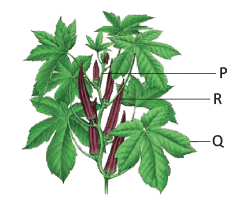
Q48: The given figure shows plant parts labelled as P, Q, R and S. Which of the following options correctly list the plants in which labelled part is edible ?
Ans: (c) In the given figure, P is stem, Q is leaf, R is seed and S is root. The edible part in rajma, soybean and pea is seed.
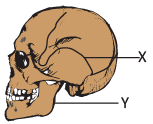
Q49: Refer to the given figure and select the correct option:
(a) X type of joint shows no movement at all. (b) Y type of joint is also present in our elbow. (c) X type of joint is also found in between vertebrae. (d) Both (a) and (b)
Solution:
Ans: (d) Joints are the places where two bones are joined together. 'X' represents joint between bones in the skull which shows no movement, Y-type joint (hinge joint) present between lower jaw and skull, is also present in elbow. It allows movement in only one direction. Cartilaginous joints are found between vertebrae that allow slight movement of bones unlike the 'X' type joint.
Q50: Saanjh has two syringes whose tips are sealed. In syringe X, there is 30 cm³ of water, and in syringe Y, there is 30 cm³ of air. Syringe X: 30 cm³ water, Sealed tip, Plunger Syringe Y: 30 cm³ air, Sealed tip, Plunger What will happen when both the plungers are pushed in? (a) Plunger of syringe X will move a greater distance as compared to the plunger of syringe Y. (b) Plunger of syringe Y will move a greater distance as compared to the plunger of syringe X. (c) Plungers of both syringes will move equal distances. (d) Plunger of both syringes will not move at all.
Solution:
Ans: (b)
Syringe X has 30 cm³ of water, while syringe Y has 30 cm³ of air.
Both syringes have sealed tips, meaning no liquid or gas can escape.
When the plungers are pushed, the air in syringe Y can be compressed easily, allowing its plunger to move further.
In contrast, the water in syringe X is not compressible, so its plunger will not move as far.
FAQs on Science Olympiad Previous Year Questions - 1
1. What topics are covered in the Class 5 Science Olympiad?
Ans. The Class 5 Science Olympiad covers various topics including life sciences, physical sciences, and earth sciences. Students may encounter questions related to plants and animals, human body systems, matter, energy, and environmental science.
2. How can I prepare for the Class 5 Science Olympiad effectively?
Ans. To prepare effectively for the Class 5 Science Olympiad, students should review their class notes, refer to their textbooks, and practice sample papers. Participating in group discussions and using educational apps or websites for quizzes can also enhance understanding and retention of concepts.
3. What is the format of the Class 5 Science Olympiad exam?
Ans. The Class 5 Science Olympiad typically consists of multiple-choice questions (MCQs) that test various scientific concepts. The exam is usually conducted in a timed setting, and students need to choose the correct answer from the given options.
4. Are there any recommended books for Class 5 Science Olympiad preparation?
Ans. Yes, there are several recommended books for Class 5 Science Olympiad preparation. Some popular choices include "Science Olympiad Class 5" by various publishers, NCERT textbooks, and workbooks that focus on Olympiad-level questions.
5. What skills can students develop by participating in the Science Olympiad?
Ans. Participating in the Science Olympiad helps students develop critical thinking, problem-solving skills, and a deeper understanding of scientific concepts. It also encourages curiosity and a passion for learning about the natural world.
Objective type Questions, Science Olympiad Previous Year Questions - 1, Exam, MCQs, Semester Notes, Previous Year Questions with Solutions, Summary, Science Olympiad Previous Year Questions - 1, ppt, Science Olympiad Previous Year Questions - 1, Important questions, study material, Extra Questions, shortcuts and tricks, practice quizzes, past year papers, mock tests for examination, Free, Sample Paper, Viva Questions, pdf , video lectures;

 (a)
(a)  (b)
(b)  (c)
(c)  (d)
(d) 
 (a) 35
 (b)
(b)  (c)
(c)  (d)
(d) 
 (a) Hinge joint
 (a) Volume of water will change.