Note: The questions provided in this document are similar to the questions that were asked in the actual Olympiad exam. So, we recommend you study these for your Olympiad preparation.
Logical Reasoning Section
Q1: If a # b = a ÷ b, a % b = a × b, a d b = a + b and a $ b = a - b, then what is the value of (7 % 6) + (16 # 8) + (4 d 3)? (a) 41 (b) 51 (c) 42 (d) 53
Solution:
Ans: (b)
First, calculate 7 % 6: This means 7 × 6 = 42.
Next, calculate 16 # 8: This means 16 ÷ 8 = 2.
Then, calculate 4 d 3: This means 4 + 3 = 7.
Now, add these results together: 42 + 2 + 7 = 51.
Thus, the final answer is 51.
Q2: Choose the odd one out from the following options. (a) Venus (b) Neptune (c) Jupiter (d) Uranus
Solution:
Ans: (a)
Except Venus and Mercury, all the other planets have their natural satellites. So, Venus is the odd one among the given options.
Q3: Some students are arranged in a row facing North. Akhil occupies the 15th position from the left end. Vivek is positioned 12th to the right of Akhil. If Vivek's position is 4th from the right end, how many students are there in total in that row? (a) 18 (b) 20 (c) 25 (d) 30
Solution:
Ans: (d)
To find the total number of students, we first determine Akhil's position: he is 15th from the left.
Vivek is 12th to the right of Akhil, which means his position is 15 + 12 = 27th from the left.
Since Vivek is also 4th from the right, we can set up the equation: Total students = Vivek's position from the left + Vivek's position from the right - 1.
Thus, Total students = 27 + 4 - 1 = 30.
Q4: Look at this series: 36, 34, 30, 28, 24, ... Which number should come next? (a) 20 (b) 22 (c) 23 (d) 26
Ans: (b)
Solution:
This is an alternating number subtraction series. First, 2 is subtracted, then 4, then 2, and so on.
36 - 2 = 34
34 - 4 = 30
30 - 2 = 28
28 - 4 = 24
24 - 2 = 22
Q5: Find the alternative which will replace the question mark (?). 5 : 26 :: 7 : ? (a) 42 (b) 45 (c) 47 (d) 50
Solution:
Ans: (d)
The relation here is n : n2 + 1
5 : 52 + 1 = 26
7 : 72 + 1 = 50
Q6: In a specific coding system, ORDINARY is represented as TWINJWNU. How will PRECIOUS be encoded in that same system? (a) SUHFLFNP (b) TVIGKEOQ (c) VXKIEKQO (d) UWJHEKQO
Solution:
Ans: (d)
The coding system involves shifting each letter in the word by a certain number of positions in the alphabet.
For example, in ORDINARY to TWINJWNU, each letter is shifted forward by a specific pattern.
Applying the same pattern to PRECIOUS results in UWJHEKQO.
This shows how the letters are transformed consistently according to the established code.
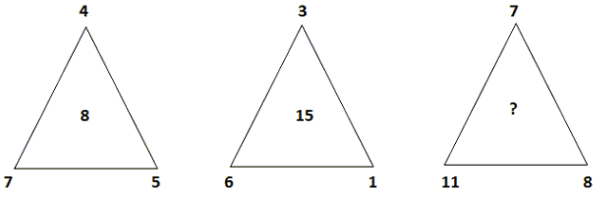
Q7: The number written inside each triangle has some relation with the three numbers written on the vertices of the triangle. Find the number which will come in place of the question mark.
Q8: Identify the missing number based on the given pattern, which follows a specific rule either across rows or down columns: 18 21 16 17 23 14 12 24 ? 23 20 9 (a) 18 (b) 19 (c) 20 (d) 21
Solution:
Ans: (d)
The numbers are arranged in a grid, and we need to find a pattern.
Looking at the last column: 17, 12, ?, 20, 9, we can see that each number decreases by 5.
So, if we subtract 5 from 12, we get 7, which is not an option. However, if we look at the second column: 21, 14, 24, we can see a pattern of increasing by 3.
Thus, the missing number that fits the overall pattern is 21.
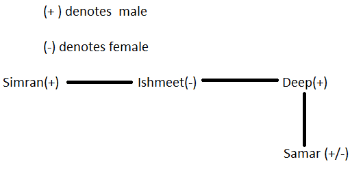
Q9: Simran is the brother of Ishmeet, Ishmeet is the sister of Deep and Deep is the father of Samar. How is Simran related to Samar? (a) Sister (b) Brother (c) Brother-in-law (d) Uncle
Solution:
Ans: (d)
Clearly, Simran is Samar's uncle.
Q10: P, Q, R, S, T, and U are six individuals traveling together in a boat. Among them, Q, R, and T are women, while the others are men. P, Q, R, and T are all vegetarians, whereas S and U are non-vegetarians. Additionally, Q, T, and U can swim, while the others cannot. Which of the following is the vegetarian female who knows how to swim? (a) R (b) Q (c) P (d) U
Solution:
Ans: (b)
The question asks for a vegetarian female who can swim.
From the information, the vegetarian females are Q, R, and T.
Among these, the ones who can swim are Q and T.
Thus, the correct answer is Q, as she is a vegetarian female who knows how to swim.
Science Section
Q11: Which of the following statements are not correct? I. All metals have high melting points. II. Iodine crystals are lustrous because iodine it is a metal. III. Metals form ionic compounds with non-metals. IV. Bromine is the only non-metal which is liquid at room temperature. I, II and III I and II I, III and III II and IV
Solution:
Ans: (b)
Metals generally have high melting points, but mercury, cesium and gallium have low melting points. Mercury is liquid at room temperature, and cesium and gallium are liquids close to room temperature. Hence, statement I is incorrect.
Although iodine exhibits metallic lustre, it is an electronegative element and is essentially a non-metal. Hence, statement II is incorrect.
Statements III and IV are correct. Hence, option (b) is the correct answer.
Q12: Some common methods of food preservation are given below: P: Preservation by sugar Q: Heat and cold treatments R: Preservation by using chemicals S: Preservation by oil and vinegar Which of the statements is incorrect regarding methods of food preservation? P increases the moisture content which inhibits the growth of bacteria R uses sodium benzoate and sodium metabisulphite Q is involved in the pasteurisation of milk S is used in the preservation of fruits and vegetables in the form of pickles.
Solution:
Ans: (a)
Jams, jellies and squashes are preserved by sugar. Sugar reduces the moisture content which inhibits the growth of bacteria which spoil food.
Q13: The bulb of a mercury thermometer is initially placed in melting ice (at standard pressure), followed by steam (at standard pressure), and finally in a liquid X. The lengths of the mercury thread in the uniform tube above the bulb for these three cases are 30 mm, 180 mm, and 60 mm respectively. What is the temperature of liquid X? (a) 20°C (b) 40°C (c) 29.4°C (d) 33.3°C
Solution:
Ans: (a)
The mercury thermometer measures temperature based on the length of the mercury column.
In melting ice, the temperature is defined as 0°C, which corresponds to the 30 mm length of mercury.
In steam, the temperature is 100°C, which corresponds to the 180 mm length of mercury.
The length of mercury in liquid X is 60 mm. To find the temperature of X, we can use the linear relationship between the lengths and temperatures.
Using the formula, we can calculate that the temperature of liquid X is 20°C.
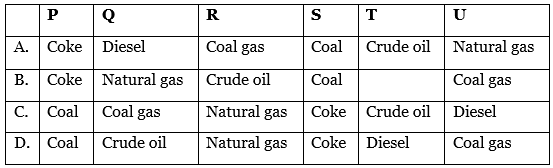
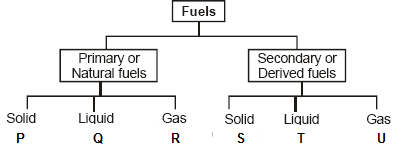
Q14: Fuels can be classified as natural (primary) fuels and derived (secondary) fuels.
Observe the following table and select the correct option to represent P, Q, R, S, T and U.
(a) A (b) B (c) C (d) D
Solution:
Ans: (d)
Coal, crude oil and natural gas are primary fuels.
Coke, diesel and coal gas are secondary fuels. Coal and coal gas are obtained during the destructive distillation of coal and diesel is obtained during the destructive distillation of petroleum.
Hence, option (d) is correct.
Q15: Which of the following options is FALSE? (a) Sodium and potassium are stored under kerosene. (b) Lemon pickle is stored in aluminium utensils. (c) Immersion rods for heating the liquids are made up of metallic substances. (d) Copper cannot displace zinc from its salt solution.
Solution:
Ans: (b)
Metals react with acids and pickles are acidic in nature.
Hence, lemon pickle should not be stored in aluminium utensils as it would react with the metal to produce toxic substances..
Q16: In which of the following processes do plants release water in the form of vapour? (a) Photosynthesis (b) Respiration (c) Transpiration (d) Evaporation
Solution:
Ans: (c)
Transpiration is the process where plants lose water vapor through tiny openings called stomata.
This process helps in cooling the plant and also aids in nutrient transport from the roots to the leaves.
While photosynthesis and respiration involve gas exchange, they do not primarily focus on water loss.
Thus, the correct answer is transpiration, as it specifically refers to the release of water vapor.
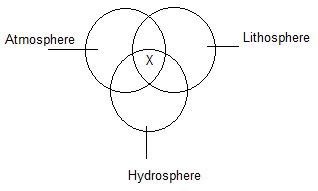
Q17: Refer to the Venn diagram given below and choose the correct option.
(a) X comprises only flora and fauna present on land. (b) X includes only non-living components. (c) In the zone X, various living and non-living organisms show interdependence. (d) No interaction between biotic and abiotic factors occurs in X.
Solution:
Ans: (c)
X represents biosphere. Everything in the biosphere is interrelated. Plants, animals and microbes show interrelationship with respect to their nutritional requirement and habitat. All biotic and abiotic components show connection with each other.
Q18: Which of the following groups consists solely of non-metal elements? (a) Oxygen, Nitrogen, Magnesium (b) Phosphorus, Chlorine, Sulphur (c) Calcium, Sodium, Carbon (d) Neon, Aluminium, Boron
Solution:
Ans: (b)
The correct answer is Phosphorus, Chlorine, Sulphur, which are all non-metals.
In contrast, Oxygen and Nitrogen are non-metals, but Magnesium is a metal.
Calcium and Sodium are also metals, while Carbon is a non-metal.
Lastly, Neon is a non-metal, but Aluminium and Boron are metals.
Q19: Which of the following options is TRUE? (a) Weeds are the unwanted plants growing along crops. (a) Weeds share the nutrients meant for plants. (a) Weedicides are sprayed in the fields to kill the unwanted plants. (a) All of the above
Solution:
Ans: (d)
Weeds are the unwanted plants growing along crops. They share the nutrients meant for plants and thus are harmful for crops. We can control weeds with the help of chemicals weedicides. The removal of weeds is called weeding. They are either removed manually or by chemicals. Manually this can be done with the help of Khurpi or Seed-drill. Weedicides are sprayed in the fields to kill the unwanted plants. These weedicides do not affect the main crop. Weeds are removed or killed during their vegetative phase before flowering or bearing of seeds.
Q20: Which planet can be seen in western sky after sunset? (a) Mercury (b) Venus (c) Jupiter (d) Uranus
Solution:
Ans: (b)
Venus appears in the western sky after sunset and is called the evening star. As it does so, it changes from the "Evening Star", visible after sunset, to the "Morning Star", visible before sunrise. Although Mercury, the other inferior planet, reaches a maximum elongation of only 28° and is often difficult to discern in twilight, Venus is hard to miss when it is at its brightest.
Q21: Diana, Dave and Cameron are working on a project in which they are burning a heap of green leaves, but they are finding difficulty in doing so. Why is it difficult to burn a heap of green leaves? (a) Because it has a high ignition temperature. (b) Because it contains high amounts of water. (c) Because it contains low amounts of water and has a low ignition temperature. (d) Because it contains high amounts of water and has a high ignition temperature.
Solution:
Ans: (d)
Diana, Dave and Cameron are finding difficulty in burning a heap of green leaves because it contains a lot of water and has a very high ignition temperature. As water is a natural fire extinguisher, it does not allow leaves to catch fire easily.
Q22: A light ray strikes a plane mirror. If the angle formed between the incident ray and the reflected ray is 60°, what is the angle of incidence? (a) 20° (b) 30° (c) 40° (d) 60°
Solution:
Ans: (b)
When a light ray hits a mirror, it reflects off at the same angle it came in, known as the angle of incidence.
The angle between the incident ray and the reflected ray is given as 60°. This means the angle of incidence and the angle of reflection together make up this angle.
Since the angle of incidence equals the angle of reflection, we can say: Angle of incidence + Angle of reflection = 60°.
Let's denote the angle of incidence as x. Therefore, we have: x + x = 60°, which simplifies to 2x = 60°.
Solving for x, we find that x = 30°, which is the angle of incidence.
Q23: Which of the following options is/are TRUE? (a) The carpet produces greater frictional force than the tiled surface. (b) We are more likely to slip while walking on a wet floor. (c) A bigger and heavier box is more difficult to be moved than a smaller and lighter box. (d) All of the above
Solution:
Ans: (d)
A rough surface produces greater friction as compared to a smooth surface and a heavier object exerts a greater frictional force. So, 1. The carpet produces greater frictional force than the tiled surface, 2. We are more likely to slip while walking on a wet floor 3. A bigger and heavier box is more difficult to be moved than a smaller and lighter box.
Q24: What is the chemical name for baking soda? (a) Sodium hydroxide (b) Sodium carbonate (c) Sodium bicarbonate (d) Potassium bicarbonate
Solution:
Ans: (c)
The chemical name for baking soda is sodium bicarbonate.
This compound is commonly used in baking as a leavening agent.
It helps dough rise by producing carbon dioxide gas when it reacts with acids.
Other options like sodium hydroxide and sodium carbonate are different compounds and not used for baking.
Q25: Identify the accurate statement about the role of fertilizers and pesticides in farming. (a) They enhance the soil's ability to retain water. (b) They assist in preserving soil fertility over extended periods. (c) They aid in supplying essential nutrients to crops for improved growth. (d) They represent a sustainable approach for long-term farming practices.
Solution:
Ans: (c)
Fertilizers and pesticides are crucial in agriculture as they provide essential nutrients to crops, which is vital for their growth.
While they may have other benefits, their primary role is to enhance crop yield by ensuring that plants receive the nutrients they need.
Options (a), (b), and (d) suggest benefits that are not the main purpose of fertilizers and pesticides.
Thus, the correct answer is (c), as it directly addresses their role in supporting better crop growth.
Q26: Which of the following represents a chemical change? (a) Melting of ice (b) Dissolving sugar in water (c) Burning of paper (d) Freezing of water
Solution:
Ans: (c)
Chemical change involves a transformation that alters the substance's chemical structure.
In this case, burning of paper results in ash and smoke, indicating a new substance is formed.
On the other hand, melting ice and dissolving sugar are physical changes where the original substances remain unchanged.
Thus, the correct answer is the burning of paper, as it exemplifies a true chemical change.
Q27: An object travels 40 meters in 5 seconds. What is the speed of the object? (a) 8 m/s (b) 150 m/s (c) 35 m/s (d) 45 m/s
Solution:
Ans: (a)
To find the speed of an object, you can use the formula: speed = distance / time.
Here, the distance traveled is 40 meters and the time taken is 5 seconds.
So, speed = 40 meters / 5 seconds = 8 m/s.
This means the object is moving at a speed of 8 meters per second.
Q28: The human heart is divided into four chambers. The left atrium receives oxygen-rich blood from: (a) Lungs (b) Right atrium (c) Right ventricle (d) Body cells
Solution:
Ans: (a)
The human heart has four chambers: two atria and two ventricles.
The left atrium specifically receives oxygen-rich blood from the lungs.
This blood is then pumped into the left ventricle, which sends it to the rest of the body.
The other options do not provide oxygen-rich blood; the right atrium and right ventricle deal with oxygen-poor blood.
Q29: Which of the following statements regarding carbon dioxide is accurate? (a) It turns blue litmus red. (b) It supports combustion. (c) It is a gas essential for respiration in humans. (d) It can be prepared by the reaction of an acid with metal carbonates.
Solution:
Ans: (d)
Carbon dioxide is produced when an acid reacts with metal carbonates, which is a common chemical reaction.
Option (a) is incorrect because carbon dioxide actually turns red litmus blue, not the other way around.
Option (b) is also incorrect as carbon dioxide does not support combustion; in fact, it is a product of combustion.
Option (c) is misleading; while carbon dioxide is important for plants during photosynthesis, it is not essential for human respiration.
Q30: A ray of light passes from air into water. What happens to the speed of the light as it passes into water? (a) It decreases (b) It increases (c) It remains the same (d) It becomes infinite
Solution:
Ans: (a)
When light travels from air to water, it moves into a denser medium.
This change in medium causes the speed of light to decrease.
The denser the medium, the slower the light travels through it.
Thus, the correct answer is that the speed of light decreases when entering water.
Q31: Which of the following substances will be drawn towards a magnet? (a) Wood (b) Paper (c) Plastic (d) Iron
Solution:
Ans: (d)
The correct answer is Iron because it is a ferromagnetic material, meaning it can be attracted to magnets.
Wood, paper, and plastic are not magnetic and will not be attracted to a magnet.
When a magnet is brought close to iron, it creates a magnetic field that pulls the iron towards it.
Q32: Which of the following statements accurately describes electric current? (a) It is the flow of protons through a conductor. (b) It is the flow of neutrons through a conductor. (c) It is the flow of electrons through a conductor. (d) It is the flow of negative charges only.
Solution:
Ans: (c)
Electric current refers to the movement of charged particles.
The correct definition is that it is the flow of electrons through a conductor, such as a wire.
Protons and neutrons do not move in a conductor; instead, it is the electrons that carry the charge.
Thus, option (c) is the only accurate statement regarding electric current.
Q33: The intensity of a sound is influenced by which of the following factors? (a) Frequency of the sound wave (b) Amplitude of the sound wave (c) Velocity of the sound wave (d) Wavelength of the sound wave
Solution:
Ans: (b)
The loudness of a sound is primarily determined by the amplitude of the sound wave. A larger amplitude means a louder sound.
The frequency affects the pitch, not the loudness, so it is not the correct answer.
The speed of sound is constant in a given medium and does not affect loudness.
Wavelength is related to frequency and speed, but it does not directly determine how loud a sound is.
Q34: Which of the following organisms acts as a producer in a food chain? (a) Lion (b) Rabbit (c) Grass (d) Eagle
Solution:
Ans: (c)
Producers are organisms that create their own food through processes like photosynthesis.
In this case, grass is a plant that uses sunlight to produce energy, making it a primary producer.
Other options like lion, rabbit, and eagle are consumers that rely on other organisms for food.
Thus, the correct answer is grass, as it is the only producer listed.
Q35: Which of the following is not considered a renewable energy source? (a) Wind (b) Solar (c) Coal (d) Hydropower
Solution:
Ans: (c)
Coal is a fossil fuel and is not renewable, meaning it cannot be replenished in a short time frame.
In contrast, winds, solar energy, and hydropower are all renewable sources, as they are naturally replenished.
Using coal contributes to environmental issues, while the other options are cleaner and sustainable.
Thus, coal is the correct answer as it does not fit the definition of renewable energy.
Q36: Which of the following materials is the most effective conductor of electricity? (a) Copper (b) Rubber (c) Wood (d) Glass
Solution:
Ans: (a)
The best conductor of electricity is copper, which allows electric current to flow easily through it.
Rubber and plastic are insulators, meaning they do not conduct electricity well.
Glass also does not conduct electricity effectively.
In summary, among the options, copper stands out as the most efficient material for conducting electricity.
Q37: Which process leads to the rust formation on iron? (a) Combustion (b) Electrolysis (c) Oxidation (d) Reduction
Solution:
Ans: (c)
The process responsible for rusting is oxidation, which occurs when iron reacts with oxygen in the presence of moisture.
During oxidation, iron loses electrons and forms iron oxide, commonly known as rust.
This reaction is a type of chemical change that deteriorates the metal over time.
Preventing rust involves reducing exposure to moisture and oxygen, such as through painting or galvanizing the iron.
Q38: Which of the following gases contributes to global warming? (a) Nitrogen (b) Carbon dioxide (c) Oxygen (d) Methane
Solution:
Ans: (b)
Carbon dioxide is a major greenhouse gas that traps heat in the atmosphere, leading to global warming.
While Nitrogen and Oxygen are abundant in the atmosphere, they do not significantly contribute to the greenhouse effect.
Methane is also a greenhouse gas, but in this context, Carbon dioxide is the primary focus.
Reducing emissions of Carbon dioxide is crucial for combating climate change.
Q39: What is the primary element found in biogas? (a) Oxygen (b) Nitrogen (c) Carbon dioxide (d) Methane
Solution:
Ans: (d)
The main component of biogas is methane, which is a type of gas produced during the breakdown of organic matter.
Biogas is generated through anaerobic digestion, where microorganisms decompose organic materials in the absence of oxygen.
While carbon dioxide is also present in biogas, it is not the primary component.
Understanding biogas is important for renewable energy, as it can be used for heating, electricity, and as a vehicle fuel.
Q40: Which of the following is not a role of the human digestive system? (a) Absorption (b) Respiration (c) Digestion (d) Ingestion
Solution:
Ans: (b)
The human digestive system is primarily responsible for breaking down food, which is known as digestion.
It also plays a key role in absorption, where nutrients from food are taken into the body.
Ingestion refers to the process of taking in food, which is also a function of the digestive system.
However, respiration is not a function of the digestive system; it is related to the respiratory system, which is responsible for breathing and gas exchange.
Q41: Which of the following types of energy is contained in food? (a) Kinetic energy (b) Potential energy (c) Chemical energy (d) Thermal energy
Solution:
Ans: (c)
The energy that is stored in food is known as chemical energy. This is the energy that is released when we digest food.
Kinetic energy refers to the energy of motion, while potential energy is stored energy based on position.
Electrical energy is related to electric charges, which is not relevant to food.
Thus, the correct answer is chemical energy, as it is the form of energy that our bodies use for various functions.
Q42: Which of the following statements is accurate regarding acids? (a) Acids turn blue litmus paper red. (b) Acids are sweet in taste. (c) Acids feel slippery to touch. (d) Acids have a pH greater than 7.
Solution:
Ans: (a)
Acids are known to turn blue litmus paper red, which is a classic test for identifying them.
They typically have a sour taste, not bitter or sweet.
Acids do not feel slippery; that characteristic is associated with bases.
Acids usually have a pH less than 7, contrary to the statement about having a pH greater than 7.
Q43: Directions: Read the two statements and choose the correct alternative. A: CO2 in the atmosphere causes global warming. R: CO2 traps the heat reflected by the earth. (a) A is false, but R is true. (b) Both A and R are true, but R is not the right explanation of A. (c) Both A and R are true and R explains A. (d) A is true, but R is false.
Solution:
Ans: (c)
Gases like carbon dioxide, methane, water vapour, ozone and nitrous oxide trap the heat radiated by the earth and are the main gases in the atmosphere responsible for global warming.
Hence, both statements A and R are true and R explains A.
Q44: Which of the following statements about the human circulatory system is correct? (a) Veins carry oxygen-rich blood. (b) Arteries carry blood without oxygen. (c) Blood circulates twice through the heart in one complete cycle. (d) The heart pumps blood into the lungs through the pulmonary artery.
Solution:
Ans: (c)
Blood circulates through the heart in two loops: the pulmonary circuit (to the lungs) and the systemic circuit (to the body).
In one complete cycle, blood goes from the heart to the lungs and back, then to the rest of the body and back to the heart.
Option (a) is incorrect because veins carry deoxygenated blood, while arteries carry oxygenated blood.
Option (d) is also incorrect as the heart pumps blood into the lungs through the pulmonary artery, not the vein.
Q45: Frictional force on any object depends on 1. mass of object 2. speed of object relative to surface. 3. coefficient of friction Which of the above statements is/are correct? (a) All 1, 2 and 3 (b) Only 1 and 3 (c) Only 2 and 3 (d) Only 1
Solution:
Ans: (b)
The frictional force is given by umg, where u is coefficient of friction , m is mass and g is acceleration due to gravity
hence it just depends on mass and coefficient of friction.
Achievers Section
Q46: Three friends made the following statements: Mehak: Indian giant squirrel is found only in India. It is an X species. Shruti: Eichhornnia, now seen growing in ponds and lakes, was naturally not found in India. It is an Y species. Priyanka: Orangutan will no longer be seen on the earth if not conserved. It is an Z species. Identify the terms X, Y and Z and select the correct option. X: Endemic; Y: Extinct; Z: Exotic X: Endemic; Y: Extinct; Z: Endangered X: Endemic; Y: Exotic; Z: Endangered X: Endemic; Y: Endangered; Z: Exotic
Solution:
Ans: (c)
Endemic species are species of those plants and animals which are found in just one particular region and nowhere else in the world.
Animals and plant species introduced from other countries and which are not otherwise found locally are termed exotic. These introduced or exotic species can adversely affect the ecosystem.
An endangered species is a species which has been categorised as very likely to become extinct in the near future.
Q47: Abida and Ramesh were conducting an experiment in which water was to be heated in a beaker. Abida kept the beaker near the wick on the yellow part of the candle flame. Ramesh kept the beaker on the outermost part of the flame. Which of the following options is TRUE according to the situation? (a) Abida has kept the beaker in the non-luminous zone of the flame. (b) Ramesh's beaker will be heated faster (c) Abida's beaker will be heated faster (d) Ramesh has kept the beaker in the luminous zone of the flame.
Solution:
Ans: (b)
The non-luminous (outermost) part of the flame is the hottest, on account of complete combustion of the fuel in this zone.
The luminous (Yellow, middle) part of the flame is less hot due to incomplete combustion.
Since Abida has kept the beaker in the luminous zone of the flame, the beaker will take more time to get heated.
On the other hand, Ramesh has kept the beaker in the non-luminous zone of the flame, so his beaker will be heated in shorter time.
Hence, option (b) is correct.
Q48: A car starts from rest and accelerates uniformly at 2 m/s². What is the velocity of the car after 10 seconds? (a) 10 m/s (b) 20 m/s (c) 30 m/s (d) 40 m/s
Solution:
Ans: (b)
To find the velocity of the car after a certain time, we can use the formula: velocity = initial velocity + (acceleration × time).
Here, the initial velocity is 0 m/s (since the car starts from rest), the acceleration is 2 m/s², and the time is 10 seconds.
Plugging in the values: velocity = 0 + (2 m/s² × 10 s) = 20 m/s.
Thus, the final velocity of the car after 10 seconds is 20 m/s.
Q49: Which of the following accurately describes the transition from a liquid to a gas? (a) Sublimation (b) Evaporation (c) Condensation (d) Melting
Solution:
Ans: (b)
The process of evaporation is when a liquid turns into a gas. This happens when the molecules in the liquid gain enough energy to break free from the surface.
Sublimation refers to a solid changing directly to a gas, while condensation is the opposite, where a gas turns into a liquid.
Freezing is the process of a liquid becoming a solid, and melting is the reverse of that.
Thus, the correct answer is evaporation, as it specifically describes the change from liquid to gas.
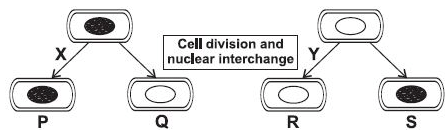
Q50: Ravi performed an experiment in which he took two microorganisms X and Y that reproduce by binary fission. Just after cell division, he interchanged the nuclei of the two daughter organisms as shown in the figure given below:
Which of the following is the most likely result of his experiment? (a) Organisms P and S will show similar characteristics. (b) Organism Q will show characteristics of parent organism X. (c) Organism R will show characteristics of parent organism X. (d) Organisms P and Q will show similar characteristics.
Solution:
Ans: (a)
Since P and S have similar genetic material, they will show similar characteristics.
practice quizzes, Extra Questions, study material, Free, shortcuts and tricks, Previous Year Questions with Solutions, Summary, Objective type Questions, Science Olympiad Model Test Paper - 2, pdf , Exam, Science Olympiad Model Test Paper - 2, MCQs, mock tests for examination, Semester Notes, Sample Paper, Important questions, Science Olympiad Model Test Paper - 2, Viva Questions, video lectures, past year papers, ppt;

 Observe the following table and select the correct option to represent P, Q, R, S, T and U.