Note: The questions provided in this document are similar to the questions that were asked in the actual Olympiad exam. So, we recommend you study these for your Olympiad preparation.
Logical Reasoning Section
Q1: A truck transports goods from city M, moving 28 km North. It then makes a right turn and travels 36 km, followed by another right turn to cover 10 km. After that, it turns right again and goes 6 km. Finally, it turns left and travels 8 km to arrive at city N. What is the distance and direction of the truck from city M? (a) 3√10 km, South-West (b) 10√10 km, North-East (c) 10√10 km, East (d) 3√10 km, South-East
Solution:
Ans: (b)
The truck starts at city M and moves 28 km North.
After turning right, it travels 36 km East.
Another right turn takes it 10 km South.
Then, it turns right again and goes 6 km West.
Finally, it turns left and travels 8 km South to reach city N.
Calculating the final position, the truck is 10√10 km away from city M in the North-East direction.
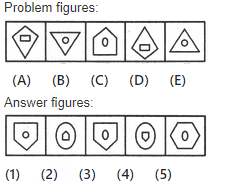
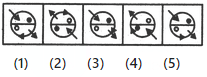
Q2: Select a figure from amongst the Answer Figures which will continue the same series as established by the five Problem Figures.
(a) 3 (b) 2 (c) 1 (d) 4
Solution:
Ans: (a) Similar figure repeats in every third step and each time a figure reappears it gets vertically inverted.
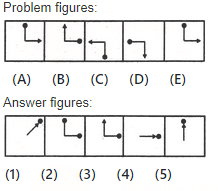
Q3: Select a figure from amongst the Answer Figures which will continue the same series as established by the five Problem Figures.
(a) 4 (b) 2 (c) 3 (d) 5
Solution:
Ans: (c) In each step, the pin rotates 90o clockwise and the arrow rotates 90o anti-clockwise.
Q4: How many pairs of letters can be found in the word GUIDELINES that have the same number of letters between them as they do in the English alphabet? (a) Three (b) Four (c) Five (d) More than five
Solution:
Ans: (d)
To find the pairs, we need to look at the letters in GUIDELINES and see if the distance between them matches their distance in the English alphabet.
For example, the letters G and I have 2 letters between them in the word and also in the alphabet (G, H, I).
After checking all possible pairs, we find that there are indeed more than five such pairs.
Thus, the correct answer is "More than five".
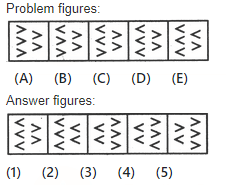
Q5: Select a figure from amongst the Answer Figures which will continue the same series as established by the five Problem Figures. (a) 3 (b) 1 (c) 4 (d) 2
Solution:
Ans: (d) In each step, one of the elements gets laterally inverted.
Q6: Seven friends P, Q, R, S, T, U, and V are positioned facing East, but not in the same arrangement. P is located second to the left of V. S and T occupy the extreme ends, and V is positioned fourth to the right of S. P is situated between Q and R. R is a direct neighbor of V, and U is a direct neighbor of T. What is U's position in relation to P? (a) Third to the left (b) Second to the right (c) Third to the right (d) Second to the left
Solution:
Ans: (c)
To solve this, we first place S at one end and V fourth to the right of S, which gives us a clear layout.
P is then positioned second to the left of V, and since R is a neighbor of V, we can place R next to V.
With P between Q and R, we can determine U's position as a neighbor of T, who is at the other end.
After arranging everyone, we find that U is indeed third to the right of P.
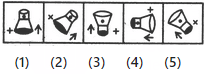
Q7: Choose the figure which is different from the rest.
(a) 5 (b) 1 (c) 2 (d) 4
Solution:
Ans: (d) In all other figures, the arrow and the V sign lie towards the black end of the main figure.
Q8: Introducing Rekha, Neha mentioned, "I am the mother of the son-in-law of her mother." If Rekha is the only married child of her parents, then what is the relationship between Neha's daughter and Rekha? (a) Sister (b) Mother-in-law (c) Sister-in-law (d) Can't be determined
Solution:
Ans: (c)
Neha is the mother of Rekha's husband (the son-in-law of Rekha's mother).
Since Rekha is the only married child, her husband is Neha's son.
This means Neha's daughter is Rekha's sister-in-law.
Thus, the correct relationship is that Neha's daughter is Rekha's sister-in-law.
Q9: Choose the figure which is different from the rest.
(a) 5 (b) 1 (c) 2 (d) 4
Solution:
Ans: (a) Only in fig. (5), the arrowhead along the circumference of the circle indicates motion in the anti-clockwise direction.
Q10: In a specific coding system, the phrase 'flying very high' translates to 'tec pec bec', 'high and low' translates to 'sec din tec', and 'birds flying low' translates to 'pec bin sec'. What is the code for the word 'birds'? (a) pec (b) din (c) bec (d) bin
Solution:
Ans: (d)
To find the code for 'birds', we analyze the given phrases and their codes.
The phrase 'birds flying low' includes the code 'pec bin sec'.
From the phrase 'flying very high', we see that 'flying' corresponds to 'pec'.
Since 'flying' is already identified, the remaining codes in 'birds flying low' must correspond to 'birds' and 'low'.
By elimination, 'bin' must be the code for 'birds'.
Science Section
Q11: Read the given statements and select the correct option. Statement 1: When three identical bulbs of 80 W, 220 V rating are connected in series to a 220 V supply, the power drawn by them will be 240 W. Statement 2: In series combination, the total power loss is always equal to the sum of the power ratings of individual electric appliances. (a) Both statements 1 and 2 are true and statement 2 is the correct explanation of statement 1. (b) Both statements 1 and 2 are true but statement 2 is not the correct explanation of statement 1. (c) Statement 1 is true but statement 2 is false. (d) Both statements 1 and 2 are false.
Solution:
Ans: (d)
Statement 1 is incorrect because when bulbs are connected in series, the voltage is divided among them, and they do not draw the total power as stated.
Statement 2 is also incorrect because in a series circuit, the total power is not simply the sum of the individual power ratings; it depends on the voltage across each bulb.
Thus, both statements are false, making option (d) the correct choice.
Q12: Oxygen is prepared by catalytic decomposition of potassium chlorate (KClO3). Decomposition of potassium chlorate gives potassium chloride (KCl) and oxygen (O2). The following reaction takes place: 2KClO3(s) → 2KCl(s) + 3O2(g) How many grams of KClO3 are required to produce 192 grams of O2? (a) 490 g (b) 320 g (c) 249 g (d)467 g
Solution:
Ans: (a) 2KClO3 → 2KCl + 3O2 3 moles of O2 = 3 x 32 = 96 g 2 moles of KClO3 = 2 (39 +35.5 + 48) = 245 g 96 g of O2 is produced by 245 g KClO3. 192 g of O2 is produced by (245/96) x 192 = 490 g
Q13: Salt A is commonly used as a bakery product. On heating, it gets converted into another salt B, which itself is used for removal of hardness of water and a gas C is evolved. This gas turns lime water milky when passed through it. Identify A, B and C: (a) A - NaHCO3, B - Na2CO3, C - CO2 (b) A - NaCO3, B - Na2CO3, C - O2 (c) A - Na2CO3, B - NaHCO3, C - CO2 (d) A - CaCO3, B - NaHCO3, C - O2
Solution:
Ans: (a) A is baking soda (NaHCO3). On heating, NaHCO3 forms Na2CO3 (B) and CO2 gas (C).
Q14: Peter passed sulphur dioxide through (i) water and (ii) lime water. Which of the following will be his observation? (a) (i) - Sulphurous acid is formed, (ii) - Sulphurous acid is formed (b) (i) - Sulphuric acid is formed, (ii) - Sulphurous acid is formed (c) (i) - Calcium sulphite, (ii) - Sulphuric acid is formed (d) (i) - Sulphurous acid is formed, (ii) - Calcium sulphite
Solution:
Ans:(d) When sulphur dioxide is passed through water, sulphurous acid is formed. When sulphur dioxide is passed through lime water, calcium sulphite (white ppt.) is formed.
Q15: Consider the following statements and choose the correct option: Statement 1: When Ca(OH)2 reacts with CO2, it will give CaCO3 and H2O. Statement 2: The nature of CaCO3 is neutral. (a) Statement 1 is correct but statement 2 is incorrect. (b) Statement 1 is incorrect but statement 2 is correct. (c) Both the statements are correct. (d) Both the statements are incorrect.
Solution:
Ans: (a) CaCO3 is basic in nature, as it is a salt is strong base Ca(OH)2 and a weak acid H2CO3.
Q16: Which of the following statements are accurate? (i) We use red light in traffic signals to stop the vehicles because red color is the most scattered color. (ii) The angle of deviation for a prism of refractive index 3/2 and angle 60°, is 45°. (iii) The blue color of the sky is explained by the scattering of light. (iv) An observer can see a rainbow when the Sun is behind the observer. (a) (iii) and (iv) only (b) (i), (ii), and (iii) only (c) (ii), (iii), and (iv) only (d) (i), (ii), (iii), and (iv)
Solution:
Ans: (a)
The statement about using red light in traffic signals is incorrect because red is not the most scattered color; it is used because it is easily visible from a distance.
The angle of deviation for a prism with a refractive index of 3/2 and an angle of 60° is not 45°; this statement is also incorrect.
The blue color of the sky is indeed explained by the scattering of light, which is correct.
An observer can see a rainbow when the Sun is behind them, which is also correct.
Thus, the correct statements are (iii) and (iv) only.
Q17: Consider the following statements and choose the correct option: Statement 1: Au is less reactive than Mg. Statement 2: Carbon is a metalloid. (a) Statement 1 is correct but statement 2 is incorrect. (b) Statement 1 is incorrect but statement 2 is correct. (c) Both the statements are correct. (d) Both the statements are incorrect.
Solution:
Ans: (a) Carbon is a non-metal.
Q18: Which of the following statements is/are correct? I. Metal atoms tend to have a maximum of 2 electrons in the outermost energy level. II. Non-metallic elements tend to be very poor conductors of heat and electricity. III. Metals tend to lose electrons and act as reducing agents in their reactions with elements and compounds IV. Non-metallic elements tend to form basic oxides while metals tend to form acidic oxides. (a) Only II and III (b) Only III and IV (c) I, II and III (d) II, III and IV
Solution:
Ans:(a) Metal atoms tend to have a maximum of 8 electrons in the outermost energy level. Non-metallic elements tend to form acidic oxides while metals tend to form basic oxides.
Q19: What is the chemical name for Vitamin C? (a) Folic Acid (b) Biotin (c) Ascorbic Acid (d) Tocopherols
Solution:
Ans: (c) Vitamin C is also known as ascorbic acid or L-ascorbic acid. It is a vitamin found in fresh fruits and vegetables, particularly citrus fruits and also taken as a dietary supplement.
Q20: What is the scattering of light by the particles in a colloidal solution called? (a) Tyndall effect (b) Rayleigh scattering change (c) Pure spectrum (d) Angular dispersion
Solution:
Ans: (a) The scattering of light by the particles in a colloidal solution is called Tyndall effect. The phenomenon makes the path of the light through the medium visible. It is named after John Tyndall, the scientist who first observed it.
Q21: Which of the following can be defined as the feeding of complex organic matter by ingestion, which is subsequently digested and absorbed? (a) Holozoic nutrition (b) Parasitic nutrition (c) Chemosynthesis nutrition (d) Saprotrophic nutrition
Solution:
Ans: (a) Holozoic nutrition is a type of heterotrophic nutrition. The term is derived from two Greek words, 'bolos' meaning 'whole', and 'zoic' meaning 'animal'. Thus, it can be defined as the feeding of complex organic matter by ingestion, which is subsequently digested and absorbed. Amoeba, paramecium, frogs and human beings show this type of nutrition.
Q22: Phagocytosis is the ingestion of bacteria or other material by phagocytes and amoeboid protozoans. High abundance of which of the following organelles in their cytosol will help in the process (a) Golgi bodies (b) Endoplasmic reticulum (c) Mitochondria (d) Lysosome
Solution:
Ans: (c) The mitochondrion is responsible for the production of ATP. Hence, high number of mitochondria gives enough energy for the process.
Q23: Select the accurate statement. (a) Metals like Ca and Mg can be extracted from their compounds by heating with carbon. (b) Solder, a mixture of Cu and Sn, has a low melting point and is used for welding electrical wires together. (c) Copper interacts with humid nitrogen in the atmosphere and develops a green layer. (d) Hydrogen gas is not produced when a metal reacts with nitric acid.
Solution:
Ans: (d)
The statement is correct because when metals react with nitric acid, they typically do not release hydrogen gas. Instead, they form nitrogen oxides.
In contrast, metals like Ca and Mg can indeed be obtained from their compounds using carbon, which makes option (a) incorrect.
Option (b) is wrong because solder has a low melting point, not high, and is used for joining electrical components, not welding.
Option (c) is misleading as copper reacts with oxygen and moisture to form a green patina, not specifically with nitrogen.
Q24: Four substances were thoroughly mixed with water separately to obtain mixtures P, Q, R, and S. Some of their properties are given below: (i) The solute particles are visible to the naked eye in R but invisible in P, Q, and S. (ii) On leaving undisturbed, the particles of the substances settle down in R but not in P, Q, and S. (iii) The path of a beam of light passing through the mixtures is visible in Q, R, and S but invisible in P. From the above properties, it can be concluded that: (a) P and Q are colloids, S is a true solution (b) R is a suspension and P, S are true solutions (c) P is a true solution and Q, S are colloids (d) Q is a colloid and R, S are true solutions
Solution:
Ans: (c)
P is a true solution because its particles are not visible and do not settle.
Q and S are colloids since their particles are small enough to remain suspended and scatter light.
R is a suspension as its particles are large, visible, and settle when undisturbed.
The visibility of light in Q, R, and S indicates they contain larger particles compared to P.
Q25: Read the given statements and select the correct option. Statement 1: Both methanol and ethanol react with sodium metal to evolve CO2 gas. Statement 2: Methanol and ethanol do not have the same functional group. (a) Both statements 1 and 2 are true and statement 2 is the correct explanation of statement 1. (b) Both statements 1 and 2 are true but statement 2 is not the correct explanation of statement 1. (c) Statement 1 is true but statement 2 is false. (d) Both statements 1 and 2 are false.
Solution:
Ans: (d)
Statement 1 is false because methanol and ethanol do not produce CO2 gas when they react with sodium metal; they produce hydrogen gas instead.
Statement 2 is also false because methanol and ethanol both contain the same functional group, which is the hydroxyl group (-OH).
Since both statements are incorrect, the correct option is (d).
Q26: The hormone that promotes secondary sexual characters in human male is: (a) Oestrogen (b) Progesterone (c) Luteinising hormone (d) Testosterone
Solution:
Ans: (d) Testosterone is the primary male sex hormone and an anabolic steroid. In men, testosterone plays a key role in the development of male reproductive tissues such as the testis and prostate, as well as promoting secondary sexual characteristics such as increased muscle and bone mass, and the growth of body hair.
Q27: Germ cells consist of only a single set of genes. These are produced by the process of (a) meiosis (b) mitosis (c) binary fission (d) parthenogenesis
Solution:
Ans: (a) Each cell consists of two copies of chromosomes, one each from male and female parents. Meiosis produces germ cells which take one chromosome from each pair. Thus, germ cells consist of only a single set of genes.
Q28: The genetic material of endangered species can be preserved by (a) gene pool (b) gene library (c) gene bank (d) gene laboratory
Solution:
Ans: (c) Gene banks are a type of biorepository which preserve genetic material. For plants, this could be by freezing cuttings from the plant, or stocking the seeds (e.g. in a seedbank). For animals, this is the freezing of sperm and eggs in zoological freezers until further need. This is the best way to preserve the gene pool of endangered species so that it could be used in future.
Q29: What is the ratio of the coefficients of the substance that is reduced to the substance that is oxidized in the balanced reaction: MnO2 + Al → Mn + Al2O3? (a) 3 : 4 (b) 4 : 2 (c) 3 : 2 (d) 2 : 3
Solution:
Ans: (a)
The reaction involves MnO₂ being reduced to Mn and Al being oxidized to form Al₂O₃.
When the reaction is balanced, the coefficients show that for every 3 moles of MnO₂ reduced, 4 moles of Al are oxidized.
Thus, the ratio of the coefficients of the reduced substance (MnO₂) to the oxidized substance (Al) is 3:4.
This means for every 3 parts of the substance that gets reduced, there are 4 parts of the substance that gets oxidized.
Q30: The boiling points of four liquids P, Q, R, and S are 373 K, 129 K, 351.3 K, and 337.7 K respectively. Identify the incorrect statement(s): (i) The increasing order of their interparticle forces of attraction is Q < S < R < P. (ii) Among the four liquids, Q is the most volatile and P is the least volatile liquid. (iii) At 25°C, the liquid S will be in the gaseous state while liquid Q remains in liquid state. (a) II and III only (b) I and II only (c) III only (d) None of these
Solution:
Ans: (c)
The boiling points indicate that Q has the lowest boiling point at 129 K, making it the most volatile liquid.
Liquid S has a boiling point of 337.7 K, which means at 25°C (298 K), it will be in the liquid state, not gaseous.
Thus, statement (iii) is incorrect because it claims that S will be gaseous at 25°C.
Statements (i) and (ii) are correct as they accurately describe the order of interparticle forces and volatility.
Q31: What is a biodiversity hotspot? (a) Region having volcano eruptions (b) Region where rocks melt to generate magma (c) Biogeographic region with a significant reservoir of biodiversity that is under threat from humans (d) Biogeographic region with a significant reservoir of biodiversity that has extreme weather condition
Solution:
Ans: (c) A biodiversity hotspot is a biogeographic region with a significant reservoir of biodiversity that is under threat from humans. A hotspot is an area which faces serious threat from human activities and supports a unique biodiversity (endemic, threatened, rare species) with representatives of evolutionary of speciation and extinction.
Q32: An object is moving towards the plane mirror with speed 'v'. Then, the speed of the image as observed by an object is (a) 2v (b) v (c) 4v (d) Cannot be determined
Solution:
Ans: (a) In case of the plane mirror, the object distance from the plane mirror is always equal to the image distance from the mirror. So, the distance covered by the both object and image in a given time interval is same and they will approach each other with the same speed. Hence, the speed of the image as observed by the object is vio = v + v = 2v
Q33: Which of the following materials can be used to increase the intensity of the magnetic field in an electromagnet? (a) Aluminium (b) Soft iron core (c) Wood (d) Plastic
Solution:
Ans: (b) A soft iron core can be used to increase the intensity of the magnetic field in an electromagnet because soft iron core is a magnetic material. When the magnetic field lines of the electromagnet pass through the iron core, it gets magnetised. Hence, the total magnetic field in the electromagnet is the sum of the magnetic field due to the iron core and the magnetic field also due to the electric current in the coil.
Q34: 15.3 g of potassium chlorate was heated in a dry test tube until no further mass loss occurred. The remaining residue weighs 9.3 g. (Given: atomic mass of K = 39 u, Cl = 35.5 u, O = 16 u) Which of the following statements is correct? (a) The molecular mass of the chemical compound present in the residue is 64.5 u and the loss of mass is due to oxygen. (b) The weight of gas produced is 3.0 g and the given observation proves the law of constant composition. (c) The molecular mass of the chemical compound present in the residue is 74.5 u and the weight of gas produced is 2.5 g. (d) The loss of mass is due to the evolution of 6 g of oxygen, and the given observation proves the law of conservation of mass.
Solution:
Ans: (d)
The initial mass of potassium chlorate is 15.3 g.
The residue after heating weighs 9.3 g.
The mass lost during the reaction is 15.3 g - 9.3 g = 6 g.
This loss is attributed to the release of oxygen gas, confirming the law of conservation of mass, which states that mass cannot be created or destroyed in a chemical reaction.
Q35: Which of the following is not a limitation of Mendeleev's periodic table? (a) Position of the noble gases (b) osition of isotopes (c) Position of hydrogen (d) Anomalous pairs
Solution:
Ans: (a) The limitations of Mendeleev's periodic table are as follows: 1. Anomalous pairs, e.g. Co is placed before Ni even though Ni has a lower atomic mass. 2. Position of hydrogen is controversial as it resembles both alkali metals as well as halogens in many characteristics. 3. Position of isotopes is controversial as they were given the same slot, even though they have different atomic masses. However, the noble gases could be accommodated in Mendeleev's table when they were discovered without disturbing the existing order.
Q36: Which of the following elements belongs to the group IA in the modern periodic table? (a) Be (b) Rb (c) He (d) B
Solution:
Ans: (b) Rb (Rubidium) is an alkali metal and it belongs to the group IA of the modern periodic table.
Q37: Read the following statements and choose the accurate option: Statement 1: Oral contraceptives are medications that contain hormones. Statement 2: Oral contraceptives are available in tablet form. (a) Both statements 1 and 2 are true and statement 2 is the correct explanation of statement 1. (b) Both statements 1 and 2 are true but statement 2 is not the correct explanation of statement 1. (c) Statement 1 is true but statement 2 is false. (d) Both statements 1 and 2 are false.
Solution:
Ans: (b)
Both statements are accurate: Oral contraceptives indeed contain hormones and are typically taken in tablet form.
Statement 2 does not explain statement 1: While both statements are true, the fact that they are tablets does not explain why they are hormone-containing medications.
Understanding the terms: It's important to recognize that the form (tablet) does not define the function (hormonal medication).
Conclusion: Therefore, the correct choice is that both statements are true, but one does not explain the other.
Q38: The transmission of a nerve impulse across a synapse occurs by (a) covalent bond formation between two dendrites (b) diffusion of neurotransmitter across the cleft (c) physical contact of axon to dendrite (d) movement of potassium ions across the cleft
Solution:
Ans: (b) Synaptic transmission relies on the availability of the neurotransmitter; the release of the neurotransmitter by exocytosis; the binding of the postsynaptic receptor by the neurotransmitter; the functional response of the postsynaptic cell; and the subsequent removal or deactivation of the neurotransmitter.
Q39: A pea plant that is heterozygous for yellow seeds and green pods was crossed with a pea plant having green seeds and yellow pods. What will be the phenotypic ratio of new combinations in the F2 generation? (a) 9 : 1 (b) 3 : 1 (c) 3 : 3 (d) 9 : 3
Solution:
Ans: (c)
The cross involves a heterozygous plant for yellow seeds (Yy) and green pods (Gg) with a plant that has green seeds (yy) and yellow pods (gg).
The resulting F1 generation will show a mix of traits, and when these plants are crossed, the F2 generation will exhibit a phenotypic ratio of 3:3.
This means there will be three plants with one combination of traits and three with another, leading to a total of six distinct phenotypes.
Thus, the correct answer is 3:3, indicating an equal distribution of the two phenotypic combinations.
Q40: In some organisms, the unfertilised egg can develop into a new individual. What is this development without fertilisation called? (a) Totipotency (b) Emasculation (c) Parthenogenesis (d) Hybridisation
Solution:
Ans: (c) In some organisms, the unfertilised egg can develop into a new individual. This type of development without fertilisation is called parthenogenesis. Examples: Rotifers, drones of honeybees, etc.
Q41: In some animals, extreme environmental conditions determine the sex of the child. In turtles, males are predominant below (a) 35oC (b) 27oC (c) 25oC (d) 39oC
Ans: (c) In turtles, males are predominant below 25oC and females above 30oC.
Q42: In a composite fish culture system, which fish primarily inhabits the surface zone and feeds on zooplankton? (a) Catla (b) Rohu (c) Mrigal (d) Goldfish
Solution:
Ans: (a)
Catla is known for its behavior of living near the surface of the water.
This fish primarily feeds on zooplankton, which are tiny organisms found in water.
In a composite fish culture, different species are raised together, and Catla plays a crucial role in utilizing surface food resources.
Other options like Rohu and Mrigal are more bottom feeders, making them less likely to be the correct answer.
Q43: Which property makes CO2 an effective heat-trapping greenhouse gas? (a) Ability to absorb and re-emit infrared radiation (b) Ability to emit ultraviolet radiation (c) Ability to absorb cosmic rays (d) Ability to release gamma rays and heat
Solution:
Ans: (a) The ability to absorb and re-emit infrared energy makes CO2 an effective heat-trapping greenhouse gas.
Q44: What is the full form of OTEC with context to energy?
(a) Ocean Thermal Energy Conversion (b) Ocean Thermal Energy Consumption (c) Over Thermal Energy Consumption (d) Ocean Temperature Energy Conversion
Solution:
Ans: (a) OTEC stands for Ocean Thermal Energy Conversion. The difference in temperature between warm surface waters heated by the sun and colder waters found at ocean depths is another form in which solar energy becomes available from the oceans. This is called ocean thermal energy.
Q45: Refer to the provided list of nutrients essential for plants. (i) Iron (ii) Magnesium (iii) Copper (iv) Nitrogen (v) Sulfur How many of these nutrients are classified as macronutrients? (a) 3 (b) 2 (c) 4 (d) 5
Solution:
Ans: (a)
The nutrients listed include Iron, Magnesium, Copper, Nitrogen, and Sulfur.
Among these, Nitrogen, Magnesium, and Sulfur are considered macronutrients because plants need them in larger amounts.
Iron and Copper are classified as micronutrients, which are needed in smaller quantities.
Thus, the total number of macronutrients from the list is 3.
Achiever's Section
Q46: Solid calcium oxide reacts vigorously with water to form calcium hydroxide with the liberation of heat. This process is known as slaking of lime. Again, calcium hydroxide dissolved in water to form its solution is called lime water. Which among the following statements are true about slaking of lime and the solution formed? (I) It is an exothermic reaction. (II) It is an endothermic reaction. (III) The pH of resulting solution is greater than 7. (IV) The pH of resulting solution is less than 7. (a) (I) and (III) (b) (II) and (III) (c) (I) and (IV) (d) (II) and (IV)
Solution:
Ans: (a) The reaction is exothermic and the solution is basic and will turn red litmus blue. Hence, the pH of lime water is more than 7.
Q47: The following are given some statements. Select the option which shows the correct statement(s) regarding metals and non-metals. Statements: I. Metals have 1 to 3 electrons in the valence shell and non-metals have 4-8 electrons in their valence shell. II. Metallic oxides give acids on reaction with water and non-metallic oxides give bases on reaction with water. III. Among the metals, the less electropositive metals displace the more electropositive metals from their salts. IV. Non-metals lose electrons from their valence shell to attain a stable configuration and form cations. V. Metals like Au and Pt also form oxides. (a) Only I (b) Both I and II (c) I, II and III (d) I, III and V
Solution:
Ans: (a) The correct statements are as follow: 1. Metals have 1 to 3 electrons in the valence shell and non-metals have 4-8 electrons in their valence shell. 2. Metallic oxides give bases on reaction with water and non-metallic oxides give acids on reaction with water. 3. Among the metals, the more electropositive metals displace the less electropositive metals from their salts. 4. Non-metals accept electrons to attain a stable configuration and form anions. 5. Metals like Au and Pt are less reactive and do not form oxides.
Direction (Question No. 48 and 49): An organic compound 'X' having the molecular formula, C2H4O2 has a melting point of 290 K in its purest form and it often freezes during winter in cold climates. Q48: Compound (X) contains: (a) Two C-H single bonds and one O-H single bond (b) Two C-O single bonds and one C=O double bond (c) One C=O double bond and three C-H single bonds (d) One C-C single bond and two C-O single bonds
Solution:
Ans: (c)
Compound X has the formula C₂H₄O₂, which indicates it is likely an acid or an alcohol.
Its melting point of 290 K suggests it is a liquid at room temperature but can freeze in cold conditions.
The correct structure includes one C=O double bond and three C-H single bonds, typical for compounds like acetic acid.
Other options do not accurately represent the bonding structure of this compound.
Q49: Compound (X): Which of the following statements is true? (a) Turns red litmus blue (b) Reacts with ethanol to give a sweet-smelling compound (c) Reacts with metallic sodium to produce a gas which turns limewater milky (d) Reacts with sodium carbonate to produce a salt and a gas which is a supporter of combustion
Solution:
Ans: (b)
The correct answer is that Compound (X) reacts with ethanol to produce a sweet-smelling compound. This indicates that it likely has an alcoholic functional group.
Option (a) suggests it is a base, but that does not confirm the sweet-smelling reaction.
Option (c) describes a reaction with sodium, which is not relevant to the sweet-smelling property.
Option (d) mentions a reaction with sodium carbonate, which does not lead to the sweet-smelling compound either.
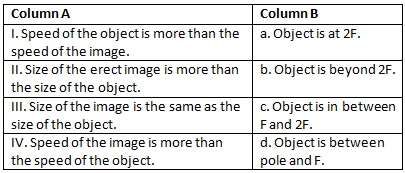
Q50: An object is approaching the concave mirror having focal length F. An object is approaching the mirror very far away from the centre of curvature. Based on above information, match the entities of Column A with the entities of Column B.
When the object is at infinity, the image is formed at F as the object approaches the mirror. When it is at 2F, its image is formed at 2F. In this case, the distance travelled by the image is just F (2F - F) as the object moves from infinity to 2F. Hence, the distance travelled by the object is more as compared to its image, so the speed of the object is more than the speed of its image.
When the object is at centre of curvature, its real and inverted image of the size as that of the object is formed at the centre of curvature.
When the object is in between pole and F, virtual and enlarged image is formed.
When the object is at centre of curvature, its real and inverted image of the size as that of the object is formed at the centre of curvature and when the object is at F, its image is formed at infinity. As the object moves form 2F to F, its image moves from 2F to infinity. Hence, the distance travelled by the object is less as compared to its image, so the speed of the object is less than the speed of its image.
1. What subjects are covered in the Class 10 Science Olympiad?
Ans.The Class 10 Science Olympiad typically covers various subjects within the science curriculum, including Physics, Chemistry, and Biology. It emphasizes concepts from these fields, encouraging students to apply their knowledge and problem-solving skills to different scientific scenarios.
2. How can I prepare effectively for the Science Olympiad?
Ans.Effective preparation for the Science Olympiad involves a combination of studying the syllabus thoroughly, practicing previous years' question papers, and taking mock tests. Students should also focus on understanding fundamental concepts and engaging in group discussions to clarify doubts and enhance learning.
3. What is the format of the Science Olympiad exam?
Ans.The Science Olympiad exam generally consists of multiple-choice questions (MCQs) that assess students' understanding of scientific concepts. The exam may include questions that require critical thinking and application of knowledge, and it is usually conducted in a timed setting to evaluate students' performance under pressure.
4. Are there any specific books recommended for Science Olympiad preparation?
Ans.Yes, several books are recommended for Science Olympiad preparation. Commonly suggested titles include NCERT textbooks for Class 10, Olympiad preparatory books published by various educational publishers, and reference books that cover the syllabus comprehensively. It’s beneficial to choose books that offer practice questions and detailed explanations.
5. What are the benefits of participating in the Science Olympiad?
Ans.Participating in the Science Olympiad offers numerous benefits, including enhancing students' scientific knowledge and reasoning abilities. It also builds competitive spirit, improves problem-solving skills, and can provide recognition that may be advantageous for future academic opportunities. Additionally, it fosters a deeper interest in science among students.
shortcuts and tricks, Extra Questions, Summary, study material, mock tests for examination, Science Olympiad Previous Year Paper - 1, practice quizzes, Important questions, Sample Paper, past year papers, Science Olympiad Previous Year Paper - 1, Semester Notes, Objective type Questions, pdf , Viva Questions, Science Olympiad Previous Year Paper - 1, ppt, video lectures, Free, MCQs, Exam, Previous Year Questions with Solutions;