Note: The questions provided in this document are similar to the questions that were asked in the actual Olympiad exam. So, we recommend you study these for your Olympiad preparation.
Logical Reasoning Section
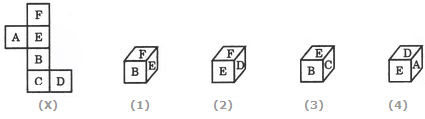
Q1: Choose the box that is similar to the box formed from the given sheet of paper (X). (a) 1, 2, 3 and 4 only (b) 2 only (c) 1 only (d) 1 and 3 only
Solution:
Ans: (b) The fig. (X) is similar to Form III. So, when the sheet in fig. (X) is folded to form a cube, then 'F' appears opposite 'B', 'E' appears opposite 'C' and 'A' appears opposite 'D' Therefore, the cube in fig. (1) which shows 'F' adjacent to 'B' the cube in fig. (3) which shows 'E' adjacent to 'C' and the cube in fig. (4) which shows 'A' adjacent to 'D' cannot be formed. Hence, only the cube in fig.(2) can be formed.
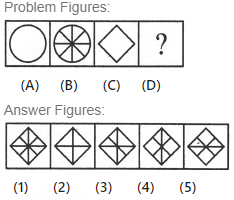
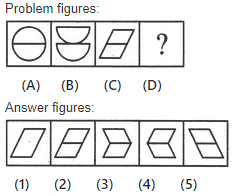
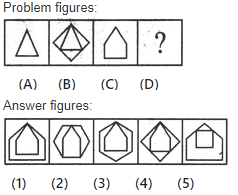
Q2: Select a suitable figure from the answer figures that would replace the question mark (?).
(a) 1 (b) 3 (c) 2 (d) 4
Solution:
Ans: (a) The figure gets divided into eight equal parts.
Q3: In a specific coding system, if CARING is represented as EDVGKC, what will be the code for BASKET in that same system? (a) DDWMHX (b) ABTLFU (c) DDWIBP (d) ABTLBP
Solution:
Ans: (c)
The coding system involves shifting each letter in the word by a certain number of positions in the alphabet.
For example, in CARING to EDVGKC, each letter is shifted forward by a specific pattern.
Applying the same pattern to BASKET, we find that it translates to DDWIBP.
This means that the letters in BASKET are also shifted in a similar manner as in CARING.
Q4: Select a suitable figure from the Answer Figures that would replace the question mark (?). (a) 2 (b) 3 (c) 4 (d) 1
Solution:
Ans: (b) The symbols move in the sequence. Also, the arrow rotates 135o anti-clockwise; the trapezium gets vertically inverted and the pin-shaped symbol rotates 90o clockwise.
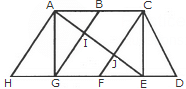
Q5: Find the number of triangles in the given figure. (a) 10 (b) 8 (c) 14 (d) 12
Solution:
Ans: (c) The figure may be labelled as shown. The simplest triangles are AHG, AIG, AIB, JFE, CJE and CED i.e. 6 in number. The triangles composed of two components each are ABG, CFE, ACJ and EGI i.e. 4 in number. The triangles composed of three components each are ACE, AGE and CFD i.e. 3 in number. There is only one triangle i.e. AHE composed of four components. Therefore, There are 6 + 4 + 3 + 1 = 14 triangles in the given figure.
Q6: Select a suitable figure from the Answer Figures that would replace the question mark (?). (a) 1 (b) 2 (c) 4 (d) 3
Solution:
Ans: (d) The upper part of the figure gets vertically inverted.
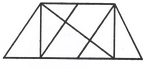
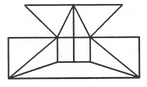
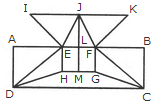
Q7: Find the minimum number of straight lines required to make the given figure. (a) 18 (b) 19 (c) 16 (d) 17
Solution:
Ans: (d) The figure may be labelled as shown.
The horizontal lines are IK, AB, HG and DC i.e. 4 in number. The vertical lines are AD, EH, JM, FG and BC i.e. 5 in number. The slanting lines are IE, JE, JF, KF, DE, DH, FC and GC i.e. 8 is number. Thus, there are 4 + 5 + 8 = 17 straight lines in the figure.
Q8: In the equation below, two operators must be swapped to make it accurate. Select the operators from the options provided. 8 × 7 - 15 ÷ 5 + 3 = 6 (a) - and × (b) + and - (c) × and + (d) ÷ and ×
Solution:
Ans: (c)
To solve the equation, we need to find the correct combination of operators that will make the equation true.
By swapping the operators × and +, the equation becomes: 8 + 7 - 15 ÷ 5 + 3.
Calculating this gives us: 15 - 3 + 3 = 6, which is correct.
Thus, the correct answer is to interchange × and +.
Q9: Select a suitable figure from the Answer Figures that would replace the question mark (?). (a) 1 (b) 2 (c) 3 (d) 4
Solution:
Ans: (c) The figure is enclosed in a new figure with one more number of sides, in such a way that the upper vertex of the two figures coincides.
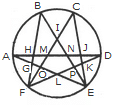
Q10: Find the number of triangles in the given figure. (a) 26 (b) 28 (c) 24 (d) 22
Solution:
Ans: (b) The figure may be labelled as shown. The simplest triangles are AGH, GFO, LFO, DJK, EKP, PEL and IMN i.e. 7 in number. The triangles having two components each are GFL, KEL, AMO, NDP, BHN, CMJ, NEJ and HFM i.e. 8 in number. The triangles having three components each are IOE, IFP, BIF and CEI i.e. 4 in number. The triangles having four components each are ANE and DMF i.e. 2 in number. The triangles having five components each are FCK, BGE and ADL i.e. 3 in number. The triangles having six components each are BPF, COE, DHF and AJE i.e. 4 in number. Total number of triangles in the figure = 7 + 8 + 4 + 2 + 3 + 4 = 28.
Science Section
Q11: Read the following statements and choose the correct option. Statement 1: The magnification of a convex mirror is always positive, while for a concave mirror, it can be either positive or negative. Statement 2: The sign of magnification for a mirror is determined by the chosen sign convention. (a) Both statements 1 and 2 are true and statement 2 is the correct explanation of statement 1. (b) Both statements 1 and 2 are true but statement 2 is not the correct explanation of statement 1. (c) Statement 1 is true but statement 2 is false. (d) Both statements 1 and 2 are false.
Solution:
Ans: (a)
Statement 1 is correct because a convex mirror always produces a virtual image that is upright, leading to a positive magnification. In contrast, a concave mirror can produce both real and virtual images, resulting in either positive or negative magnification.
Statement 2 is also correct as the sign of magnification indeed depends on the sign convention used in optics.
Since both statements are true and statement 2 explains statement 1, option (a) is the correct choice.
Q12: A satellite with a mass of 300 kg orbits the Earth at a radius of 3/2 RE, where RE represents the Earth's radius. Given that the gravitational force on a 1 kg mass at the Earth's surface is 10 N, what will be the gravitational pull on the satellite? (a) 1000 N (b) 1333 N (c) 1200 N (d) 8000 N
Solution:
Ans: (b)
The gravitational force experienced by an object in orbit depends on its distance from the center of the Earth.
Using the formula for gravitational force, we find that the force on the satellite is proportional to the mass and inversely proportional to the square of the distance from the Earth's center.
At a distance of 3/2 RE, the gravitational pull is reduced compared to the surface, specifically by a factor of (1/(3/2)^2), which equals 4/9.
Thus, the gravitational pull on the satellite is 300 kg * (10 N * 4/9) = 1333 N.
Q13: Which among the following is a character that cannot to transferred from the parent to the progeny? (a) Leukaemia (b) Attached earlobes (c) Amputation (d) Facial features
Solution:
Ans: (c) Amputation is a physical condition and it does not affect the DNA. Hence it can't be inherited by the progeny.
Q14: Which among the following is not a correct observation regarding a large gene pool? (a) Low genetic diversity (b) Genetic drift (c) High genetic diversity (d) The question does not have sufficient data
Solution:
Ans: (a) The pairs in the question are formed based on the artificial selection of cabbage that leads to the development of various vegetables. The plant and plant parts that humans consume are matched together. Kales -Flower is the wrong answer and we consume the leaves of Kales.
Q15: Identify the incorrect statement regarding sex chromosomes in humans and sex determination. (a) The Y chromosome is shorter than the X chromosome. (b) Males have two Y chromosomes. (c) All humans have at least one X chromosome. (d) All of the above
Solution:
Ans: (b) Males only have one Y chromosome. The other one is an X chromosome inherited from the mother.
Q16: Which among the following statement regarding the evolution of a new species is correct? (a) Geographic isolation leads to the formation of new species. (b) Island populations tend to evolve differently compared to the mainland. (c) Isolation of population is one of the many prerequisites for the evolution of population and emergence of a new species. (d) All of these are correct
Solution:
Ans: (d) Speciation occurs when a species is separated by various factors such as genetic features or geographical factors such as mountains, rivers, islands etc. Such factors contribute to the evolution of existing species to adapt to their present environment which may lead to the development of new species.
Q17: When a magnetic compass needle is brought close to a straight wire that is conducting current, then (i) The straight wire results in a significant deflection of the compass needle. (ii) The orientation of the needle is tangential to an imaginary circle with the straight wire at its center and lies in a plane parallel to the wire. (a) Only (i) is correct (b) Only (ii) is correct (c) Both (i) and (ii) are correct (d) Neither (i) nor (ii) is correct
Solution:
Ans: (a)
The straight wire carrying current generates a magnetic field. This magnetic field interacts with the compass needle, causing it to deflect.
The compass needle aligns itself with the magnetic field lines. This means that the needle will point in a direction that is tangential to an imaginary circle around the wire.
Thus, statement (i) is true because the wire does cause a noticeable deflection, and statement (ii) is also true as the needle's alignment is indeed tangential to the circle.
However, since the question asks for the correct options, only statement (i) is explicitly mentioned as correct in the answer choice.
Q18: In a monohybrid cross (flower colour: red and white), the F1 generation produced a phenotypic ratio of 1:1. If one parent was homozygous for the flower colour, then identify the genotype of the second parent. (a) RR (b) Rr (c) rr (d) None of these
Solution:
Ans: (b) The graphical representation depicts the phenomenon of natural selection. In the initial population, the blue dots were dominant but after many generations, they went extinct and red dots took over.
Q19: In the game of blindfold, a boy after walking every 10 steps in one direction each of length 80 cm, turns randomly to the left or right by 90°. After walking a total of 60 steps, what is the maximum displacement of the boy from his starting point? (a) Zero (b) 24√2 m (c) 16 m (d) 16√2 m
Solution:
Ans: (b)
The boy walks 80 cm for each step, and after 60 steps, he covers a total distance of 4800 cm or 48 m.
Since he turns 90° randomly, the maximum displacement occurs when he moves in a square pattern, effectively forming a diagonal.
The maximum displacement can be calculated using the formula for the diagonal of a square, which is side√2. Here, the side is 24 m (since he can effectively cover 24 steps in one direction).
Thus, the maximum displacement is 24√2 m from the starting point.
Q20: What is the most significant limitation of Dobereiner's classification of elements? (a) Element in the triads had different masses but similar properties. (b) All known elements could not be classified into groups of three, forming triads. (c) Known element were randomly grouped into the triads. (d) Dissimilar elements having similar atomic masses were placed together.
Solution:
Ans: (b) The main limitation of the Dobereiner's classification was that all the known elements could not be classified into triads on the basis of their properties. Only three triads were identified: 1. Triad of alkali metals 2. Triad of alkaline earth metals 3. Triad of halogens.
Q21: Read the following statements and choose the accurate option. Statement 1: The sound produced by a source travels uniformly in all directions. Statement 2: When sound waves move, both energy and matter are transferred from one location to another. (a) Both statements 1 and 2 are true and statement 2 is the correct explanation of statement 1. (b) Both statements 1 and 2 are true but statement 2 is not the correct explanation of statement 1. (c) Statement 1 is true but statement 2 is false. (d) Both statements 1 and 2 are false.
Solution:
Ans: (d)
Statement 1 is incorrect because sound does not travel uniformly in all directions; it can be affected by the environment.
Statement 2 is also incorrect as sound waves transfer energy, but they do not transfer matter.
Thus, both statements are false, making option (d) the correct choice.
Understanding sound propagation is essential; it involves energy transfer, not matter transfer.
Q22: How many moles of iron will react with excess of water to produce four moles of hydrogen gas? Fe + 4H2O → Fe3O4 + 4H2 (a) Fe3 + 4H2O → Fe3O4 + 4H2 (b) 3Fe3 + 4H2O → Fe3O4 + 4H2 (c) 3Fe + 4H2O → 3Fe3O4 + 4H2 (d) 3Fe + 4H2O → Fe3O4 + 4H2
Solution:
Ans: (d) A balanced equation should have equal number of atoms of each element on each side of the equation. All the elements besides Fe are already balanced. The balanced equation shows that 3 moles of Fe react with 4 moles of H2O to produce 1 mole of Fe3O4 and 4 moles of H2.
Q23: Gibberellins were discovered by a Japanese botanist while studying the "foolish seedling" disease in rice. They were first isolated from the fungus known as (a) Gibberella moniliformis (b) Gibberella fujikuroi (c) Gibberella acuminata (d) Gibberella africana
Solution:
Ans: (b) Gibberellins were discovered in 1926 by a Japanese scientist, Eiichi Kurosawa, studying bakanae, the "foolish seedling" disease in rice. It was first isolated in 1935 by Teijiro Yabuta and Sumuki, from fungal strain (Gibberella fujikuroi) provided by Kurosawa.
Q24: It is a biological fact that human stomach produces acid. Which of the following is not a role of hydrochloric acid produced by the stomach? (a) Sterilisation of the food (b) Prevention of harmful bacteria from entering the GI tract (c) Creation of optimal condition that promotes bacterial growth (d) Activation of pepsinogen to pepsin
Solution:
Ans: (c) The primary role of hydrochloric acid is to sterilise the food you eat and to prevent harmful bacteria from entering the GI tract. HCl also triggers the release of enzymes such as pepsin, which are essential for the digestion of protein.
Q25: Rutherford conducted experiments by bombarding a thin sheet of gold foil with α-particles. Which of the following observations is inaccurate? (a) Most of the fast-moving α-particles were deflected by the foil by small angles. (b) Nearly 99% of the α-particles passed straight through the gold foil without getting deflected from their original path. (c) One out of every 12000 particles appeared to rebound. (d) A few alpha particles were deflected by the foil by small angles.
Solution:
Ans: (a)
The key observation from Rutherford's experiment was that most α-particles went through the gold foil without any deflection.
Nearly 99% of the particles passed straight through, indicating that the atom is mostly empty space.
Only a small fraction of particles were deflected at larger angles, and very few (about one in 12000) actually rebounded.
Thus, the statement that most α-particles were deflected by small angles is incorrect.
Q26: Site of transfer of oxygen and other nutrients from the bloodstream to other tissues in the body is (a) capillaries (b) veins (c) arteries (d) bronchioles
Solution:
Ans: (a) Capillaries are the smallest of the body's blood vessels. They are only one cell thick, and they are the site of the transfer of oxygen and other nutrients from the bloodstream to other tissues in the body. They also collect carbon dioxide waste materials and fluids for return to the veins.
Q27: A 2 cm long pin is placed perpendicular to the principal axis of a convex lens of focal length 12 cm. The distance of the pin from the lens is 15 cm. Calculate the distance of the image from the lens: (a) 60 cm (b) 80 cm (c) 45 cm (d) 12 cm
Solution:
Ans: (a) u = -15 cm, f = +12 cm Using lens formula,
Q28: Select the incorrect pairing. (a) Cream from milk - Centrifugation (b) Different components of a food sample - Chromatography (c) Mixture of acetone and water - Separating funnel (d) Separation of crystals of alum from an impure sample - Crystallization
Solution:
Ans: (c)
The correct answer is (c) because a separating funnel is not typically used for a mixture of acetone and water. Instead, this mixture can be separated using distillation due to the different boiling points of the components.
On the other hand, centrifugation is correctly used to separate cream from milk, and chromatography is effective for separating different components of a food sample.
Crystallization is indeed the right method for separating crystals of alum from an impure sample, making the other options valid.
Q29: Consider the following statements and choose the correct option: Statement 1: Twinkling of stars is due to atmospheric refraction. Statement 2: Advanced sunrise and delayed sunset are due to scattering of light. (a) Statement 1 is correct but statement 2 is incorrect. (b) Statement 1 is incorrect but statement 2 is correct. (c) Both the statements are correct. (d) Both the statements are incorrect.
Solution:
Ans: (a) Advanced sunrise and delayed sunset are due to atmospheric refraction.
Q30: Read the given statements and select the correct option. Statement 1: Ethanol when heated with alkaline KMnO4 produces ethanoic acid. Statement 2: Alkaline potassium permanganate (KMnO4) is an oxidizing agent that adds oxygen to ethanol, thereby oxidizing it to ethanoic acid. (a) Both statement 1 and statement 2 are true and statement 2 is the correct explanation of statement 1. (b) Both statement 1 and statement 2 are true but statement 2 is not the correct explanation of statement 1. (c) Statement 1 is true but statement 2 is false. (d) Both statement 1 and statement 2 are false.
Solution:
Ans: (a)
Both statements are correct: Ethanol does indeed convert to ethanoic acid when heated with alkaline KMnO₄.
Oxidizing agent: Alkaline potassium permanganate acts as an oxidizing agent, which means it helps in adding oxygen to ethanol.
Correct explanation: Statement 2 accurately explains why statement 1 is true, as it describes the process of oxidation.
Conclusion: Therefore, both statements are true, and statement 2 correctly explains statement 1.
Q31: Which of the following statements are accurate? I. 48 g of He has a greater number of moles than 23 g of Na. II. 8 g of O2 consists of 2.5 × 10²³ O2 molecules. III. The mass of 4.8 moles of nitrogen atoms is 87.2 g. IV. 0.1 moles of carbon atoms contain 6.022 × 10²² carbon atoms. (a) I and III only (b) II and III only (c) I and IV only (d) II and IV only
Solution:
Ans: (c)
Statement I is true because the molar mass of He is 4 g/mol, so 48 g of He equals 12 moles, while 23 g of Na (molar mass 23 g/mol) equals 1 mole.
Statement II is incorrect; 8 g of O₂ equals 0.25 moles, which is not 2.5 × 10²³ molecules.
Statement III is correct; 4.8 moles of nitrogen (molar mass 14 g/mol) equals 67.2 g, not 87.2 g.
Statement IV is true; 0.1 moles of carbon equals 6.022 × 10²² atoms.
Q32: In a compound like ammonia, the mass ratio of nitrogen to hydrogen remains 14 : 3 regardless of the ammonia's source. What principle does this statement demonstrate? (a) Law of multiple proportions (b) Law of chemical combination (c) Law of constant proportions (d) Law of energy conservation
Solution:
Ans: (c)
This statement shows the Law of constant proportions, which states that a chemical compound always contains its component elements in fixed ratio by mass.
In ammonia, the mass ratio of nitrogen to hydrogen is consistently 14:3, no matter how the ammonia is produced.
This principle highlights that the composition of a pure substance is always the same, which is a key concept in chemistry.
Other laws mentioned do not apply here as they deal with different aspects of chemical reactions and compositions.
Q33: "These are very beneficial for an organism while reproducing. These are distributed easily by air to far-off places to avoid competition at one place. Large numbers are produced in a single sporangium and they are also covered with thick walls to avoid dehydration." From the passage of the arguments given above, find out the unit of reproduction being discussed. (a) Spore (b) Pollen (c) Reduction body (d) Gemmule
Solution:
Ans: (a) A spore is a unit of sexual or asexual reproduction that may be adapted for dispersal and for survival, often for extended periods of time, in unfavourable conditions. The description given is of fungal spores.
Q34: The mass number of an atom whose dipositive ion has 10 electrons and 12 neutrons is (a) 22 (b) 23 (c) 25 (d) 24
Solution:
Ans: (d)
The mass number of an atom is the total number of protons and neutrons in its nucleus.
A dipositive ion means the atom has lost two electrons, so it originally had 12 electrons (10 + 2).
If it has 10 electrons, it must have 12 protons (since the number of protons equals the number of electrons in a neutral atom).
Thus, the mass number is calculated as protons (12) + neutrons (12) = 24.
Q35: Which of the following traits was not identified as a dominant characteristic by Mendel? (a) Tall stem (b) Terminal position of flower on stem (c) Yellow color of the seed (d) Violet color of the flower
Solution:
Ans: (b)
Mendel's experiments focused on dominant traits in pea plants.
The terminal position of flowers on the stem was not a dominant trait he studied.
Traits like tall stem, yellow seeds, and violet flowers were identified as dominant.
Understanding these traits helped establish the foundation of genetics.
Q36: Which of the following statements is/are accurate? (i) A quick response to a stimulus is known as reflex action. (ii) Sensory neurons transmit signals from the spinal cord to muscles. (iii) Motor neurons send signals from receptors to the spinal cord. (a) (i) and (ii) only (b) (i) and (iii) only (c) (i) only (d) (i), (ii), and (iii)
Solution:
Ans: (c)
Reflex action is a quick, automatic response to a stimulus, which is correctly stated in (i).
However, (ii) is incorrect because sensory neurons actually carry signals from the body to the spinal cord, not the other way around.
(iii) is also incorrect as motor neurons carry signals from the spinal cord to the muscles, not from receptors to the spinal cord.
Thus, the only correct statement is (i), making (c) the right answer.
Q37: A highly polluted city will not show the growth of (a) lichens (b) angiosperms (c) algae (d) bryophytes
Solution:
Ans: (a) The hardy lichens are useful bio-indicators for air pollution, especially sulphur dioxide pollution, since they derive their water and essential nutrients mainly from the atmosphere rather than from the soil.
Q38: The structure that prevents the acidic contents of the stomach from moving upward into the esophagus is (a) anal sphincter (b) cardiac sphincter (c) precapillary sphincter (d) pyloric sphincter
Solution:
Ans: (b) The cardiac sphincter, at the upper portion (cardia) of the stomach, prevents the acidic contents of the stomach from moving upward into the esophagus.
Q39: The pathway which is common to both aerobic and anaerobic pathways of respiration is (a) glycolysis (b) Kreb's cycle (c) electron transport chain (d) oxidative phosphorylation
Solution:
Ans: (a) Glucose is broken down by the process of glycolysis. This is the common pathway for both aerobic and anaerobic conditions. Under aerobic conditions, pyruvate formed enters the Kreb's cycle. Under anaerobic conditions, pyruvate is converted into lactate in muscles.
Q40: Urea, the principal nitrogenous excretory compound in humans, is synthesised (a) in the liver but eliminated mostly through kidneys (b) in kidneys but eliminated mostly through liver (c) as well as eliminated by kidneys (d) in liver and also eliminated by the same through bile
Solution:
Ans: (a) Urea is the principal nitrogenous compound which is excreted by the humans. It is synthesised in the liver by urea cycle but excreted via kidneys.
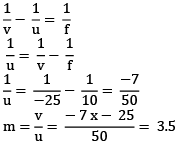
Q41: A lens of focal length 10 cm is being used by Harry in the laboratory as a magnifying glass. His least distance of distinct vision is 25 cm. What magnification is Harry getting? (a) 3 (b) 3.5 (c) 7 (d) 6
Solution:
Ans: (b) v = - 25 cm, f = 10 cm
Q42: Read the following statements and choose the accurate option. Statement 1: The primary substances that harm the ozone layer are chlorofluorocarbons. Statement 2: Chlorine and nitrous oxide also contribute to the damage of the ozone layer. (a) Statement 1 is false but statement 2 is true. (b) Both statements 1 and 2 are true. (c) Statement 1 is true but statement 2 is false. (d) Both statements 1 and 2 are false.
Solution:
Ans: (b)
Both statements are accurate. Chlorofluorocarbons (CFCs) are indeed the main chemicals that lead to the depletion of the ozone layer.
Additionally, chlorine and nitrous oxide also play a significant role in damaging the ozone layer.
This means that both statements correctly identify the harmful substances affecting the ozone layer.
Thus, the correct option is that both statements are true.
Q43: Which of the following is considered a deficiency disease in humans? (a) Filariasis (b) Pellagra (c) Conjunctivitis (d) Malaria
Solution:
Ans: (b)
Pellagra is a deficiency disease caused by a lack of niacin (vitamin B3) in the diet.
It leads to symptoms such as dermatitis, diarrhea, and dementia.
In contrast, Filariasis, Conjunctivitis, and Sleeping sickness are not caused by nutrient deficiencies.
Understanding these diseases helps in recognizing the importance of a balanced diet for health.
Q44: In a plant, smooth seeds (S) are dominant over wrinkled seeds (s) and green seeds (G) are dominant over yellow seeds (g). A plant homozygous for smooth and green seeds is crossed with a plant having wrinkled and yellow seeds. The F1 offsprings are self-crossed to produce F2 generation. If a total of 160 offsprings are produced, how many plants are expected to be having wrinkled and green seeds in F2 generation, according to a typical Mendelian cross? (a) 90 (b) 30 (c) 20 (d) 15
Solution:
Ans: (b)
The parent plants are smooth green (SSGG) and wrinkled yellow (ssgg).
The F1 generation will all be smooth green (SsGg) since smooth and green are dominant traits.
When F1 plants are self-crossed, the F2 generation will show a typical Mendelian ratio of 9:3:3:1 for the traits.
For wrinkled green seeds, the expected ratio is 3 out of 16 total combinations, which translates to (3/16) * 160 = 30 plants.
Q45: Select the incorrectly matched pair. (a) Montreal Protocol - 1987 (b) Ganga Action Plan - 1986 (c) Chipko Movement - 1973 (d) Kyoto Protocol - 1982
Solution:
Ans: (d)
The Kyoto Protocol was actually adopted in 1997, not 1982, making it the incorrect match.
The Montreal Protocol was established in 1987 to protect the ozone layer.
The Ganga Action Plan was initiated in 1986 to clean the Ganges River.
The Chipko Movement, which started in 1973, focused on environmental conservation and tree protection.
Achiever's Section
Direction (Q. No. 46 and 47): Read the given passage and answer the questions that follow.
Q46: A functional group can be defined as an atom or a group of atoms present in a molecule which largely decides its physical and chemical nature. Few organic compounds that consist of functional groups are listed below: (i) Ethanol (ii) Ethanoic acid (iii) Bromopropane (iv) Propanol (v) Propanal (vi) Propanone (vii) Butanone Which of the following statements regarding the given compounds is/are correct? I. Compounds (i) and (v) contain the same functional group. II. Compounds (vi) and (vii) represent the same homologous series. III. Compound (iii) consists of multiple (double/triple) bonds. IV. Compound (ii) reacts with ethanol in the presence of an acid catalyst to produce an ester. (a) I and IV only (b) II only (c) II and IV only (d) I and III only
Solution:
Ans: (c)
Statement I: Compounds (i) Ethanol and (v) Propanal have different functional groups; hence, this statement is incorrect.
Statement II: Compounds (vi) Propanone and (vii) Butanone are both ketones, making them part of the same homologous series, so this statement is correct.
Statement III: Compound (iii) Bromopropane does not have multiple bonds; it is a saturated compound, making this statement incorrect.
Statement IV: Ethanoic acid does react with ethanol to form an ester in the presence of an acid catalyst, confirming this statement is correct.
In summary, the correct statements are II and IV, which is why the answer is (c).
Q47: Identify the compound that interacts with hot concentrated sulfuric acid to yield ethene. (a) Propanal (b) Propanol (c) Ethanoic acid (d) Ethanol
Solution:
Ans: (d)
The compound that reacts with hot concentrated sulfuric acid to form ethene is ethanol.
When ethanol is heated with sulfuric acid, it undergoes dehydration, losing a water molecule to form ethene.
Other options like propanal, propanol, and ethanoic acid do not produce ethene under these conditions.
This reaction is a common method in organic chemistry to produce alkenes from alcohols.
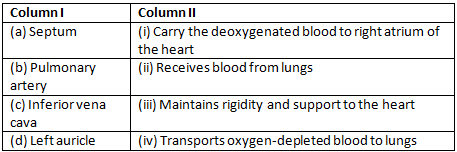
Q48: Match the below mentioned parts of human heart in column I with their appropriate functions in column II. (a) a - iii, b - iv, c - ii, d - i (b) a - iv, b - iii, c - i, d - ii (c) a - iii, b - iv, c - i, d - ii (d) a - iv, b - iii, c - ii, d - i
Solution:
Ans: (c) Septum is responsible for maintaining rigidity and support to the heart and it helps in proper functioning of the heart. Inferior vena cava carries de-oxygenated blood from the lower half of the body to the right atrium of the heart. Pulmonary artery is responsible for transporting oxygen-depleted blood away from the heart and towards the lungs. Left auricle receives blood from the lungs.
Q49: What kind of epithelium is found in our respiratory system? (a) Ciliated epithelium (b) Squamous epithelium (c) Cuboidal epithelium (d) Simple epithelium
Solution:
Ans: (a) Ciliated epithelial tissue is found in our respiratory tract and in the Fallopian tubes of women. Ciliated epithelium contains goblet cells, which secrete mucous. This mucous, combined with the cilia on the tissue, helps move harmful particles out of our bodies to keep us healthy.
Q50: Villi are adapted for the maximum absorption of digested food molecules. Which property makes them suitable for the same? (a) The folded villi greatly increase the surface area of the intestine. (b) The villi are made of a single layer of thin cells. (c) Beneath the villi is an extensive blood capillary network. (d) All of the above
Solution:
Ans: (d) Villi are adapted for the maximum absorption of digested food molecules. This is because the folded villi greatly increase the surface area of the intestine; the villi are made of a single layer of thin cells; beneath the villi is an extensive blood capillary network to distribute the absorbed food molecules.
1. What topics are covered in the Science Olympiad for Class 10?
Ans. The Science Olympiad for Class 10 typically covers a range of topics including Physics, Chemistry, Biology, and Environmental Science. Specific subjects may include concepts like force and motion, chemical reactions, human physiology, and ecological balance, among others.
2. How can I prepare effectively for the Science Olympiad?
Ans. To prepare effectively for the Science Olympiad, students should review their class textbooks, practice previous years' question papers, engage in mock tests, and utilize online resources for additional practice. Group study sessions can also help in understanding complex topics.
3. What is the format of the Science Olympiad exam?
Ans. The Science Olympiad exam usually consists of multiple-choice questions (MCQs), true or false questions, and sometimes short answer questions. The number of questions and the duration of the exam may vary depending on the organizing body.
4. Are there any specific strategies to tackle logical reasoning questions in the exam?
Ans. To tackle logical reasoning questions, students should practice identifying patterns, relationships, and logical sequences. Reading the questions carefully, eliminating clearly wrong answers, and managing time wisely during the exam can significantly improve performance.
5. What resources can I use to find sample questions for the Science Olympiad?
Ans. Students can find sample questions for the Science Olympiad through various resources, including official Olympiad websites, educational platforms, study guides, and books specifically designed for Olympiad preparation. Additionally, teachers and tutors can provide valuable resources for practice.
Science Olympiad Previous Year Paper - 3, Free, Summary, pdf , Important questions, Science Olympiad Previous Year Paper - 3, Exam, Objective type Questions, video lectures, shortcuts and tricks, past year papers, Extra Questions, ppt, Previous Year Questions with Solutions, MCQs, Viva Questions, Science Olympiad Previous Year Paper - 3, Semester Notes, practice quizzes, mock tests for examination, Sample Paper, study material;

 (a) 1, 2, 3 and 4 only
 (a) 1
(a) 1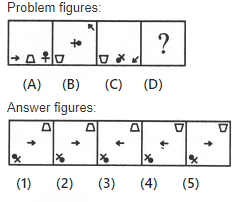


 (a) a - iii, b - iv, c - ii, d - i

