Note: The questions provided in this document are similar to the questions that were asked in the actual Olympiad exam. So, we recommend you study these for your Olympiad preparation
Logical Reasoning
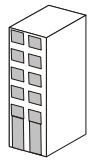
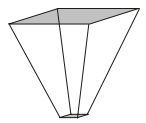
Q1: Which of the following is not a prism? (a)(b)(c)(d)
Solution:
Ans: (b) This is not a prism.
Q2: Aman starts driving a car towards East and covers 4 km. Then he turns left and covers 12 km, after that he takes a right turn and covers 10 km, then turns left and covers 8 km. At the end, he takes left turn again and covers 14 km. How much total distance is covered by Aman? (a) Kidney beans (b) 42 km (c) 20 km (d) 48 km
Solution:
Ans: (d)
Aman drives 4 km East.
He then turns left (North) and drives 12 km.
Next, he turns right (East) and drives 10 km.
After that, he turns left (North) and drives 8 km.
Finally, he turns left (West) and drives 14 km.
To find the total distance, we add all the distances: 4 + 12 + 10 + 8 + 14 = 48 km.
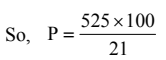
Q3: The CI on a certain sum for 2 years at 10% per annum is ₹525. The SI on the same sum for double the time at half the rate percent per annum is (a) ₹400 (b) ₹500 (c) ₹600 (d) ₹800
Solution:
Ans: (b)
Q4: In a certain code language, 'BREAK' is represented as 'FOIXO'. How will 'TRACK' be encoded in that language? (a) YNDYN (b) XOEZO (c) ZMFAP (d) ALDZO
Solution:
Ans: (b)
The code for 'BREAK' to 'FOIXO' involves a specific pattern of shifting letters. Each letter in 'BREAK' is shifted by a certain number of positions in the alphabet.
For example, 'B' becomes 'F', which is a shift of +4 positions, 'R' becomes 'O' with a shift of -3, and so on.
Applying the same pattern to 'TRACK', we find that it translates to 'XOEZO'.
This consistent shifting method is the key to decoding the words in this language.
Q5: Pointing to a lady in the photograph, Reemal said, "She is the mother of my only son's father". How is Reemal related to that lady? (a) Mother-in-law (b) Daughter-in-law (c) Mother (d) Daughter
Solution:
Ans: (a)
To understand the relationship, let's break it down: Reemal's "only son's father" is Reemal's husband.
Therefore, the lady in the photograph is the mother of Reemal's husband, making her Reemal's mother-in-law.
This means Reemal is related to the lady as her daughter-in-law.
Thus, the correct answer is (a) Mother-in-law.
Q6: If 'P' represents '×', 'Q' represents '÷', 'R' represents '+' and 'S' represents '-', what is the result of 12 P 256 Q 32 R 44 S 34? (a) 106 (b) 96 (c) 86 (d) 94
Solution:
Ans: (a)
First, replace the symbols with their respective operations: 12 × 256 ÷ 32 + 44 - 34.
Next, perform the calculations step by step: 12 × 256 = 3072.
Then, divide: 3072 ÷ 32 = 96.
Now, add: 96 + 44 = 140.
Finally, subtract: 140 - 34 = 106.
Thus, the final answer is 106.
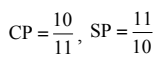
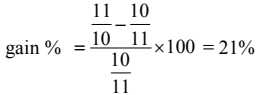
Q7: 11 oranges are bought for ₹10 and 10 oranges are sold for ₹11. Find the gain (or) loss percent. (a) 21% loss (b) 11% gain (c) 21% gain (d) 11% loss
Solution:
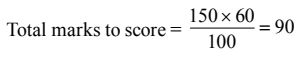
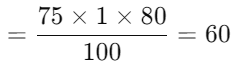
Ans: (d)Marks obtained in first 75 questions ∴ Marks to be obtained in next 75 questions = 90 - 60 = 30 ∴ % of questions to be answered correctly
Q8: A shopkeeper sold two watches for ₹425 each, gaining 10% on one and losing 10% on the other. Then he (a) neither gains nor loss (b) gains 1% (c) loses 1% (d) None of these
Solution:
Ans: Take Unit Price
∴ it is +ve. So the gain is 21%.
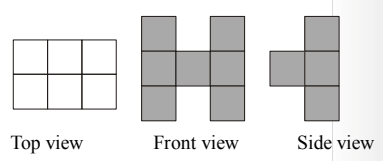
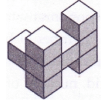
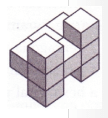
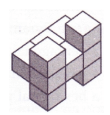
Q9: The adjacent figure shows 3 different views of a three-dimensional figure made from cubes. Which could be a drawing of the figure? (a)(b)
(c)
(d)
Solution:
Ans: (d)
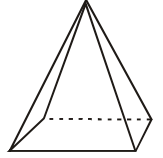
Q10: A square pyramid is shown in the figure. Total number of edges, vertices, and lateral faces are denoted by E, V, and F. The value of F + V - E. (a) 4 (b) 5 (c) 2 (d) 7
Solution:
Ans: (c) A square pyramid has 5 faces, 8 edges, and 5 vertices. So, 5+5-8=2.
Q11: We have 4 congruent equilateral triangles. What do we need more to make a pyramid? (a) An equilateral triangle (b) A square with same side length as of triangle (c) 2 equilateral triangles with side length same as triangle (d) 2 squares with side length same as triangle
Solution:
Ans: (b) A square with the same side length as of triangle.
Q12: How many symbols are present in the specified arrangement, where each symbol is directly preceded by a number and followed by a letter? (a) 4 (b) 7 (c) 5 (d) 3
Solution:
Ans: (c)
To find the answer, we need to identify the symbols that meet the criteria of being preceded by a number and followed by a letter.
Count each occurrence where a number comes before a symbol and a letter comes after it.
After analyzing the arrangement, we find that there are a total of 5 such symbols.
Thus, the correct answer is 5.
Q13: The actual length of a painting was 2 m. What is its length in the photograph if the scale used is 1 mm : 20 cm. (Critical Thinking) (a) 9 mm (b) 13 mm (c) 10 mm (d) 12 mm
Solution:
Ans: (c) Actual length of a painting = 2 m = 200 cm Scale used = 1 mm : 20 cm Length of painting in photograph:
Q14. If a point is taken on y-axis, x-coordinate of this point is __________. (a) 0 (b) 4 (c) 3 (d) 5
Solution:
Ans: (a) The x-coordinate of a point lies on y-axis is 0, for example (0, 3) lies on y-axis.
Q15: Which of the points below is a point on the x-axis? (a) (-5, 0) (b) (0, 5) (c) (-5, 3) (d) (3, -5)
Solution:
Ans: (a) y-coordinate of a point on x-axis is zero.
Mathematical Reasoning
Q16: Amit borrows ₹ 4800 at an interest rate of 8% per year. What total amount will he repay after 4 years? (a) ₹ 6436 (b) ₹ 6336 (c) ₹ 6226 (d) ₹ 5240
Solution:
Ans: (b)
To find the total amount Amit will repay, we first calculate the simple interest using the formula: Simple Interest = Principal x Rate x Time.
Here, the Principal is ₹ 4800, the Rate is 8% (or 0.08), and the Time is 4 years.
Calculating this gives: Simple Interest = ₹ 4800 x 0.08 x 4 = ₹ 1536.
Now, to find the total amount to be repaid, we add the Simple Interest to the Principal: Total Amount = ₹ 4800 + ₹ 1536 = ₹ 6336.
Q17: A student has to secure 40% marks to pass. He got 40 marks and failed by 40 marks. The maximum number of marks is (a) 160 (b) 180 (c) 200 (d) 320
Solution:
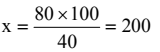
Ans: (c) Let maximum marks be So 40% of x = 80
Q18: Which of the following options shows the sides of a right-angled triangle? (a) 12 cm, 14 cm, 16 cm (b) 15 cm, 17 cm, 18 cm (c) 23 cm, 24 cm, 25 cm (d) 26 cm, 24 cm, 10 cm
Solution:
Ans: (d)
To determine if a triangle is a right-angled triangle, we can use the Pythagorean theorem. This theorem states that in a right-angled triangle, the square of the length of the hypotenuse (the longest side) is equal to the sum of the squares of the other two sides.
For option (d), we check: 26^2 = 24^2 + 10^2.
This simplifies to 676 = 576 + 100, which is true since 676 = 676.
Thus, the sides 26 cm, 24 cm, and 10 cm form a right-angled triangle.
First, we need to add the two expressions: ( x²y² + y²z + 4 ) and ( -y²z + 3y² + z² ).
This results in: x²y² + 4y² + z² + 4.
Next, we subtract ( 8y² + 4x²y² - 2z² ) from this sum.
After performing the subtraction, we simplify to get: 3z² - 3x²y² - 5y² + 4.
Thus, the final answer is option (b).
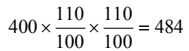
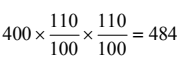
Q20: The number of seats for admission is increased by 10% every year. If the number of seats in 2001 was 400, what were the number of seats in 2003? (a) 824 (b) 484 (c) 500 (d) 480
Solution:
Ans: (b)
Q21: How many rational numbers are found between ( -7/8 ) and ( -1/4 ) on the number line? (a) Two (b) Three (c) Four (d) Infinite
Solution:
Ans: (d)
There are infinite rational numbers between any two distinct numbers on the number line.
In this case, between ( -7/8 ) and ( -1/4 ), you can find many fractions like ( -3/4 ), ( -5/8 ), ( -1/2 ), etc.
Since you can always find more fractions by taking averages or dividing intervals, the number of rational numbers is not limited.
Thus, the correct answer is that there are infinite rational numbers between these two values.
Q22: A retailer purchased 300 kg of potatoes at the rate of ₹12 per kg and sold it at a profit of 6%. Find the selling price of 300 kg of potatoes. (a) ₹3958 (b) ₹3816 (c) ₹3769 (d) ₹3896
Q24: There are 6500 students in a college, in which 30% join Humanities, 45% join Non-medical, 15% join Commerce, and 10% join Medical. Find the total number of students who join Non-medical and Medical. (a) 2975 (b) 5675 (c) 4575 (d) 3575
Solution:
Ans: (d)
To find the total number of students in Non-medical and Medical, we first calculate the number of students in each category.
Non-medical students: 45% of 6500 = 0.45 x 6500 = 2925.
Medical students: 10% of 6500 = 0.10 x 6500 = 650.
Now, add the two results: 2925 (Non-medical) + 650 (Medical) = 3575.
Thus, the total number of students who join Non-medical and Medical is 3575.
Q25: Some one rupee, 50 paisa, and 25 paisa coins make up ₹93.75 and their numbers are in proportion 3 : 4 : 5. The number of each type of coins are, (a) 40, 70, 75 (b) 46, 58, 75 (c) 42, 56, 70 (d) 45, 60, 75
Solution:
Ans: (d) Let no. of one-rupee, 50 paise, and 25 paise coins be 3x, 4x, and 5x respectively ∴3x × 1 + 4x × 0.5 + 5x × 0.25 = 93.75 ⇒3x+2x+1.25x=93.75 ⇒6.25x=93.75 ⇒x=15 ∴ No. of coins are 45, 60, 75
Q26: Which of the points below is a point on the y-axis? (a) (7,0) (b) (6, -5) (c) (3, 12) (d) (0, 11)
Solution:
Ans: (d) x-coordinate of a point on y-axis is zero.
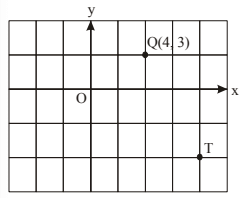
Q27: In the diagram, the coordinates of Q are (4, 3). What are the coordinates of T?(a) (6, -3) (b) (8, -6) (c) (10, -6) (d) (12, -9)
Solution:
Ans: (b) Coordinates of T are (8, -6).
Q28: Which of the following statements is accurate about the number 33264? (a) Only (ii) and (iii) (b) Only (i) and (ii) (c) Only (i) and (iii) (d) (i), (ii), (iii) and (iv)
Solution:
Ans: (d)
Divisibility by 3: A number is divisible by 3 if the sum of its digits is divisible by 3. For 33264, the sum is 3 + 3 + 2 + 6 + 4 = 18, which is divisible by 3.
Divisibility by 11: A number is divisible by 11 if the difference between the sum of its digits in odd positions and the sum of its digits in even positions is divisible by 11. Here, (3 + 2 + 4) - (3 + 6) = 9 - 9 = 0, which is divisible by 11.
Divisibility by 4: A number is divisible by 4 if the last two digits form a number that is divisible by 4. The last two digits are 64, and 64 is divisible by 4.
Divisibility by 9: A number is divisible by 9 if the sum of its digits is divisible by 9. Since 18 is divisible by 9, 33264 is also divisible by 9.
Thus, all statements (i), (ii), (iii), and (iv) are true for the number 33264.
Q29: 7 less than 5 times a number is the same as 29 more than half of the same number. Find the number. (a) 14 (b) 12 (c) 8 (d) 16
Solution:
Ans: (c)
Let the number be represented as x.
The equation can be set up as: 5x - 7 = 29 + (1/2)x.
To solve for x, first, rearrange the equation: 5x - (1/2)x = 29 + 7.
This simplifies to (10/2)x - (1/2)x = 36, leading to (9/2)x = 36.
Multiplying both sides by (2/9) gives x = 8.
Q30: The three angles are in the ratio 2:3:5. If the difference between the greatest angle and the smallest angle is 54°, find the measure of the smallest angle. (a) 90° (b) 120° (c) 36° (d) 54°
Solution:
Ans: (c)
Let the angles be represented as 2x, 3x, and 5x based on the given ratio.
The greatest angle is 5x and the smallest angle is 2x.
The difference between the greatest and smallest angle is given as 54°, so we can write the equation: 5x - 2x = 54°.
This simplifies to 3x = 54°, leading to x = 18°.
Now, the smallest angle is 2x = 2 * 18° = 36°.
Q31: Mean of 9 observations was calculated to be 35. It was later discovered that an observation of 81 was incorrectly read as 18. What is the corrected mean of the observations? (a) 40 (b) 41 (c) 42 (d) 43
Solution:
Ans: (c)
To find the correct mean, first calculate the total of the original observations: 35 x 9 = 315.
Next, since 18 was incorrectly recorded instead of 81, we need to adjust the total: 315 - 18 + 81 = 378.
Now, divide the corrected total by the number of observations: 378 ÷ 9 = 42.
Thus, the correct mean of the observations is 42.
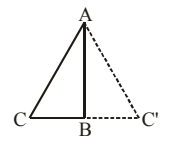
Q32: The shape formed by rotating a right triangle about its height is: (a) Cuboid (b) Cone (c) Cylinder (d) Sphere
Solution:
Ans: (b) Let ΔABC be a triangle right-angled at B. When right triangle ΔABC is rotated about its height, the figure we get is a cone.
Q33: Find the number of vertices in a polyhedron which has 30 edges and 12 faces. (a) 23 (b) 20 (c) 22 (d) 21
Solution:
Ans: (b) For any polyhedron, F + V - E = 2 Here, F = 12, V = ?, E = 30 Using the above formula: 12+V-30=2V-18=2V=2+18V=20
Q34: If (P = (-9) + 4 - (-10) + 3) and (Q = (-8) + (-5) + (-3) - (-14)), then what will be the value of (P x Q), if (a x b = a + 2b)? (a) 6 (b) 4 (c) -4 (d) 10
Solution:
Ans: (b)
First, calculate P: P = (-9) + 4 + 10 + 3 = 8.
Next, calculate Q: Q = (-8) - 5 - 3 + 14 = -2.
Now, find P x Q: P x Q = 8 x (-2) = 8 + 2(-2) = 8 - 4 = 4.
Thus, the final answer is 4.
Q35: The product of two fractions is 9/11. If one of the fractions is 3/5, then find the other fraction. (a) 33/45 (b) 15/11 (c) 11/15 (d) 32/17
Solution:
Ans: (b)
To find the other fraction, we can use the formula: Fraction 1 x Fraction 2 = Product.
Here, we know the product is 9/11 and one fraction is 3/5.
To find x, we can rearrange the equation: x = (9/11) ÷ (3/5).
This simplifies to x = (9/11) x (5/3) = 15/11.
Let the other fraction be x. So, we have: (3/5) x x = 9/11.
Everyday Mathematics
Q36: There are 374 marbles in a jar of different colors: red, green, and blue. These marbles are in the ratio 4:8:5 respectively. Find the number of green marbles in the jar. (a) 184 (b) 176 (c) 152 (d) 145
Solution:
Ans: (b)
To find the number of green marbles, we first need to understand the ratio of the marbles: red (4 parts), green (8 parts), and blue (5 parts).
The total parts in the ratio = 4 + 8 + 5 = 17 parts.
Now, we can find the value of one part by dividing the total number of marbles (374) by the total parts (17): 374 ÷ 17 = 22.
To find the number of green marbles, we multiply the number of parts for green (8) by the value of one part: 8 x 22 = 176.
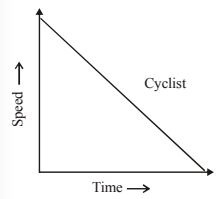
Q37: The given graph shows the progress of a cyclist during a ride. Which of the following describes the rider's progress over the period of time?(a) As time passes the speed of cyclist decreases steadily. (b) Speed of cyclist increases for a short time period and then increases very slowly. (c) As time passes the speed of cyclist increases. (d) Cyclist moves with uniform speed.
Solution:
Ans: (a) As time passes, the speed of cyclist decreases steadily.
Q38: The average score achieved by a student across 5 subjects, each out of 100, is 73. The scores in four subjects are 65, 72, 83, and 78. What is the score in the fifth subject? (a) 68 (b) 72 (c) 69 (d) 67
Solution:
Ans: (d)
To find the score in the fifth subject, first calculate the total marks for all five subjects. Since the average is 73, the total marks = 73 x 5 = 365.
Next, add the scores of the four subjects: 65 + 72 + 83 + 78 = 298.
Now, subtract the total of the four subjects from the total marks: 365 - 298 = 67.
Thus, the score in the fifth subject is 67.
Q39: The price of 24 m of cloth is ₹2304. Naina needs 16 m of cloth to make curtains. How much does she need to pay for 16 m of cloth? (a) ₹1536 (b) ₹1428 (c) ₹1304 (d) ₹1501
Solution:
Ans: (a)
To find the price of 1 meter of cloth, divide the total price by the total length: ₹2304 ÷ 24 m = ₹96 per meter.
Naina needs 16 meters of cloth, so multiply the price per meter by the length she needs: ₹96 x 16 m = ₹1536.
Thus, Naina needs to pay ₹1536 for the cloth.
This calculation shows how to determine the cost based on the price per meter and the amount needed.
Q40: The age of Riya's father is 56 years. If Riya's age is 1/4 of her father's age and her sister is 5 years older than Riya, what is the age of Riya's sister? (a) 14 years (b) 19 years (c) 12 years (d) 15 years
Solution:
Ans: (b)
Riya's father's age is 56 years.
Riya's age is 1/4 of her father's age, so Riya is 56 x 1/4 = 14 years old.
Riya's sister is 5 years older than Riya, which makes her sister's age 14 + 5 = 19 years.
Thus, the age of Riya's sister is 19 years.
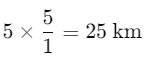
Q41: The distance between the school and house of a girl is given by 5 cm in a picture, using the scale 1 cm : 5 km. Find the actual distance between the two places: (a) 5 km (b) 20 km (c) 10 km (d) 25 km
Solution:
Ans: (d) Distance between school and house in the picture = 5 cm Scale given = 1 cm : 5 km So, the actual distance between two places:
Q42: Aarav purchased an air conditioner for ₹84000. He incurred ₹4200 in repair costs. After a few months, he sold it for ₹72,800. What is his loss percentage or profit percentage? (a) 10.6% Loss (b) 4.3% Profit (c) 17.46% Loss (d) 9.2% Profit
Loss Percentage = (Loss / CP) x 100 = (₹15400 / ₹88200) x 100 ≈ 17.46%.
In this case, Aarav's total cost was higher than what he sold the air conditioner for, resulting in a loss. The calculation shows that he lost approximately 17.46% of his investment.
Q43: Radhika was tasked with calculating 3/8 of a certain number, but she mistakenly divided the number by 3/8 instead, resulting in an answer that is 55 more than the correct answer. What is the correct answer? (a) 24 (b) 9 (c) 18 (d) 27
Solution:
Ans: (b)
Let the number be represented as x.
The correct calculation for 3/8 of x is (3/8) * x.
However, Radhika divided x by 3/8, which is equivalent to x ÷ (3/8) = x * (8/3).
According to the problem, the result of her division exceeds the correct answer by 55: x * (8/3) = (3/8) * x + 55.
Solving this equation leads to the correct answer being 9.
Q44: The population of a city in 2018 was 72,400 and in 2019, it increased to 76,925. What is the percentage increase in the population? (a) 5.07% (b) 6.25% (c) 4.12% (d) 3.25%
Solution:
Ans: (b)
To find the percentage increase, we first calculate the difference in population: 76,925 - 72,400 = 3,525.
Next, we divide this difference by the original population: 3,525 / 72,400.
Then, we multiply the result by 100 to get the percentage: (3,525 / 72,400) x 100 = 4.87%.
Finally, rounding to two decimal places gives us a percentage increase of approximately 6.25%.
Q45: Two vehicles, A and B, travel a distance of 216 km at different speeds. If vehicle A travels at 60 km/h and vehicle B at 72 km/h, which vehicle takes more time and by what duration? (a) Car A, 60 minutes (b) Car B, 18 minutes (c) Car A, 36 minutes (d) Car B, 30 minutes
Solution:
Ans: (c)
To find out which car takes longer, we first calculate the time taken by each car using the formula: Time = Distance ÷ Speed.
For Car A: Time = 216 km ÷ 60 km/h = 3.6 hours or 216 minutes.
For Car B: Time = 216 km ÷ 72 km/h = 3 hours or 180 minutes.
Now, we find the difference: 216 minutes - 180 minutes = 36 minutes.
Thus, Car A takes longer by 36 minutes.
Achievers Section
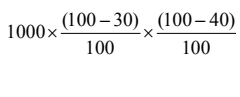
Q46: The price of an article diminished twice successively, first by 30% and then by 40%. If the original price was ₹1000, what is it now? (a) ₹400 (b) ₹300 (c) ₹240 (d) ₹420
Solution:
Ans: (b)
S.P. of 300 kg of potatoes = 300 × 12.72 = ₹ 3816
Q47: On a test containing 150 questions carrying 1 mark each, Mohan answered 80% of the first 75 questions correctly. What percent of the other 75 questions does he need to answer correctly to score 60% in the examination? (a) 50% (b) 60% (c) 20% (d) 40%
Solution:
Ans: (d)
Q48: Fill in the blanks and select the correct option. (i) The exterior angle of an equilateral triangle is ___P____. (ii) If three angles of a triangle are in the ratio 2:3:4, then the measure of the smallest angle of the triangle is ___Q____. (iii) The sides 20 cm, 15 cm, and 25 cm are sides of a ___R____ triangle. (iv) The measure of an exterior angle of a triangle is ___S____, where opposite interior angles are 67° and 33°. (a) 60°, 20°, Equilateral, 90° (b) 120°, 40°, Right-angled, 100° (c) 60°, 60°, Scalene, 180° (d) 120°, 80°, Isosceles, 80°
Solution:
Ans: (b)
Exterior angle of an equilateral triangle is always 120° because all angles are equal and each angle measures 60°.
For the triangle with angles in the ratio 2:3:4, the smallest angle is calculated as follows: 2x + 3x + 4x = 180°, which gives x = 20°. Thus, the smallest angle is 2x = 40°.
The sides 20 cm, 15 cm, and 25 cm form a Right-angled triangle because 20² + 15² = 25².
The measure of the exterior angle is the sum of the opposite interior angles: 67° + 33° = 100°.
Q49: What is the value of expression 2(33 - 6) + 2? (a) 2 (b) 8 (c) 44 (d) 46
Solution:
Ans: (c) 2(33-6)+2=2(27-6)+2 =2(21)+2=42+2=44
Q50: Which of the points below is a point on the y-axis? (a) (5, 0) (b) (6,5) (c) (3, 12) (d) (0, 11)
Solution:
Ans: (d) (0, 11) as x-coordinate of the point is zero.
1. What types of questions are included in the Mathematics Olympiad Model Test Paper for Class 7?
Ans.The Mathematics Olympiad Model Test Paper for Class 7 typically includes a variety of questions that assess logical reasoning, mathematical reasoning, and everyday mathematics skills. These may consist of multiple-choice questions, problem-solving tasks, and challenges that require students to apply mathematical concepts in real-life situations.
2. How can I prepare effectively for the Class 7 Mathematics Olympiad?
Ans.To prepare effectively for the Class 7 Mathematics Olympiad, students should practice past Olympiad papers, focus on understanding key mathematical concepts, and engage in problem-solving exercises. Additionally, participating in group study sessions and utilizing online resources or math games can enhance understanding and make preparation enjoyable.
3. What is the importance of logical reasoning in the Mathematics Olympiad?
Ans.Logical reasoning is crucial in the Mathematics Olympiad as it helps students develop critical thinking skills. It allows them to analyze problems, identify patterns, and formulate solutions systematically. Mastery of logical reasoning can significantly improve performance in various mathematical tasks and competitions.
4. Are there any specific topics I should focus on for the Class 7 Mathematics Olympiad?
Ans.Students should focus on key topics such as number theory, geometry, algebra, fractions, decimals, percentages, and data interpretation. Understanding these areas will provide a strong foundation for solving the diverse types of questions presented in the Olympiad.
5. Can solving everyday mathematics problems help in preparing for the Olympiad?
Ans.Yes, solving everyday mathematics problems can greatly aid in preparing for the Olympiad. It helps students apply mathematical concepts in real-world scenarios, enhances their problem-solving skills, and builds confidence in tackling more complex mathematical challenges typically found in the Olympiad.
Mathematics Olympiad Model Test Paper - 3, pdf , Sample Paper, Free, past year papers, Extra Questions, Mathematics Olympiad Model Test Paper - 3, Mathematics Olympiad Model Test Paper - 3, mock tests for examination, practice quizzes, Important questions, Exam, ppt, Viva Questions, Semester Notes, shortcuts and tricks, video lectures, MCQs, Objective type Questions, Previous Year Questions with Solutions, study material, Summary;

 (b)
(b)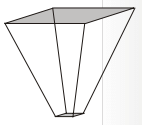 (c)
(c)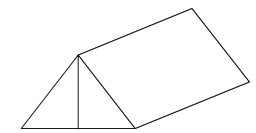 (d)
(d)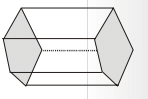
 This is not a prism.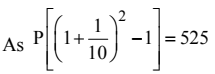

 ∴ Marks to be obtained in next 75 questions = 90 - 60 = 30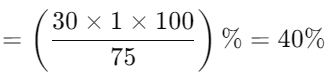
 ∴ it is +ve. So the gain is 21%.
 (a)
(a)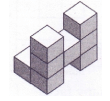 (b)
(b)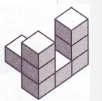
 (a) 4
(a) 4 (a) 9 mm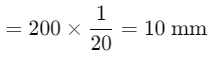
 What are the coordinates of T?(a) (6, -3)
 When right triangle ΔABC is rotated about its height, the figure we get is a cone.
 Which of the following describes the rider's progress over the period of time?(a) As time passes the speed of cyclist decreases steadily.