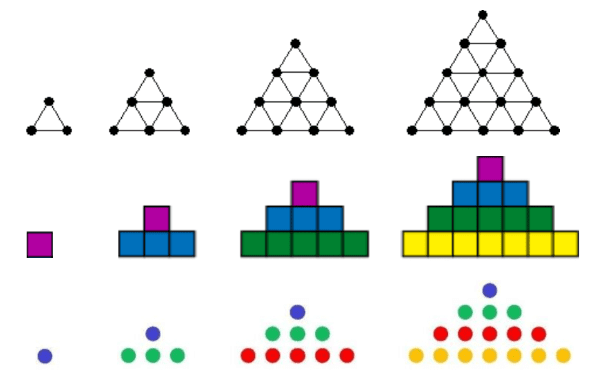
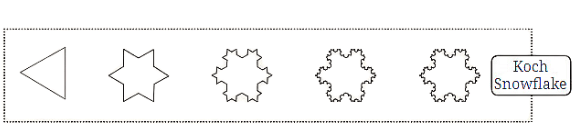
Mathematics is the study of patterns found everywhere in nature, our homes, and the universe.
It helps us understand why these patterns exist and how they work.
Patterns can be observed in daily activities like games, technology, and space.
Mathematics aims to not only identify patterns but also explain them.
These explanations can be applied to various fields, such as medicine (e.g., understanding genomes to diagnose and cure diseases).
Pattern in Numbers
Number patterns are some of the most basic patterns in mathematics.
These patterns often involve whole numbers like 0, 1, 2, 3, 4, etc.
The branch of mathematics that studies these patterns is called number theory.
Number sequences are a type of pattern studied in number theory.
Examples of Number Patterns:
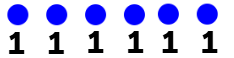
All 1's: 1, 1, 1, 1, 1, ...
Counting Numbers: 1, 2, 3, 4, 5, 6, 7, ...
Odd Numbers: 1, 3, 5, 7, 9, ...
Even Numbers: 2, 4, 6, 8, 10, ...
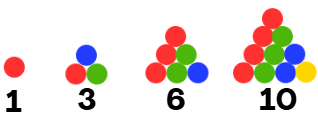
Triangular Numbers: 1, 3, 6, 10, 15, 21, ...
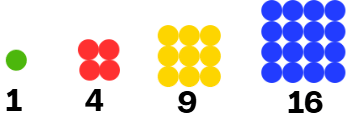
Squares: 1, 4, 9, 16, 25, ...
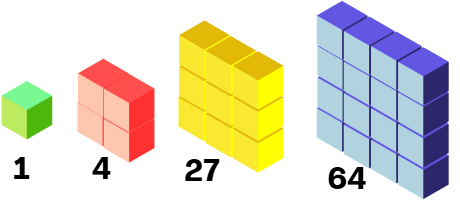
Cubes: 1, 8, 27, 64, 125, ...
Virahanka Numbers: 1, 2, 3, 5, 8, 13, 21, ...
Power of 2: 1, 2, 4, 8, 16, 32, 64, ...
Power of 3: 1, 3, 9, 27, 81, 243, ...
MULTIPLE CHOICE QUESTION
Try yourself: Which of the following number patterns represents the sequence of even numbers?
A
1, 3, 5, 7, 9, ...
B
2, 4, 6, 8, 10, ...
C
1, 2, 3, 4, 5, ...
D
1, 4, 9, 16, 25, ...
Correct Answer: B
- Even numbers are those that are divisible by 2. - In the given options, only Option B consists of a sequence of even numbers. - Therefore, the correct answer is Option B: 2, 4, 6, 8, 10, ...
Report a problem
Visualizing Number Sequence
All 1's
Counting Numbers
Odd Numbers
Even Numbers
Triangular Numbers
Squares
Cubes
Relation among Number Sequence
Summing Odd Numbers Forms Square Numbers
1 = 1
1 + 3 = 4
1 + 3 + 5 = 9
1 + 3 + 5 + 7 = 16
1 + 3 + 5 + 7 + 9 = 25
Adding Up and Down Sequence to form Squares
1 = 1
1 + 2 + 1 = 4
1 + 2 + 3 + 2 + 1 = 9
1 + 2 + 3 + 4 + 3 + 2 + 1 = 16
1 + 2 + 3 + 4 + 5 + 4 + 3 + 2 + 1 = 25
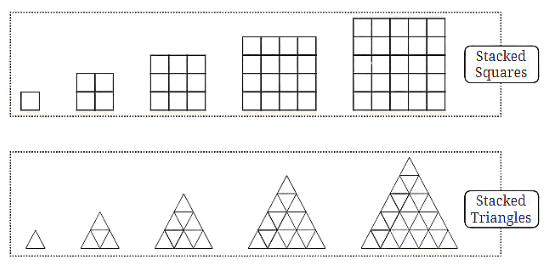
Patterns are not only found in numbers but also in shapes.
For Example:
A sequence of growing squares.
A sequence of triangles increasing in size.
MULTIPLE CHOICE QUESTION
Try yourself: Which number sequence is formed by adding consecutive odd numbers?
A
All 1's
B
Squares
C
Triangular Numbers
D
Odd Numbers
Correct Answer: B
When you add consecutive odd numbers, you get square numbers.
So, adding consecutive odd numbers forms the sequence of square numbers. Therefore, Correct answer: Option (B) Squares
Report a problem
Shape Related to Number Sequence
Shape sequences and number sequences can be related in surprising and helpful ways.
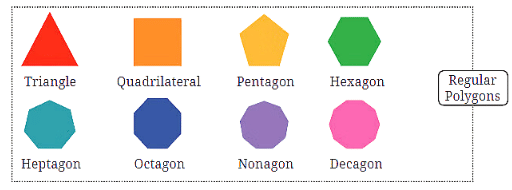
Example: Shape Sequence of Regular Polygons . Regular Polygons as shapes with equal-length sides and equal angles.
Triangle: (3 Equal Sides)
Quadrilateral: (4 Equal Sides)
Pentagon: (5 Equal Sides)
Hexagon: (6 Equal Sides)
MULTIPLE CHOICE QUESTION
Try yourself: Which shape comes next in the sequence? Triangle, Quadrilateral, Pentagon, Hexagon, ____
A
Heptagon
B
Octagon
C
Septagon
D
Nonagon
Correct Answer: A
- The given sequence is based on regular polygons with an increasing number of sides. - A triangle has 3 sides, a quadrilateral has 4 sides, a pentagon has 5 sides, and a hexagon has 6 sides. - Therefore, the next shape in the sequence should have 7 sides, which is a heptagon.
1. What is a number pattern and why is it important in mathematics?
Ans.A number pattern is a sequence of numbers that follow a specific rule or formula. It is important in mathematics because it helps students recognize relationships between numbers, develop problem-solving skills, and understand concepts like algebra and sequences.
2. How can visualizing number sequences help students in their learning?
Ans.Visualizing number sequences, such as through graphs or charts, helps students see trends and relationships more clearly. This aids in comprehension and retention of mathematical concepts, making it easier to solve problems and identify patterns.
3. What are some common types of number patterns that students should know?
Ans.Common types of number patterns include arithmetic sequences (where a constant is added), geometric sequences (where numbers are multiplied by a constant), and Fibonacci sequences (where each number is the sum of the two preceding ones). Recognizing these patterns can greatly enhance mathematical understanding.
4. How can students practice identifying patterns in number sequences?
Ans.Students can practice identifying patterns in number sequences through worksheets, online quizzes, and math games. Engaging with real-life examples, such as counting objects or measuring distances, can also help reinforce their skills in recognizing patterns.
5. What role do number patterns play in competitive exams like Olympiads?
Ans.Number patterns play a crucial role in competitive exams like Olympiads as they often test students' ability to think critically and solve problems using logic. Mastering patterns can help students tackle challenging questions efficiently and improve their overall performance.
Exam, Semester Notes, past year papers, MCQs, Viva Questions, Free, pdf , video lectures, Olympiad Notes: Patterns, Previous Year Questions with Solutions, Olympiad Notes: Patterns, mock tests for examination, shortcuts and tricks, Sample Paper, Extra Questions, Important questions, practice quizzes, Summary, ppt, study material, Olympiad Notes: Patterns, Objective type Questions;