Practice Questions: Angles

Q1: What type of angle is created between the hands of a clock at 3 o'clock?
Ans: Right Angle
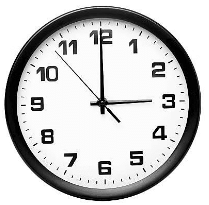
At 3 o'clock, the minute hand points to 12 and the hour hand points to 3. These positions are three hour marks apart and each hour mark equals 30°, so 3 × 30° = 90°, which is a Right Angle.
Q2: What is the angle measure of each angle in a regular triangle?
Ans: 60°
A regular triangle means all three sides and angles are equal (an equilateral triangle). The sum of angles in any triangle is 180°, so each equal angle is 180° ÷ 3 = 60°.
Q3: How many degrees is a complete angle?
Ans: 360°
A complete angle is a full turn that brings a ray back to its starting direction. A full circle measures 360°, so a complete angle is 360°.
Q4: What type of angle is an angle measuring 45°?
Ans: Acute Angle
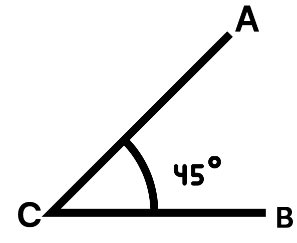
An angle less than 90° is an Acute Angle, so an angle of 45° is an Acute Angle.
Q5: How many degrees are in the angle formed between the hour and minute hands at 12 o'clock?
Ans: 0°
At 12 o'clock both the hour and minute hands point to 12, so they lie on top of each other. The angle between them is 0°, called a zero angle.
Q6: If an angle measures 135°, what type of angle is it?
Ans: Obtuse Angle
An Obtuse Angle is greater than 90° but less than 180°. Since 135° lies between 90° and 180°, it is an Obtuse Angle.
Q7: How many degrees are there between the numbers 4 and 7 on a clock?
Ans: 90°
A clock has 12 numbers equally spaced around 360°, so each gap is 360° ÷ 12 = 30°. From 4 to 7 there are three gaps, so 3 × 30° = 90°.
Q8: What type of angle does a slice of pizza usually have?
Ans: Acute Angle
A typical pizza slice is narrow and forms an angle smaller than 90°, so it is usually an Acute Angle.
Q9: If you have a regular hexagon, what is the measure of each angle?
Ans: 120°
A regular hexagon has six equal interior angles. The sum of interior angles of a hexagon is 720° (for six sides), so each angle is 720° ÷ 6 = 120°.
Q10: What is the angle formed by the minute and hour hands of a clock at 6 o'clock?
Ans: 180°
At 6 o'clock, the minute hand points to 12 and the hour hand points to 6, which are opposite each other on the clock face. The angle between them is a straight angle of 180°.
Q11: In a regular pentagon, what is the measure of each angle?
Ans: 108°
A regular pentagon has five equal angles. The total sum of interior angles is 540° (for five sides), so each angle is 540° ÷ 5 = 108°.
Q12: If two lines meet and form a 90° angle, what is this angle called?
Ans: Right Angle
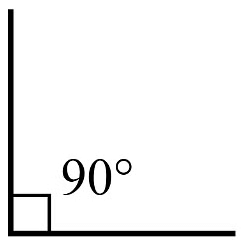
An angle of exactly 90° is called a Right Angle. When two straight lines meet to make a 90° angle, the lines are also said to be perpendicular to each other.
Q13: How many angles can be formed by arranging four matchsticks in a square shape?
Ans: 4 angles
A square has four corners and each corner is a right angle. Therefore, arranging four matchsticks as a square creates four angles in total.
Q14: What type of angle is formed by the hands of a clock at 1 o'clock?
Ans: Acute Angle
At 1 o'clock, the hour hand is on 1 and the minute hand is on 12, so they are one hour mark apart. One mark equals 30°, which is less than 90°, so the angle is an Acute Angle.
Q15: How many degrees are there in the sum of angles in a quadrilateral?
Ans: 360°
A quadrilateral can be split into two triangles and each triangle has angles adding to 180°, so 2 × 180° = 360°. Thus, the sum of interior angles in any quadrilateral is 360°.
FAQs on Practice Questions: Angles
| 1. What are the different types of angles? |  |
| 2. How do you measure angles? | |
| 3. What is the importance of angles in geometry? | |
| 4. Can angles be classified based on their size? | |
| 5. What is a complementary angle? | |