Mnemonics: The Human Eye and the Colourful World

The Human Eye
Mnemonic: "Clever Lions Investigate Real Tigers Efficiently"
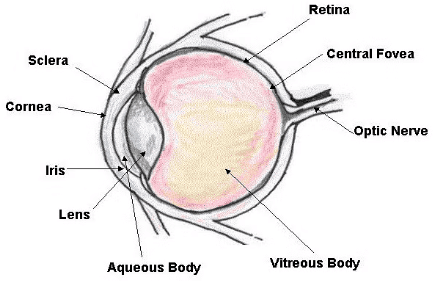
The human eye is a sense organ that detects light and enables vision. Light from objects enters the eye, is focused to form an image on the retina, and the resulting signals are transmitted to the brain where they are interpreted as sight. The eye works much like a camera: the front parts collect and focus light, the retina records the image, and the brain processes it.
- Cornea: The transparent, curved outermost layer at the front of the eye that refracts (bends) light entering the eye.
- Pupil: The opening in the centre of the iris through which light passes into the interior of the eye. Its size changes to control the amount of light entering.
- Iris: The coloured muscular diaphragm that surrounds the pupil and adjusts its diameter to regulate light intensity falling on the retina.
- Lens: A transparent, flexible structure that further focuses light rays onto the retina by changing its shape (a process called accommodation).
- Vitreous humour: The clear gel that fills the space between the lens and the retina and helps maintain the eye's shape.
- Retina: The light-sensitive layer lining the back of the eye where images are formed. Photoreceptor cells (rods and cones) convert light into electrical signals.
- Optic nerve: Carries electrical impulses from the retina to the brain, where they are interpreted as vision.
Important processes related to the eye:
- Image formation: The eye lens forms a real, inverted, and diminished image on the retina for distant objects; for near objects the lens becomes thicker to focus the image.
- Accommodation: Ability of the eye lens to change shape to focus on objects at different distances.
- Role of brain: The brain receives signals from the optic nerve and interprets them, correcting orientation so we perceive the image upright.
Dispersion of White Light by a Glass Prism
Mnemonic: "VIBGYOR"
Dispersion is the splitting of white light into its constituent colours when it passes through a medium like a glass prism. White light is a mixture of different wavelengths (colours). Different wavelengths travel with slightly different speeds in glass, so they refract by different amounts; this separates the colours to form a spectrum.
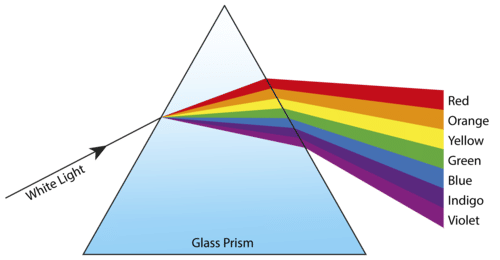
- Violet
- Indigo
- Blue
- Green
- Yellow
- Orange
- Red
Why the colours appear in this order:
- Different colours correspond to different wavelengths; violet has the shortest wavelength among visible colours and is refracted the most, while red has the longest wavelength and is refracted the least.
- Because of this wavelength dependence of refractive index, the emergent beam spreads into the sequence Violet → Indigo → Blue → Green → Yellow → Orange → Red (VIBGYOR) from the most deviated to the least deviated.
Simple experimental procedure to observe dispersion (ordered steps):
- Allow a narrow beam of white light (for example, sunlight through a small slit) to fall on a glass prism placed on a table.
- Adjust the prism so the refracted beam falls on a white screen placed on the other side.
- Observe the spectrum of colours on the screen. The colours appear in the order VIBGYOR from the side where violet is deviated most to the side where red is deviated least.
Applications and relevance:
- Spectrum analysis is used in instruments like spectrometers to study the composition of light sources.
- Prism dispersion explains natural phenomena such as rainbows (involving water droplets rather than a glass prism) where sunlight is dispersed into colours.
Mnemonic for the Parts of the Eye
Mnemonic: "Cats Play In Light Rooms Very Often"
- C - Cornea
- P - Pupil
- I - Iris
- L - Lens
- R - Retina
- V - Vitreous humour
- O - Optic nerve
This mnemonic lists the major parts in roughly the order light encounters them as it travels into the eye.
Mnemonic for the Dispersion of Light in a Prism (Reverse Order)
Mnemonic: "Rich Old Yak Grew Big Indigo Vines"
- R - Red
- O - Orange
- Y - Yellow
- G - Green
- B - Blue
- I - Indigo
- V - Violet
This mnemonic helps remember the sequence from the least deviated colour (red) to the most deviated (violet), which is the reverse of the VIBGYOR order.
Summary: Remember the eye's parts and their functions using the provided mnemonics; recall VIBGYOR to identify the order of colours produced by dispersion. The eye forms images on the retina and the brain interprets them; dispersion arises because different wavelengths refract by different amounts, producing the familiar spectrum of colours.
FAQs on Mnemonics: The Human Eye and the Colourful World
| 1. What are the main parts of the human eye and their functions? |  |
| 2. How does a prism cause the dispersion of white light? | |
| 3. What is the significance of the dispersion of light in understanding colors? | |
| 4. How do we perceive colors with the help of the human eye? | |
| 5. Can the human eye see all the colors produced by a prism? | |




