NEET Exam  >  NEET Notes  >  Physics Class 11  >  Mnemonics: Units & Measurements

Mnemonics: Units & Measurements

MNEMONICS are powerful tools to simplify complex physics concepts and make learning easier.

Mnemonics: Units & Measurements

 This edurev document provides creative and concise mnemonics to help  students quickly grasp and recall key topics.  Use them to make your study sessions more efficient and effective! Happy Learning!
Mnemonics: Units & Measurements

1.  Physical World

Mnemonic: "Good Workers work for Extended Session"

Explanation:

  • Good: Gravitation
  • Workers: Weak Nuclear Force
  • Extended: Electromagnetism
  • Session: Strong Nuclear Force

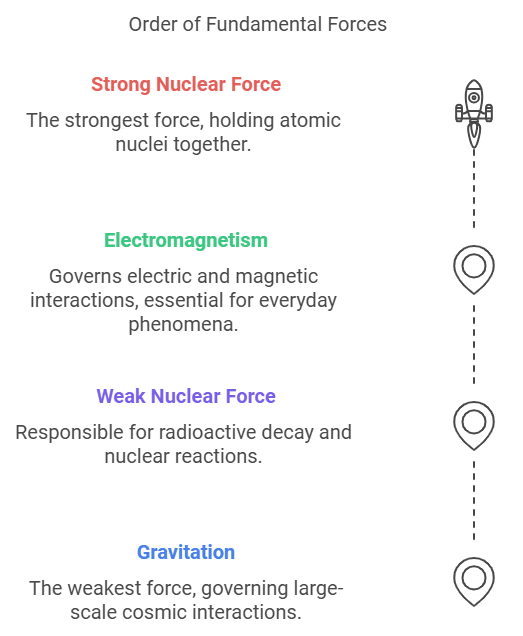
Strength wise arrangement of fundamental forces in ascending order:
Gravitation < Weak Nuclear Force < Electromagnetism < Strong Nuclear Force

The order should be learn as can be asked in conceptual based questions.
1.  Physical World

2. Seven Fundamental Quantities

Mnemonic: "Let MTime Always Keep MCalm"

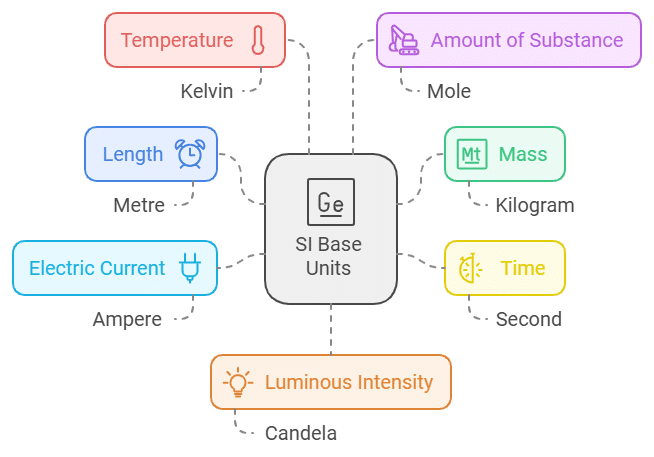
Explanation:

  • Let: Length - Metre (m)
  • My: Mass - Kilogram (kg)
  • Time: Time - Second (s)
  • Always: Electric Current - Ampere (A)
  • Keep: Thermodynamic Temperature - Kelvin (K)
  • Me: Amount of Substance - Mole (mol)
  • Calm: Luminous Intensity - Candela (cd)

Helpful in solving dimensional analysis questions.
2. Seven Fundamental Quantities

3. Systems of Units

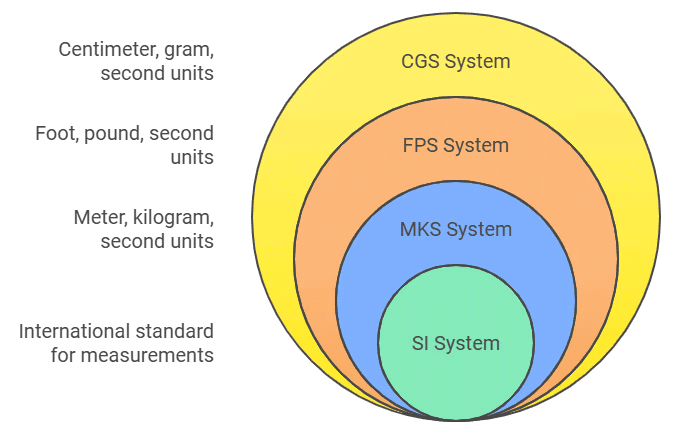
Mnemonic: "Can Frogs Make Sandwiches?"

Explanation:

  • C - CGS System (Centimeter, Gram, Second)
  • F - FPS System (Foot, Pound, Second)
  • M - MKS System (Meter, Kilogram, Second)
  • S - SI System (International Standard System)
3. Systems of Units

4. Applications of Dimensional Analysis

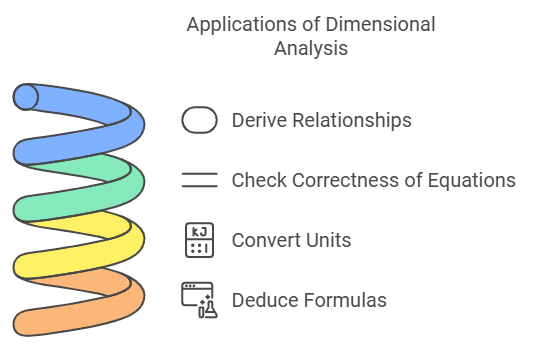
Mnemonic: "Daring Cats Climb Down"

Explanation:

  • DaringDerive relationships
  • CatsCheck correctness of equations
  • ClimbConvert units
  • DownDeduce formulas

A method for solving all the numericals of dimensional analysis.
4. Applications of Dimensional Analysis

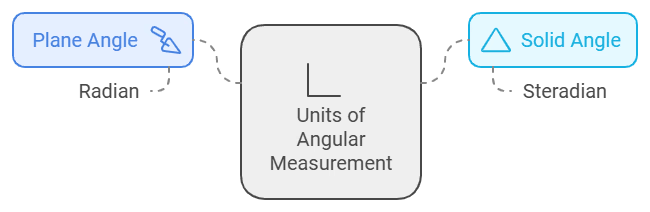
5. Two Supplementary Units

Mnemonic: "Ravi Smiles"

Explanation:

  • RaviRadian (Plane Angle)
  • SmilesSteradian (Solid Angle)

5. Two Supplementary Units

6. Scientific Notation

Mnemonic: "Power Saves Time!"

Explanation:

  • Use powers of 10 to represent very large or small numbers concisely.

MASTER THESE SHORTCUTS, AND LET SUCCESS FOLLOW! 

The document Mnemonics: Units & Measurements is a part of the NEET Course Physics Class 11.
All you need of NEET at this link: NEET

FAQs on Mnemonics: Units & Measurements

1. What are the SI base units and how do I remember them for NEET Physics?
Ans. The seven SI base units are metre (length), kilogram (mass), second (time), ampere (current), kelvin (temperature), mole (substance), and candela (luminosity). Students often use the mnemonic "MKSA + TLC" to memorise these fundamental units in Physics Class 11. Each base unit forms the foundation for derived units used throughout mechanics, thermodynamics, and electromagnetism sections of the NEET syllabus.
2. How do I convert between different unit systems like CGS and SI quickly?
Ans. Unit conversion involves multiplying by conversion factors: 1 metre = 100 cm, 1 kg = 1000 g, 1 second remains constant. The key is identifying which quantity you're converting-length, mass, force, or energy-then applying the appropriate power of 10. Practice dimensional analysis with common NEET Physics problems; this technique helps verify if your answer uses correct units before finalising solutions.
3. What's the difference between fundamental units and derived units, and why does it matter?
Ans. Fundamental units (or base units) are independent and cannot be broken down further-like kilogram for mass and second for time. Derived units combine base units, such as newton (kg·m/s²) for force or joule (kg·m²/s²) for energy. Understanding this distinction helps solve unit-based problems in NEET, where dimensional analysis is frequently tested to check formula validity and dimensional consistency across equations.
4. Why do some NEET questions use different unit prefixes like micro, nano, and pico, and how do I keep track?
Ans. Unit prefixes represent powers of 10: micro (10⁻⁶), nano (10⁻⁹), pico (10⁻¹²), milli (10⁻³), and kilo (10³). These prefixes modify base units to express very large or very small quantities without changing the measurement itself. Students should refer to flashcards or mind maps showing common prefix powers to avoid conversion errors in NEET calculations, especially in topics like atomic physics and electrostatics.
5. How do dimensional equations help verify formulas, and what's the trick to solving dimensional analysis problems?
Ans. Dimensional equations express physical quantities using base dimensions-length [L], mass [M], and time [T]. To verify a formula, substitute dimensions on both sides; they must match exactly. For dimensional analysis problems in NEET Physics, identify unknown exponents by equating dimensions on both sides of an equation, then solve simultaneously. This method quickly confirms if a derived formula is dimensionally correct without calculating numerical values.
Explore Courses for NEET exam
Get EduRev Notes directly in your Google search
Related Searches
shortcuts and tricks, ppt, Objective type Questions, past year papers, MCQs, video lectures, Summary, study material, Viva Questions, Exam, pdf , Sample Paper, Previous Year Questions with Solutions, Semester Notes, Mnemonics: Units & Measurements, Extra Questions, Mnemonics: Units & Measurements, practice quizzes, mock tests for examination, Important questions, Mnemonics: Units & Measurements, Free;