NDA Syllabus 2026


Comprehensive Overview of the NDA 2026 Syllabus
The NDA 2026 syllabus aligns closely with the Class 12 curriculum, encompassing subjects such as Mathematics, English, History, Politics, Economics, General Science, Physics, and Chemistry. For effective preparation, candidates must diligently cover all aspects of the syllabus to ensure they are well-prepared for the main examination. Below is an in-depth breakdown of the NDA 2026 syllabus, aimed at assisting candidates in organizing their study plans and concentrating on the essential topics required for success.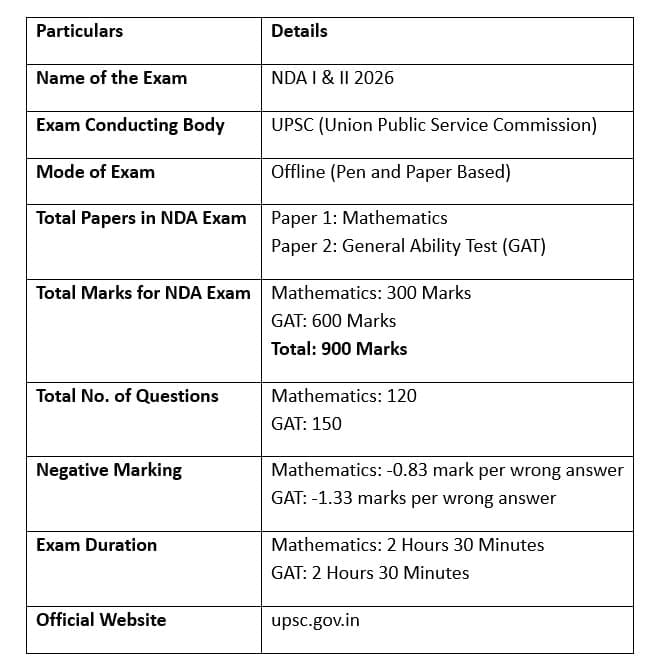
NDA Exam Pattern 2026
The NDA exam pattern for 2026 consists of two main parts: Mathematics and the General Aptitude Test. Each part assesses different skills of the candidates, focusing on:
- Problem-solving abilities
- Reasoning skills
- General awareness
After completing the written exam, candidates who perform well will be invited to the SSB test or interview. This stage is designed to further assess their:
- Personality
- Leadership qualities
- Decision-making skills
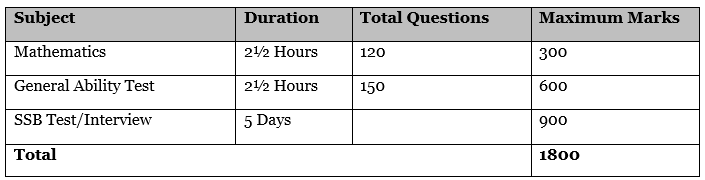
The table below provides details about the NDA exam pattern for 2026.
Detailed NDA Mathematics Syllabus 2026
The Mathematics syllabus for the NDA 2026 examination is designed to assess candidates' quantitative aptitude and problem-solving skills. Key areas include Algebra, Trigonometry, Calculus, and Analytical Geometry. Proficiency in these topics, supported by consistent practice, is crucial for achieving success.Key Topics and Subtopics
1. Algebra- Sets and Relations: Concepts of sets, operations on sets, Venn diagrams, De Morgan's laws, Cartesian product, relations, equivalence relations.
- Real Numbers: Representation on a number line, properties of complex numbers (modulus, argument, cube roots of unity), binary system, conversion between decimal and binary systems.
- Sequences and Series: Arithmetic, geometric, and harmonic progressions.
- Quadratic Equations: Quadratic equations with real coefficients; solving linear equations with two variables using graphs.
- Permutations and Combinations: Counting principles, applications of permutations and combinations, binomial theorem.
- Logarithms: Properties and equations involving logarithms.
2. Matrices and Determinants
- Types of Matrices: Square, rectangular, row, column, diagonal, scalar, identity, zero, triangular.
- Matrix Operations: Addition, subtraction, scalar multiplication, matrix multiplication, transpose, inverse, adjoint.
- Determinants: Properties and calculation for matrices (2×2, 3×3, larger matrices).
- Applications: Solving linear equations using Cramer's rule and matrix methods.
3. Trigonometry
- Angles and Measures: Degrees and radians.
- Trigonometric Ratios: Sine, cosine, tangent, cotangent, secant, cosecant.
- Identities: Sum and difference formulas, multiple and sub-multiple angles, inverse functions.
- Applications: Height and distance problems, properties of triangles.
4. Analytical Geometry of Two and Three Dimensions
- Two-Dimensional Geometry: Cartesian coordinate system, distance formula, line equations, angle between lines, distance from a point to a line, circles.
- Conic Sections: Standard forms of parabola, ellipse, hyperbola, eccentricity, and axes.
- Three-Dimensional Geometry: Points in space, distance formula, direction cosines and ratios, equations of planes, lines, and spheres; angles between lines and planes.
5. Differential Calculus
- Functions: Real-valued functions, domain, range, graphs, composite functions, one-to-one and onto functions, inverse functions.
- Limits and Continuity: Basic concepts.
- Derivatives: Rules for sum, product, quotient, and composite functions; higher-order derivatives, increasing and decreasing functions.
- Applications: Maxima and minima.
6. Integral Calculus and Differential Equations
- Integration: As the inverse of differentiation; methods including substitution and parts; standard integrals for algebraic, trigonometric, exponential, and hyperbolic functions.
- Definite Integrals: Applications such as areas under curves.
- Differential Equations: Order, degree, formation, general and particular solutions, first-order and first-degree equations, applications in growth and decay problems.
7. Vector Algebra
- Basics: Vectors in two and three dimensions, magnitude, direction, unit vectors, null vectors.
- Operations: Vector addition, scalar multiplication, dot product, cross product.
- Applications: Work done by forces, moments of forces, and geometrical problems.
8. Statistics and Probability
- Statistics: Data classification, frequency distribution, cumulative frequency, graphical representation (histograms, pie charts, frequency polygons), central tendency (mean, median, mode), variance, standard deviation, correlation, regression.
- Probability: Basic concepts, sample space, events (mutually exclusive, exhaustive, complementary), definitions of probability (classical and statistical), theorems, conditional probability, Bayes' theorem, random variables, and binomial distribution.
This detailed syllabus serves as a roadmap for candidates to focus on the critical topics and subtopics needed to excel in the Mathematics section of the NDA 2026 examination.
NDA Mathematics Marking Scheme 2026
The NDA Mathematics marking scheme is designed to assess candidates' proficiency and discourage guesswork during the examination. Key details of the scheme include:- Marks for Correct Answers: Each correct response earns 2.5 marks.
- Negative Marking: For every incorrect answer, 0.83 marks are deducted as a penalty.
- Number of Questions: The Mathematics section contains 120 questions, amounting to a total of 300 marks.
- Time Allotment: Candidates have 2 hours and 30 minutes to complete this section.
A clear understanding of this marking scheme is essential for aspirants, as it plays a pivotal role in shaping their approach to the exam, emphasizing accuracy and minimizing random guesses.

NDA GAT Syllabus 2026
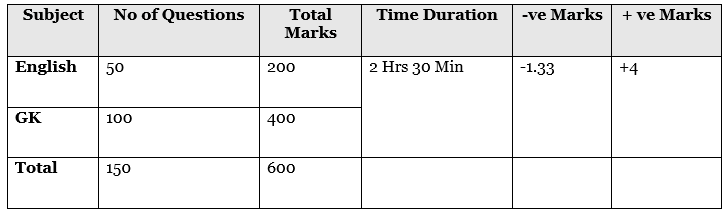
The General Ability Test (GAT), or NDA Paper 2, evaluates a candidate's proficiency across multiple subjects, including English, General Knowledge, Chemistry, Physics, Geography, General Science, and Current Events. The paper comprises 150 questions, divided as follows:- English Section: 50 questions
- General Knowledge Section: 100 questions
The GAT paper carries a total of 600 marks and assesses a wide range of skills and knowledge areas.
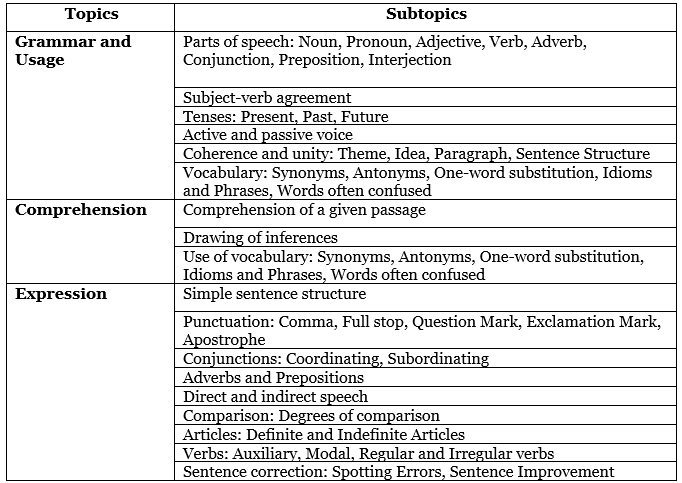
NDA English Syllabus for Part-A
NDA General Knowledge Syllabus 2026 (Part-2)
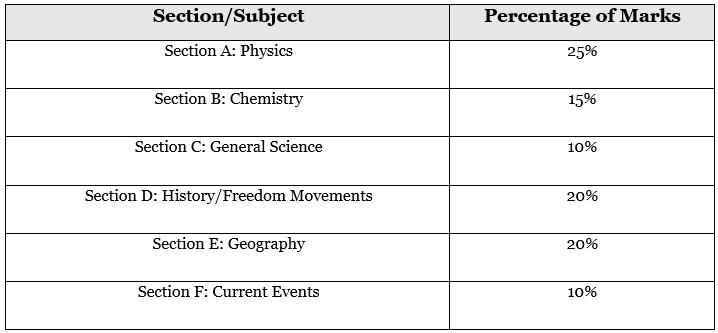
The General Knowledge section of the NDA GAT syllabus for 2026 evaluates candidates on six critical areas: Physics, Chemistry, General Science, History, Geography, and Current Affairs. This segment of the exam ensures a comprehensive assessment of the candidate's knowledge and awareness. Below is a detailed overview of the topics covered in each section.Section A: NDA Physics Syllabus 2026:
This section focuses on fundamental concepts in physics, assessing candidates' understanding of basic principles and their applications.
- Physical Properties and States of Matter
- Mass, Weight, Volume, Density, and Specific Gravity
- Principle of Archimedes and Pressure Barometer
- Motion of Objects, Velocity, and Acceleration
- Newton's Laws of Motion, Force, and Momentum
- Parallelogram of Forces, Stability, and Equilibrium of Bodies
- Gravitation
- Work, Power, and Energy
- Effects of Heat, Measurement of Temperature, and Latent Heat
- Sound Waves and Properties
- Rectilinear Propagation of Light, Reflection, Refraction
- Spherical Mirrors, Lenses, and Human Eye
- Properties of Magnets, Earth as a Magnet
- Static and Current Electricity, Ohm's Law
- Simple Electrical Circuits, Measurement of Electrical Power
- Use of X-Rays and General Principles of Devices (e.g., Pulley, Telescope, Mariner's Compass).
Section B: NDA Chemistry Syllabus 2026:
This section includes basic chemical concepts and applications in daily life.
- Physical and Chemical Changes
- Elements, Mixtures, and Compounds
- Symbols, Formulae, and Chemical Equations
- Properties of Air and Water
- Preparation and Properties of Hydrogen, Oxygen, Nitrogen, Carbon Dioxide
- Oxidation and Reduction
- Acids, Bases, and Salts
- Different Forms of Carbon
- Fertilizers (Natural and Artificial)
- Materials for Soap, Glass, Cement, Paints, and Gunpowder
- Elementary Ideas about the Structure of Atom, Valency, and Atomic Weights.
Section C: NDA General Science Syllabus 2026:
General Science assesses foundational biological and environmental knowledge.
- Difference Between Living and Non-Living
- Basis of Life-Cells, Protoplasm, and Tissues
- Growth and Reproduction in Plants and Animals
- Elementary Knowledge of Human Body and Important Organs
- Common Epidemics: Causes and Prevention
- Food as a Source of Energy, Constituents of Food, and Balanced Diet
- Solar System, Meteors, Comets, and Eclipses
- Achievements of Eminent Scientists.
Section D: NDA History Syllabus 2026:
The History section evaluates knowledge of historical events and movements, emphasizing Indian and global perspectives.
- Broad Survey of Indian History with Emphasis on Culture and Civilization
- Freedom Movement in India
- Elementary Study of Indian Constitution and Administration
- Five-Year Plans, Panchayati Raj, Co-operatives, and Community Development
- Teachings of Mahatma Gandhi (Bhoodan, Sarvodaya, National Integration)
- Forces Shaping the Modern World: Renaissance, Exploration, American Independence, French Revolution, Industrial and Russian Revolutions
- Impact of Science and Technology on Society
- United Nations, Panchsheel, Democracy, Socialism, Communism
- Role of India in the Present World.
Section E: NDA Geography Syllabus 2026:
Geography covers concepts related to the Earth, its physical features, and human interactions.
- The Earth: Shape, Size, Latitudes, Longitudes, and International Date Line
- Movements of Earth and Their Effects
- Origin of Earth
- Rocks, Weathering, Earthquakes, and Volcanoes
- Ocean Currents, Tides, and Atmospheric Composition
- Cyclones, Precipitation, Humidity, Types of Climate
- Regional Geography of India: Climate, Natural Vegetation, Agriculture, and Industrial Activities
- Important Sea Ports, Land, and Air Routes of India
- Main Items of Indian Imports and Exports.
Section F: NDA Current Affairs Syllabus 2026:
Current Affairs focuses on recent national and international developments.
- Important Events in India and the World in Recent Years
- Prominent Personalities in Culture, Sports, and Other Fields
NDA GAT Subject Wise Weightage 2026
FAQs on NDA Syllabus 2026
| 1. What are the main subjects covered in the NDA entrance exam syllabus? |  |
| 2. How is the NDA exam pattern structured and what's the total marking scheme? | |
| 3. Which topics in Mathematics carry the most weightage in the NDA exam? | |
| 4. What physics and chemistry concepts should I focus on for the NDA General Ability section? | |
| 5. How much of the NDA syllabus comes from NCERT textbooks and which classes? | |