CBSE Class 4 > Class 4 Notes > Science > Mind Map: Digestive System
Mind Map: Digestive System

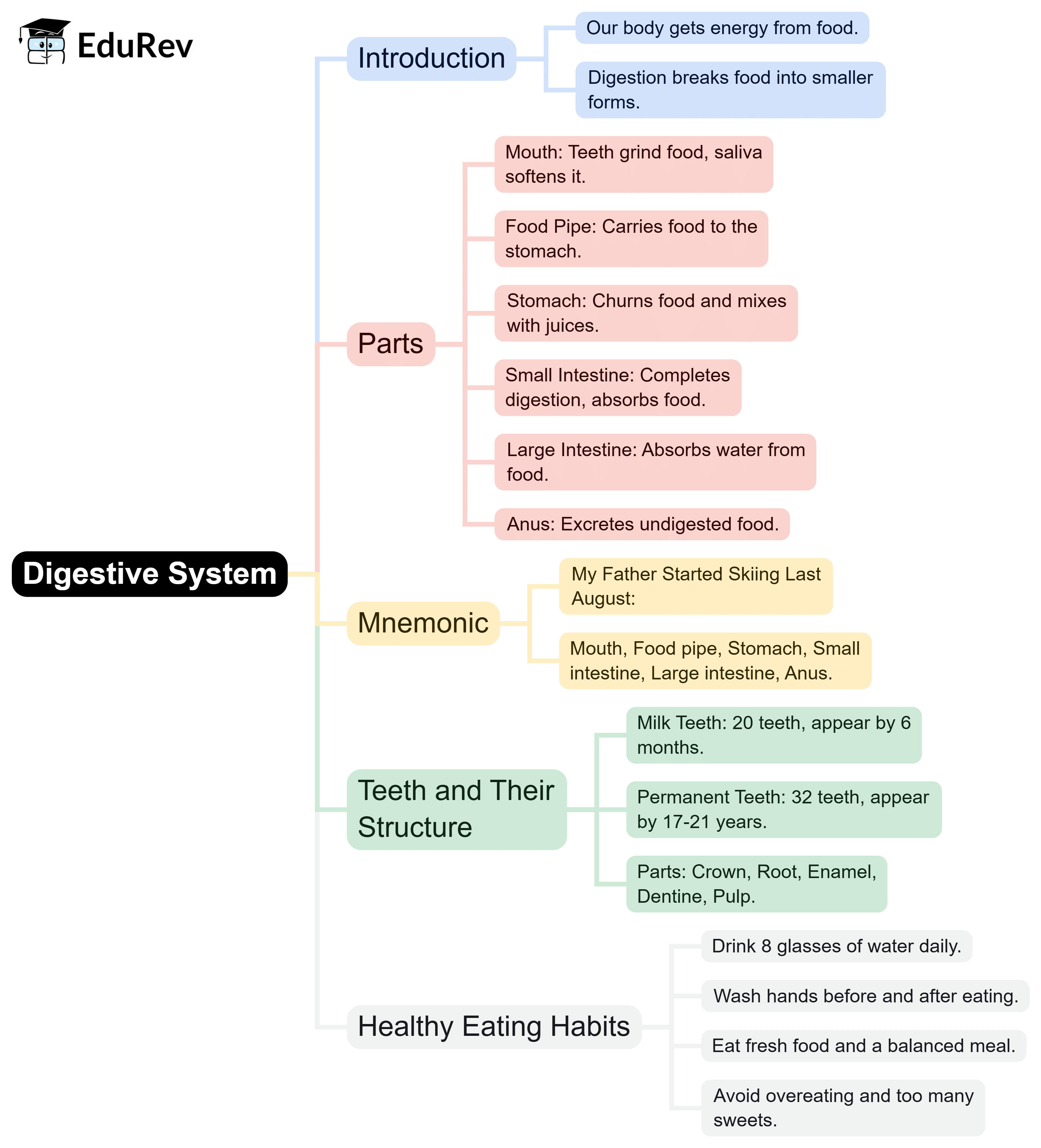
The document Mind Map: Digestive System is a part of the Class 4 Course Science for Class 4.
All you need of Class 4 at this link: Class 4
FAQs on Mind Map: Digestive System
| 1. What are the main parts of the digestive system and what does each one do? |  |
Ans. The digestive system consists of the mouth, oesophagus, stomach, small intestine, large intestine, and rectum. The mouth breaks down food mechanically and chemically, the stomach churns food into a paste, and the small intestine absorbs nutrients. The large intestine absorbs water and removes waste. Understanding these organs through digestive system mind maps helps visualise how each part plays a specific role in breaking down and absorbing nutrients from food for Class 4 students.
| 2. How does food travel through the digestive tract from mouth to stomach? | |
Ans. Food travels through the digestive tract via swallowing and muscle contractions called peristalsis. After chewing in the mouth, the food moves down the oesophagus through wave-like muscular movements, then enters the stomach for further breakdown. This journey takes several seconds. Mind map diagrams of the digestive system show this pathway clearly, helping students understand how the oesophagus acts as a connecting tube between ingestion and gastric digestion stages.
| 3. Why does the stomach produce acid and what is its purpose in digestion? | |
Ans. The stomach produces hydrochloric acid to break down proteins and kill harmful bacteria in food. This acidic environment activates digestive enzymes that further disintegrate food into smaller particles. The stomach's churning action combines acid with food, creating a semi-liquid mixture called chyme. This chemical digestion process is crucial for nutrient absorption in the small intestine, making stomach acid essential to the entire digestive system's functioning.
| 4. What is the difference between mechanical digestion and chemical digestion? | |
Ans. Mechanical digestion involves physically breaking down food through chewing and stomach churning, while chemical digestion uses enzymes and acids to break molecular bonds in food. Both processes occur simultaneously in the mouth and stomach. Mechanical digestion increases surface area for enzymes to work on, while chemical digestion actually changes food's composition. Mind map resources show how these two processes complement each other throughout the digestive tract journey.
| 5. Where does most nutrient absorption happen and why is the small intestine so important? | |
Ans. The small intestine is where most nutrient absorption occurs because its walls contain millions of tiny finger-like projections called villi. These villi dramatically increase surface area for nutrient uptake into the bloodstream. The small intestine's length and specialised structure allow nutrients from digested food to pass into blood vessels efficiently. Referring to digestive system flashcards and mind maps clarifies how the small intestine's design makes it the primary site for extracting essential nutrients for body growth and energy.
About this Document

1.5K Views

4.92/5 Rating

Apr 18, 2026 Last updated
Related Exams
Document Description: Mind Map: Digestive System for Class 4 2026 is part of Science for Class 4 preparation. The notes and questions for Mind Map: Digestive System have been prepared according to the Class 4 exam syllabus. Information about Mind Map: Digestive System covers topics like and Mind Map: Digestive System Example, for Class 4 2026 Exam. Find important definitions, questions, notes, meanings, examples, exercises and tests below for Mind Map: Digestive System.
Introduction of Mind Map: Digestive System in English is available as part of our Science for Class 4 for Class 4 & Mind Map: Digestive System in Hindi for Science for Class 4 course. Download more important topics related with notes, lectures and mock test series for Class 4 Exam by signing up for free. Class 4: Mind Map: Digestive System
Description
Mind Map: Digestive System of Science provides you one-page visual summary of the chapter covering all the important topics. Download the PDF from EduRev.
Information about Mind Map: Digestive System
In this doc you can find the meaning of Mind Map: Digestive System defined & explained in the simplest way possible. Besides explaining types of Mind Map: Digestive System theory, EduRev gives you an ample number of questions to practice Mind Map: Digestive System tests, examples and also practice Class 4 tests



Related Searches
Objective type Questions, Viva Questions, past year papers, mock tests for examination, Sample Paper, Free, Summary, Extra Questions, Exam, pdf , Previous Year Questions with Solutions, video lectures, practice quizzes, Semester Notes, shortcuts and tricks, ppt, Mind Map: Digestive System, study material, Important questions, Mind Map: Digestive System, MCQs, Mind Map: Digestive System;