CBSE Class 6 > Class 6 Notes > Social Studies > Mind Map: India's Cultural Roots
Mind Map: India's Cultural Roots

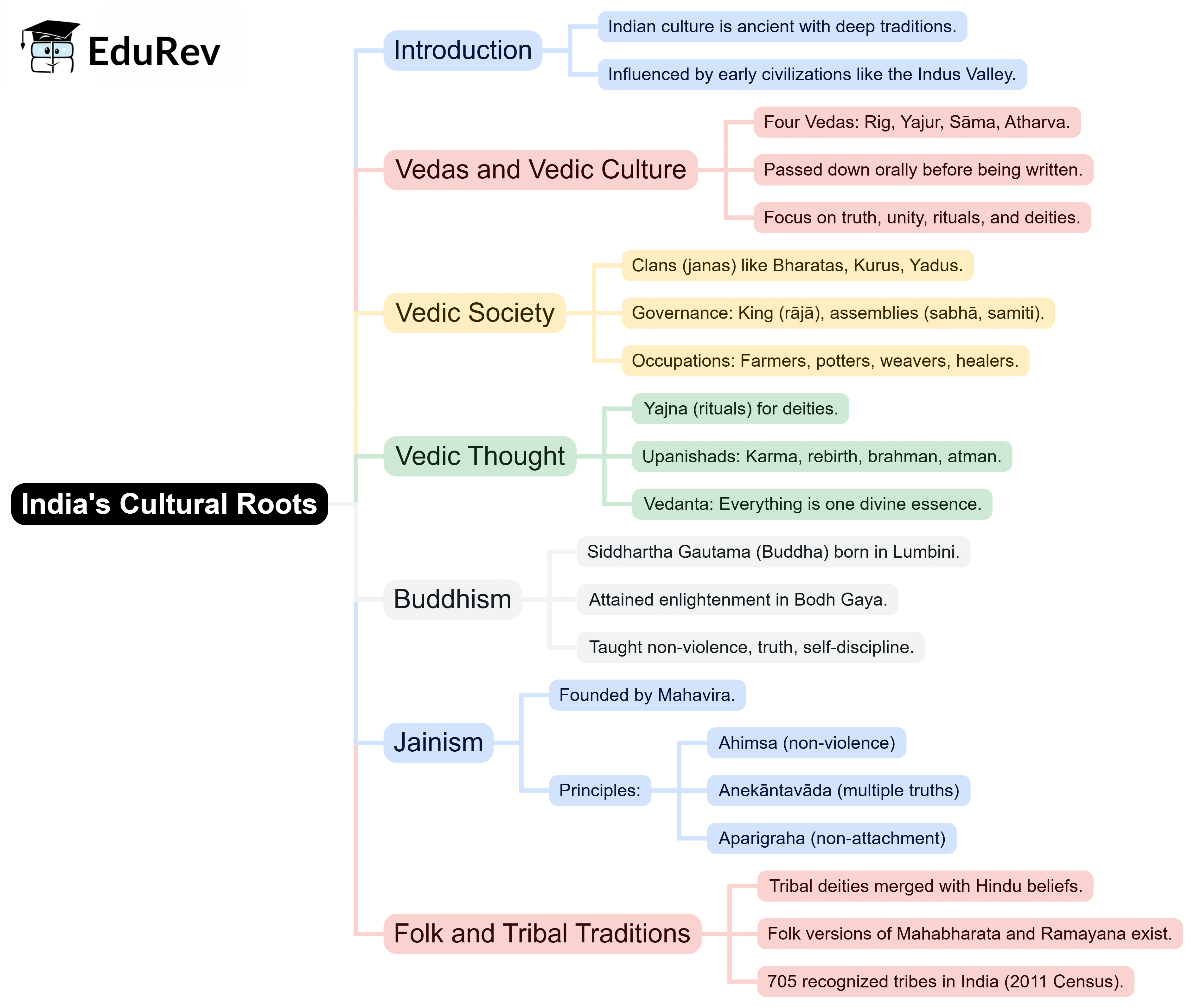
The document Mind Map: India's Cultural Roots is a part of the Class 6 Course Social Studies for Class 6.
All you need of Class 6 at this link: Class 6
FAQs on Mind Map: India's Cultural Roots
| 1. What are the main sources of India's cultural roots that I should know for Class 6? |  |
Ans. India's cultural roots emerge from ancient civilizations, religious traditions, languages, art forms, and philosophical beliefs spanning thousands of years. Key sources include the Indus Valley Civilization, Vedic traditions, Buddhism, Jainism, and regional folk practices. These elements shaped Indian society, values, and customs that persist today, forming the foundation of India's diverse cultural identity and heritage.
| 2. How do ancient Indian philosophies and spiritual traditions connect to modern Indian culture? | |
Ans. Ancient Indian philosophies like Vedanta, Buddhism, and Jainism established core values-dharma, ahimsa, and karma-that remain embedded in contemporary Indian life, ethics, and social practices. These spiritual traditions influenced literature, art, architecture, and daily customs across regions. Understanding their origins helps explain why Indian culture emphasizes tolerance, respect for nature, and moral living, connecting past wisdom to present-day traditions.
| 3. What role did different religions play in shaping India's cultural identity through history? | |
Ans. Hinduism, Buddhism, Jainism, Islam, and later Christianity contributed distinct artistic styles, festivals, architectural marvels, and philosophical ideas to Indian culture. Each religion introduced unique practices, languages, and knowledge systems that interacted and blended over centuries. This religious diversity created India's pluralistic cultural fabric, where multiple traditions coexist and influence each other, making Indian culture uniquely syncretic and inclusive.
| 4. Why is the Indus Valley Civilization important to understanding India's cultural heritage? | |
Ans. The Indus Valley Civilization (3300-1300 BCE) represents India's earliest urban culture, revealing sophisticated city planning, trade systems, and artistic traditions. Archaeological findings show advanced drainage systems, standardized weights, and terracotta figurines reflecting spiritual beliefs. This ancient civilization established foundational elements of Indian aesthetics and social organisation, making it crucial for understanding how India's cultural roots developed over millennia.
| 5. What classical art forms and literature emerged from India's cultural traditions and why do they matter? | |
Ans. Classical Indian art forms like Bharatanatyam dance, Kathak, and Sanskrit literature including the Mahabharata and Ramayana originated from ancient religious and philosophical traditions. These art forms encoded stories, spiritual teachings, and moral lessons, serving as cultural repositories. They remain vital today, preserving India's intellectual heritage, aesthetic values, and storytelling traditions while connecting contemporary society to ancient wisdom and artistic excellence across generations.
About this Document

6.1K Views

4.81/5 Rating

Apr 19, 2026 Last updated
Related Exams
Document Description: Mind Map: India's Cultural Roots for Class 6 2026 is part of Social Studies for Class 6 preparation. The notes and questions for Mind Map: India's Cultural Roots have been prepared according to the Class 6 exam syllabus. Information about Mind Map: India's Cultural Roots covers topics like and Mind Map: India's Cultural Roots Example, for Class 6 2026 Exam. Find important definitions, questions, notes, meanings, examples, exercises and tests below for Mind Map: India's Cultural Roots.
Introduction of Mind Map: India's Cultural Roots in English is available as part of our Social Studies for Class 6 for Class 6 & Mind Map: India's Cultural Roots in Hindi for Social Studies for Class 6 course. Download more important topics related with notes, lectures and mock test series for Class 6 Exam by signing up for free. Class 6: Mind Map: India's Cultural Roots
Description
Mind Map: India's Cultural Roots of SST provides you one-page visual summary of the chapter covering all the important topics. Download the PDF from EduRev.
Information about Mind Map: India's Cultural Roots
In this doc you can find the meaning of Mind Map: India's Cultural Roots defined & explained in the simplest way possible. Besides explaining types of Mind Map: India's Cultural Roots theory, EduRev gives you an ample number of questions to practice Mind Map: India's Cultural Roots tests, examples and also practice Class 6 tests



Related Searches
practice quizzes, past year papers, Previous Year Questions with Solutions, Mind Map: India's Cultural Roots, Exam, MCQs, Summary, ppt, Free, Mind Map: India's Cultural Roots, mock tests for examination, Extra Questions, Viva Questions, Mind Map: India's Cultural Roots, Sample Paper, shortcuts and tricks, Objective type Questions, pdf , Semester Notes, study material, video lectures, Important questions;