CBSE Class 10 > Class 10 Notes > Science > Mind Map: Control & Coordination
Mind Map: Control & Coordination

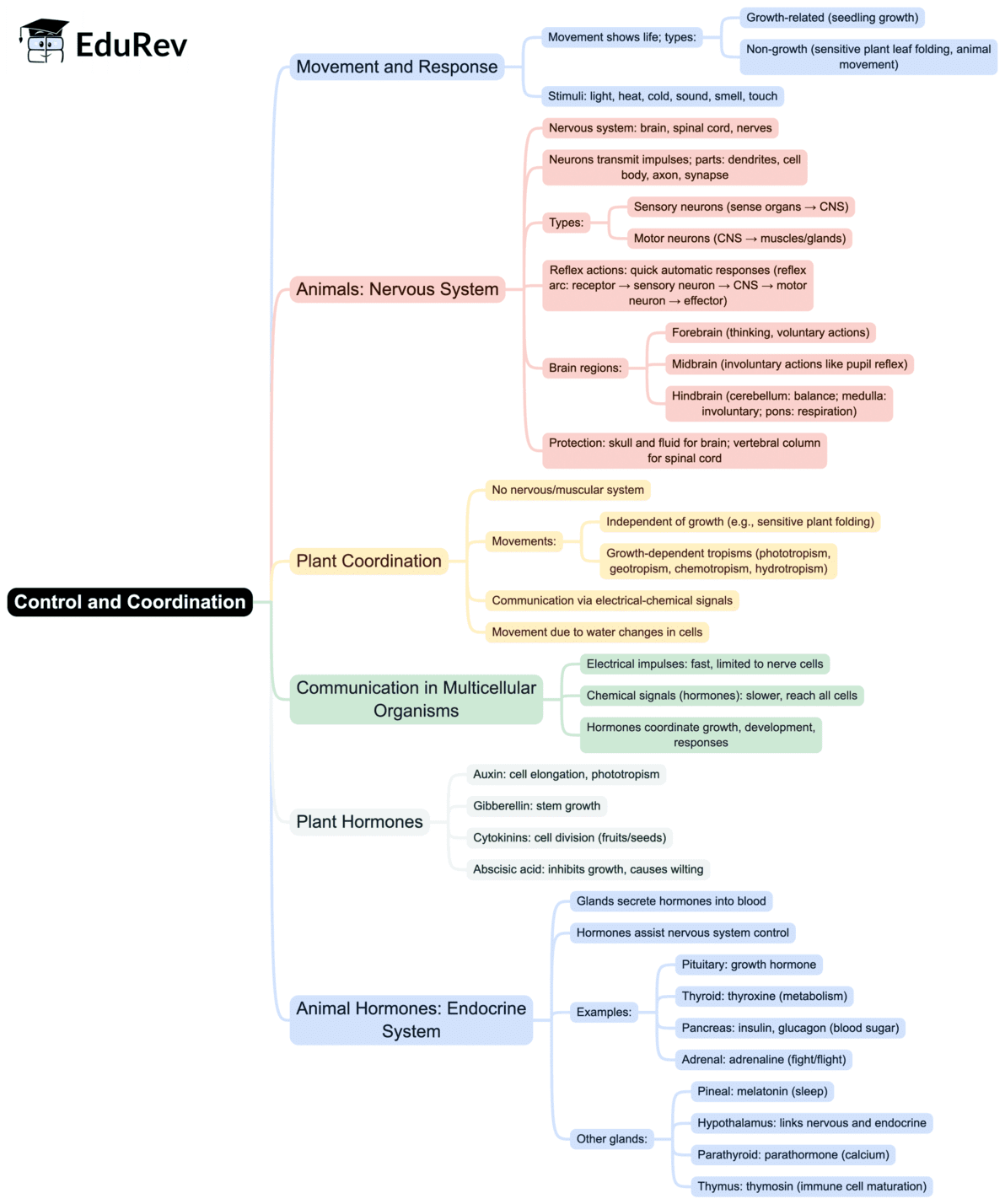
The document Mind Map: Control & Coordination is a part of the Class 10 Course Science Class 10.
All you need of Class 10 at this link: Class 10
FAQs on Mind Map: Control & Coordination
| 1. What is the role of the nervous system in control and coordination? |  |
Ans. The nervous system is essential for control and coordination as it processes information from sensory organs, sends signals to muscles, and regulates bodily functions. It consists of the central nervous system (CNS) and the peripheral nervous system (PNS), working together to maintain homeostasis and respond to stimuli.
| 2. How do hormones contribute to control and coordination in the body? | |
Ans. Hormones are chemical messengers produced by glands in the endocrine system. They travel through the bloodstream to target organs, regulating various physiological processes such as growth, metabolism, and mood. Hormonal control complements the nervous system, allowing for longer-lasting effects on body functions.
| 3. What are the main differences between the nervous system and the endocrine system in terms of control and coordination? | |
Ans. The nervous system provides rapid and short-term responses through electrical impulses, while the endocrine system offers slower, longer-lasting effects via hormonal signals. The nervous system is involved in immediate reactions, whereas the endocrine system regulates processes over a longer duration, such as growth and development.
| 4. What is the significance of reflex actions in control and coordination? | |
Ans. Reflex actions are automatic responses to stimuli that occur without conscious thought. They are crucial for protecting the body from harm, allowing for quick reactions to dangerous situations. Reflex arcs involve sensory neurons, interneurons, and motor neurons, enabling rapid communication and response.
| 5. How do plants exhibit control and coordination? | |
Ans. Plants exhibit control and coordination through hormonal responses and tropisms. Hormones like auxins regulate growth and response to environmental stimuli (e.g., light and gravity). Tropisms, such as phototropism and gravitropism, help plants orient themselves for optimal growth and resource acquisition.
About this Document

3.8K Views

4.66/5 Rating

Apr 29, 2026 Last updated
Related Exams
Document Description: Mind Map: Control & Coordination for Class 10 2026 is part of Science Class 10 preparation. The notes and questions for Mind Map: Control & Coordination have been prepared according to the Class 10 exam syllabus. Information about Mind Map: Control & Coordination covers topics like and Mind Map: Control & Coordination Example, for Class 10 2026 Exam. Find important definitions, questions, notes, meanings, examples, exercises and tests below for Mind Map: Control & Coordination.
Introduction of Mind Map: Control & Coordination in English is available as part of our Science Class 10 for Class 10 & Mind Map: Control & Coordination in Hindi for Science Class 10 course. Download more important topics related with notes, lectures and mock test series for Class 10 Exam by signing up for free. Class 10: Mind Map: Control & Coordination
Description
Mind Map: Control & Coordination of Science Class 10 provides you one-page visual summary of the chapter covering all the important topics. Download the PDF from EduRev.
Information about Mind Map: Control & Coordination
In this doc you can find the meaning of Mind Map: Control & Coordination defined & explained in the simplest way possible. Besides explaining types of Mind Map: Control & Coordination theory, EduRev gives you an ample number of questions to practice Mind Map: Control & Coordination tests, examples and also practice Class 10 tests



Related Searches
Previous Year Questions with Solutions, Viva Questions, Sample Paper, Important questions, Extra Questions, Mind Map: Control & Coordination, Mind Map: Control & Coordination, shortcuts and tricks, MCQs, Exam, ppt, Objective type Questions, mock tests for examination, Summary, study material, pdf , Mind Map: Control & Coordination, practice quizzes, video lectures, Free, Semester Notes, past year papers;