CBSE Class 8 > Class 8 Notes > Science > Mind Map: Sound
Mind Map: Sound

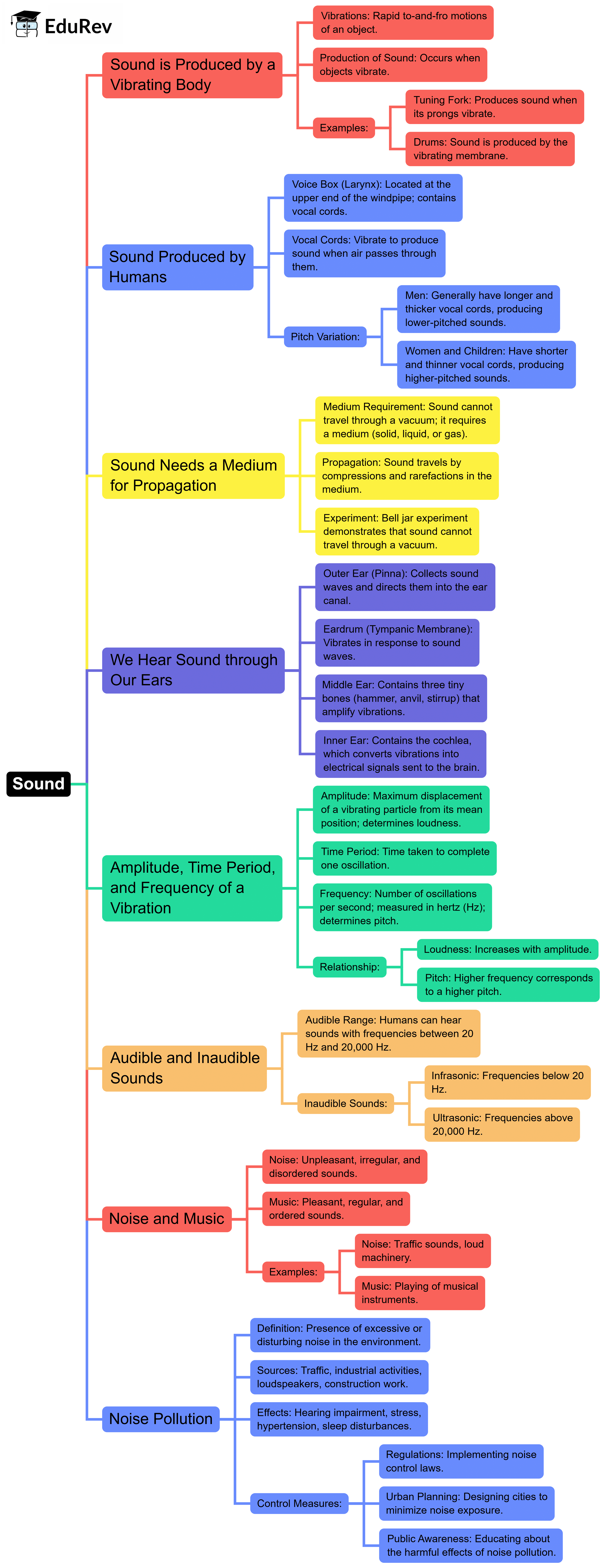
The document Mind Map: Sound is a part of the Class 8 Course Science Class 8.
All you need of Class 8 at this link: Class 8
FAQs on Mind Map: Sound
| 1. What are the different types of sound waves? |  |
Ans. Sound waves can be classified into two main types: longitudinal waves and transverse waves. Longitudinal waves, where the particle displacement is parallel to the direction of wave propagation, are the most common in air. Transverse waves, where particle displacement is perpendicular to the direction of wave propagation, are typically found in solids.
| 2. How do sound waves travel through different mediums? | |
Ans. Sound waves travel through different mediums such as solids, liquids, and gases by causing particles in the medium to vibrate. In gases, sound travels slower due to the larger distance between particles, while in solids, sound travels faster because particles are closer together, allowing for quicker energy transfer.
| 3. What factors affect the speed of sound? | |
Ans. The speed of sound is affected by several factors including the medium's temperature, density, and elasticity. Generally, sound travels faster in warmer temperatures because increased energy causes particles to vibrate more quickly. It also travels faster in denser and more elastic materials.
| 4. What is the relationship between frequency and pitch in sound? | |
Ans. Frequency refers to the number of vibrations or cycles per second of a sound wave, measured in Hertz (Hz). Pitch is the perceived frequency of a sound; higher frequencies correspond to higher pitches, while lower frequencies correspond to lower pitches. Therefore, frequency directly influences how we perceive the pitch of a sound.
| 5. How do human ears perceive sound? | |
Ans. Human ears perceive sound through a complex process. Sound waves enter the ear canal, causing the eardrum to vibrate. These vibrations are transmitted through tiny bones in the middle ear to the cochlea in the inner ear, where they are converted into electrical signals that are sent to the brain, allowing us to interpret the sound.
About this Document

2.5K Views

4.92/5 Rating

Apr 30, 2026 Last updated
Document Description: Mind Map: Sound for Class 8 2026 is part of Science Class 8 preparation. The notes and questions for Mind Map: Sound have been prepared according to the Class 8 exam syllabus. Information about Mind Map: Sound covers topics like and Mind Map: Sound Example, for Class 8 2026 Exam. Find important definitions, questions, notes, meanings, examples, exercises and tests below for Mind Map: Sound.
Introduction of Mind Map: Sound in English is available as part of our Science Class 8 for Class 8 & Mind Map: Sound in Hindi for Science Class 8 course. Download more important topics related with notes, lectures and mock test series for Class 8 Exam by signing up for free. Class 8: Mind Map: Sound
Description
Mind Map: Sound of Science Class 8 provides you one-page visual summary of the chapter covering all the important topics. Download the PDF from EduRev.
Information about Mind Map: Sound
In this doc you can find the meaning of Mind Map: Sound defined & explained in the simplest way possible. Besides explaining types of Mind Map: Sound theory, EduRev gives you an ample number of questions to practice Mind Map: Sound tests, examples and also practice Class 8 tests



Related Searches
Mind Map: Sound, ppt, Semester Notes, Previous Year Questions with Solutions, study material, pdf , Objective type Questions, Important questions, Summary, Viva Questions, Extra Questions, past year papers, Exam, video lectures, shortcuts and tricks, mock tests for examination, MCQs, Sample Paper, Free, practice quizzes, Mind Map: Sound, Mind Map: Sound;