Electrical Engineering (EE) Exam > Electrical Engineering (EE) Notes > Electrical Machines > Mind Map: Electrical Machines Basics
Mind Map: Electrical Machines Basics

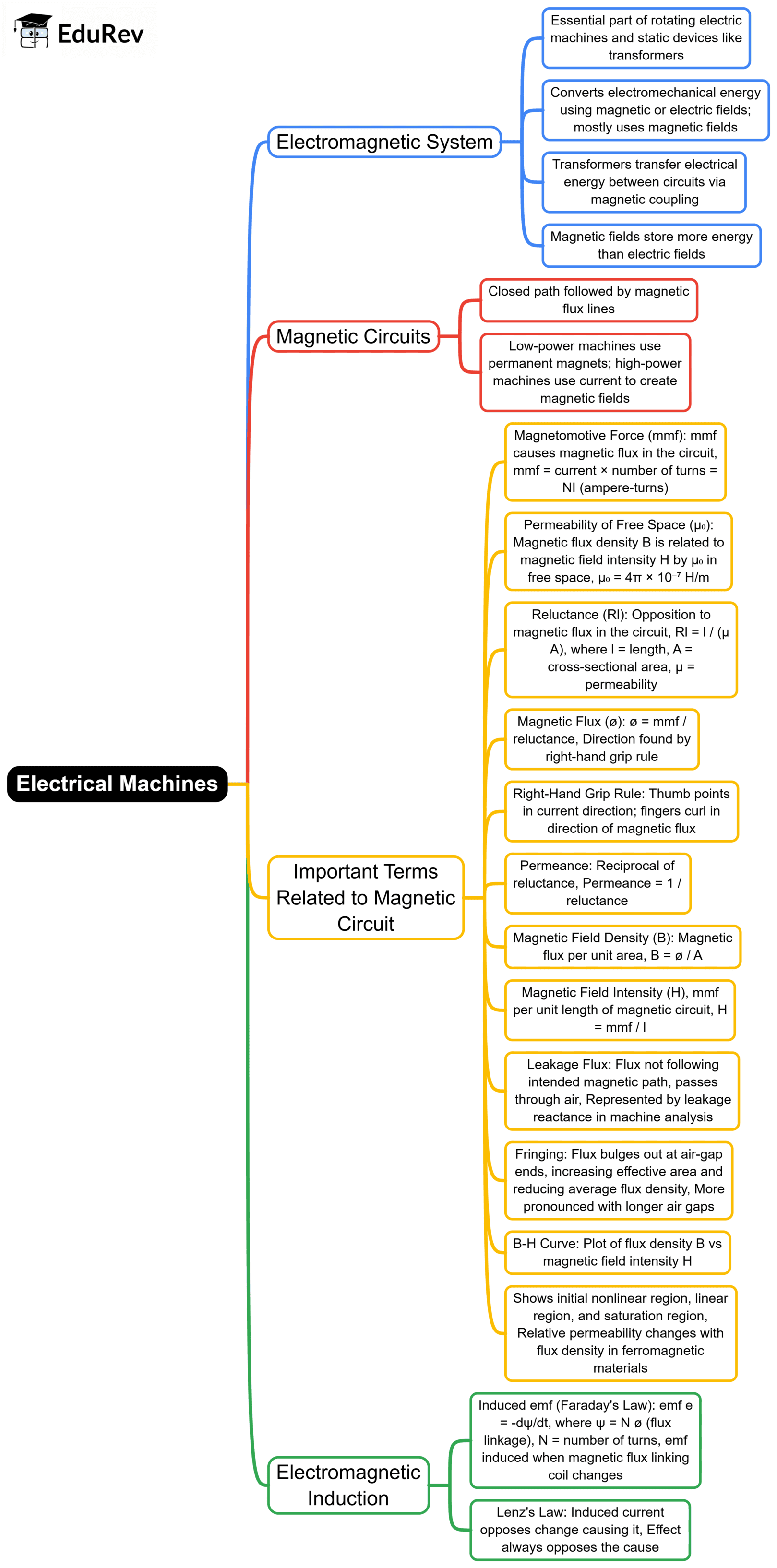
The document Mind Map: Electrical Machines Basics is a part of the Electrical Engineering (EE) Course Electrical Machines.
All you need of Electrical Engineering (EE) at this link: Electrical Engineering (EE)
FAQs on Mind Map: Electrical Machines Basics
| 1. What are the main types of electrical machines and how do they differ? |  |
Ans. Electrical machines are classified into two primary categories: generators (converting mechanical energy into electrical energy) and motors (converting electrical energy into mechanical energy). Within these, machines are further divided into AC machines (alternators, induction motors, synchronous motors) and DC machines (DC generators, DC motors). Each type operates on different electromagnetic principles and serves distinct industrial applications.
| 2. How does electromagnetic induction work in electrical machines? | |
Ans. Electromagnetic induction occurs when a magnetic field changes relative to a conductor, inducing an electromotive force (EMF). In electrical machines, rotating coils within magnetic fields generate this changing flux, producing voltage or torque. This principle, governed by Faraday's law, is fundamental to both generator operation and motor performance across AC and DC machines.
| 3. What's the difference between synchronous and asynchronous motors in practical use? | |
Ans. Synchronous motors rotate at a speed directly proportional to the supply frequency, maintaining a fixed relationship between rotor and magnetic field. Asynchronous (induction) motors operate at speeds slightly below synchronous speed due to slip, making them self-starting and more robust for industrial applications. Synchronous motors require external excitation and offer better power factor control.
| 4. Why do electrical machines need a commutator or slip rings? | |
Ans. Commutators (in DC machines) reverse current direction every half-cycle, ensuring unidirectional torque output. Slip rings (in AC machines) maintain electrical connections between stationary and rotating components without interrupting current flow. Both devices enable continuous power conversion and are essential for stable machine operation across different load conditions.
| 5. How can I quickly understand all electrical machine basics using visual study tools? | |
Ans. Mind maps effectively organise electrical machine fundamentals by linking core concepts like electromagnetic principles, machine classifications, and operating characteristics visually. Refer to EduRev's mind maps, flashcards, and PPTs on electrical machines basics to grasp relationships between stators, rotors, windings, and torque generation. Visual learning accelerates concept retention for board exam preparation.
About this Document

1.4K Views

4.90/5 Rating

Apr 19, 2026 Last updated
Related Exams
Document Description: Mind Map: Electrical Machines Basics for Electrical Engineering (EE) 2026 is part of Electrical Machines preparation. The notes and questions for Mind Map: Electrical Machines Basics have been prepared according to the Electrical Engineering (EE) exam syllabus. Information about Mind Map: Electrical Machines Basics covers topics like and Mind Map: Electrical Machines Basics Example, for Electrical Engineering (EE) 2026 Exam. Find important definitions, questions, notes, meanings, examples, exercises and tests below for Mind Map: Electrical Machines Basics.
Introduction of Mind Map: Electrical Machines Basics in English is available as part of our Electrical Machines for Electrical Engineering (EE) & Mind Map: Electrical Machines Basics in Hindi for Electrical Machines course. Download more important topics related with notes, lectures and mock test series for Electrical Engineering (EE) Exam by signing up for free. Electrical Engineering (EE): Mind Map: Electrical Machines Basics
Description
Mind Map: Electrical Machines Basics of Electrical Machines provides you one-page visual summary of the chapter covering all the important topics. Download the PDF from EduRev.
Information about Mind Map: Electrical Machines Basics
In this doc you can find the meaning of Mind Map: Electrical Machines Basics defined & explained in the simplest way possible. Besides explaining types of Mind Map: Electrical Machines Basics theory, EduRev gives you an ample number of questions to practice Mind Map: Electrical Machines Basics tests, examples and also practice Electrical Engineering (EE) tests
 | Explore Courses for Electrical Engineering (EE) exam |  |
 | Get EduRev Notes directly in your Google search | |
Related Searches
past year papers, Exam, Extra Questions, Semester Notes, Objective type Questions, study material, mock tests for examination, video lectures, pdf , practice quizzes, Previous Year Questions with Solutions, Mind Map: Electrical Machines Basics, Mind Map: Electrical Machines Basics, Mind Map: Electrical Machines Basics, Summary, Viva Questions, Sample Paper, shortcuts and tricks, Important questions, MCQs, Free, ppt;