Electronics and Communication Engineering (ECE) Exam > Electronics and Communication Engineering (ECE) Notes > Mind Map: Number System
Mind Map: Number System

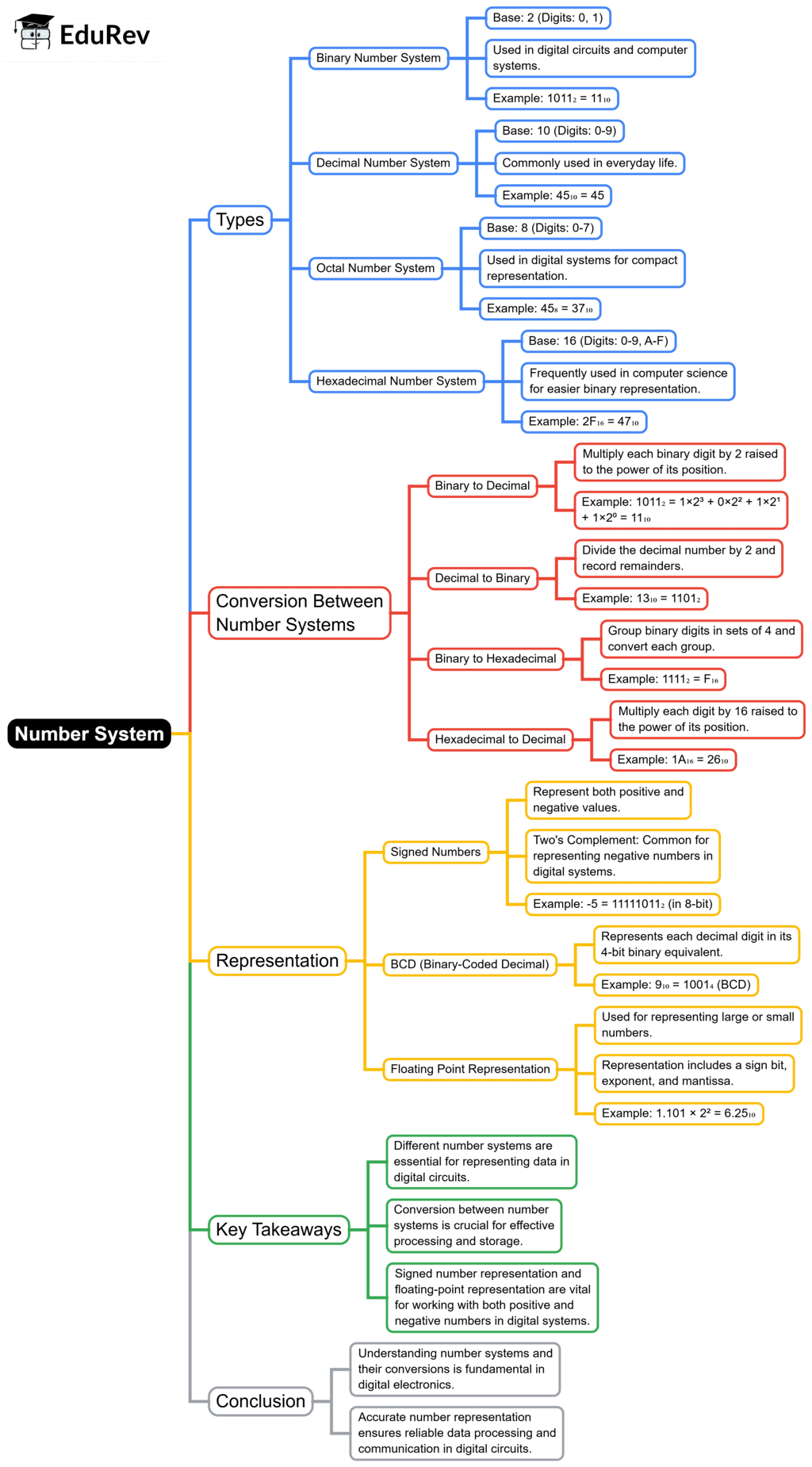
The document Mind Map: Number System is a part of Electronics and Communication Engineering (ECE) category.
All you need of Electronics and Communication Engineering (ECE) at this link: Electronics and Communication Engineering (ECE)
FAQs on Mind Map: Number System
| 1. What is the importance of the number system in Electronics and Communication Engineering (ECE)? |  |
Ans. The number system is fundamental in ECE as it provides the basis for data representation, processing, and communication in digital circuits. Different number systems like binary, decimal, octal, and hexadecimal are used to represent information in electronics, allowing for efficient data manipulation, storage, and transmission in devices and systems.
| 2. What are the different types of number systems used in ECE? | |
Ans. In ECE, the primary number systems used are: 1. <b>Binary (Base-2)</b>: Used in digital circuits and computer systems. 2. <b>Decimal (Base-10)</b>: Commonly used in everyday life and human-readable formats. 3. <b>Octal (Base-8)</b>: Sometimes used in computing as a shorthand for binary. 4. <b>Hexadecimal (Base-16)</b>: Often used in programming and memory address representation due to its compactness compared to binary.
| 3. How do you convert a binary number to a decimal number? | |
Ans. To convert a binary number to a decimal number, you multiply each bit by 2 raised to the power of its position (starting from 0 on the right) and then sum all the results. For example, the binary number 1011 is converted as follows: (1×2^3) + (0×2^2) + (1×2^1) + (1×2^0) = 8 + 0 + 2 + 1 = 11 in decimal.
| 4. What is the significance of the hexadecimal number system in ECE? | |
Ans. The hexadecimal number system is significant in ECE because it simplifies binary representation. One hexadecimal digit represents four binary digits (bits), making it easier to read and write large binary numbers. It is widely used in programming, memory addressing, and to represent color codes in web design.
| 5. How can one perform arithmetic operations in different number systems? | |
Ans. Arithmetic operations in different number systems can be performed similarly to decimal arithmetic, but one must be aware of the base of the number system. For example, in binary addition, if the sum exceeds 1, a carry is generated to the next higher bit. The same principle applies to subtraction, multiplication, and division, where specific rules for carrying and borrowing must be followed based on the base of the number system being used.
About this Document

4.1/5 Rating

Apr 29, 2026 Last updated
Related Exams
Document Description: Mind Map: Number System for Electronics and Communication Engineering (ECE) 2026 is part of Electronics and Communication Engineering (ECE) preparation. The notes and questions for Mind Map: Number System have been prepared according to the Electronics and Communication Engineering (ECE) exam syllabus. Information about Mind Map: Number System covers topics like and Mind Map: Number System Example, for Electronics and Communication Engineering (ECE) 2026 Exam. Find important definitions, questions, notes, meanings, examples, exercises and tests below for Mind Map: Number System.
Introduction of Mind Map: Number System in English is available as part of our Electronics and Communication Engineering (ECE) preparation & Mind Map: Number System in Hindi for Electronics and Communication Engineering (ECE) courses. Download more important topics, notes, lectures and mock test series for Electronics and Communication Engineering (ECE) Exam by signing up for free. Electronics and Communication Engineering (ECE): Mind Map: Number System
Description
Mind Map: Number System of covers all the important topics, helping you prepare for the Electronics & Communication Engineering (ECE) exam on EduRev. Start for free!
Information about Mind Map: Number System
In this doc you can find the meaning of Mind Map: Number System defined & explained in the simplest way possible. Besides explaining types of Mind Map: Number System theory, EduRev gives you an ample number of questions to practice Mind Map: Number System tests, examples and also practice Electronics and Communication Engineering (ECE) tests.
Download as PDF
Top Courses for Electronics and Communication Engineering (ECE)
Related Searches
Summary, Important questions, video lectures, Objective type Questions, ppt, Previous Year Questions with Solutions, Mind Map: Number System, pdf , shortcuts and tricks, mock tests for examination, Free, practice quizzes, MCQs, Exam, Mind Map: Number System, Semester Notes, Viva Questions, Mind Map: Number System, study material, Sample Paper, past year papers, Extra Questions;