Engineering Mathematics Exam > Engineering Mathematics Notes > Engineering Mathematics > Mind Map: Calculus
Mind Map: Calculus

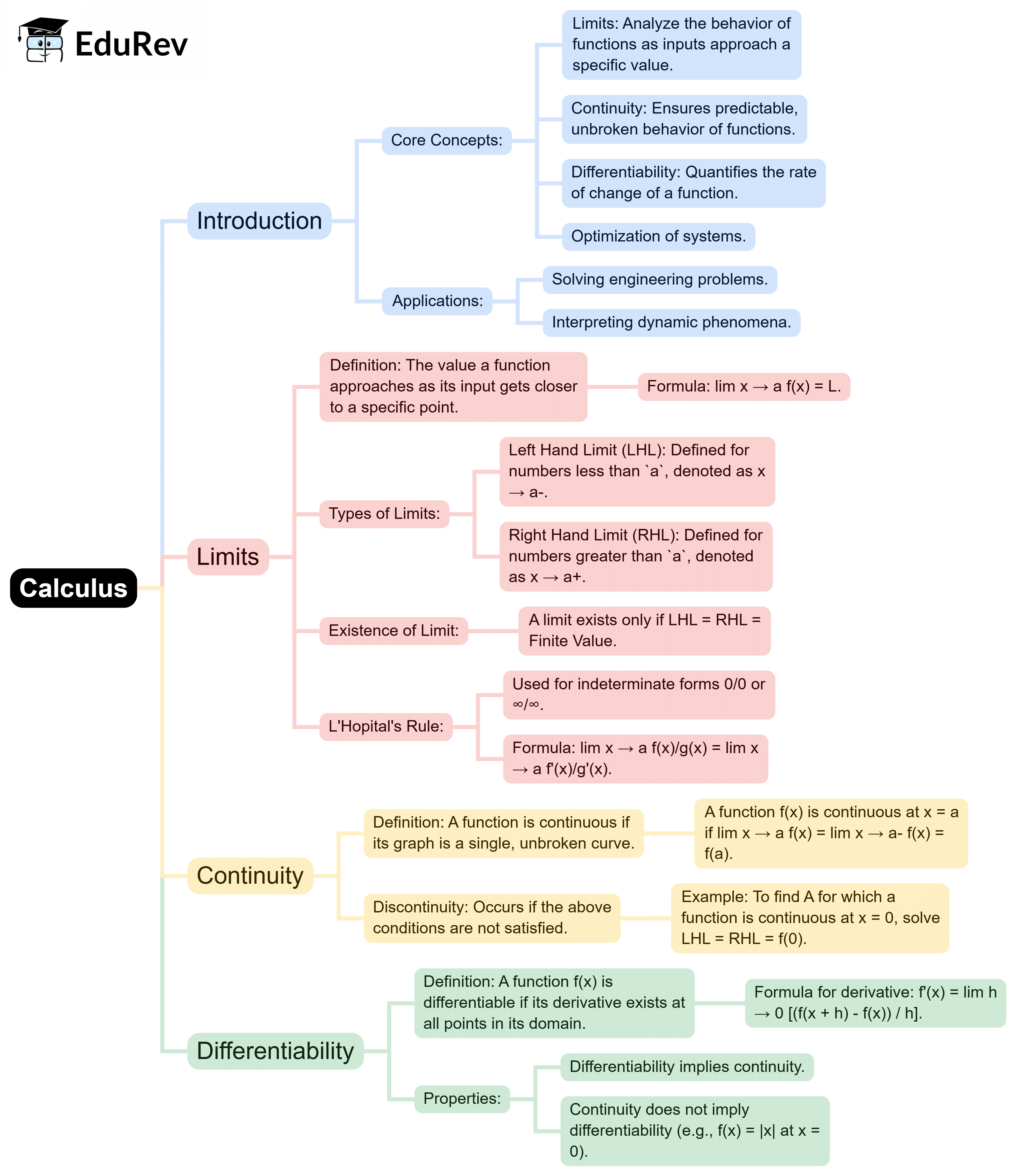
The document Mind Map: Calculus is a part of the Engineering Mathematics Course Engineering Mathematics.
All you need of Engineering Mathematics at this link: Engineering Mathematics
FAQs on Mind Map: Calculus
| 1. What is the fundamental theorem of calculus and why is it important? |  |
Ans. The fundamental theorem of calculus links the concept of differentiation with integration. It states that if a function is continuous over an interval, then the integral of that function can be computed using its antiderivative. This theorem is crucial because it provides a way to evaluate definite integrals and establishes a deep connection between the two main branches of calculus.
| 2. How do you find the derivative of a function? | |
Ans. To find the derivative of a function, you can apply the limit definition of a derivative or use differentiation rules such as the power rule, product rule, quotient rule, and chain rule. The derivative represents the rate of change of the function at a particular point. For example, if you have a function f(x) = x^3, the derivative f'(x) can be found using the power rule, resulting in f'(x) = 3x^2.
| 3. What are the applications of integrals in real life? | |
Ans. Integrals have numerous applications in real life, including calculating areas under curves, determining the total accumulation of quantities (like distance traveled over time), and finding volumes of solids of revolution. They are also used in fields such as physics for calculating work done by a force, in economics for consumer and producer surplus, and in biology for population modeling.
| 4. What is the difference between definite and indefinite integrals? | |
Ans. The key difference between definite and indefinite integrals lies in their outcomes. An indefinite integral represents a family of functions and includes a constant of integration (C), while a definite integral calculates the net area under the curve between two specific points (limits) and results in a numerical value. For example, ∫ f(x) dx (indefinite) vs. ∫[a, b] f(x) dx (definite).
| 5. How do you solve limits in calculus? | |
Ans. To solve limits in calculus, you can use various techniques such as direct substitution, factoring, rationalizing, or applying L'Hôpital's rule when you encounter indeterminate forms like 0/0. The limit describes the behavior of a function as it approaches a specific point. For example, to find the limit of f(x) as x approaches 2, you would evaluate f(2) if it's defined, or apply these techniques if it leads to an indeterminate form.
About this Document

4.86/5 Rating

Apr 29, 2026 Last updated
Related Exams
Document Description: Mind Map: Calculus for Engineering Mathematics 2026 is part of Engineering Mathematics preparation. The notes and questions for Mind Map: Calculus have been prepared according to the Engineering Mathematics exam syllabus. Information about Mind Map: Calculus covers topics like and Mind Map: Calculus Example, for Engineering Mathematics 2026 Exam. Find important definitions, questions, notes, meanings, examples, exercises and tests below for Mind Map: Calculus.
Introduction of Mind Map: Calculus in English is available as part of our Engineering Mathematics for Engineering Mathematics & Mind Map: Calculus in Hindi for Engineering Mathematics course. Download more important topics related with notes, lectures and mock test series for Engineering Mathematics Exam by signing up for free. Engineering Mathematics: Mind Map: Calculus
Description
Mind Map: Calculus of Engineering Mathematics provides you one-page visual summary of the chapter covering all the important topics. Download the PDF from EduRev.
Information about Mind Map: Calculus
In this doc you can find the meaning of Mind Map: Calculus defined & explained in the simplest way possible. Besides explaining types of Mind Map: Calculus theory, EduRev gives you an ample number of questions to practice Mind Map: Calculus tests, examples and also practice Engineering Mathematics tests



Related Searches
Viva Questions, pdf , MCQs, study material, Free, Summary, shortcuts and tricks, Mind Map: Calculus, mock tests for examination, practice quizzes, ppt, past year papers, Important questions, Objective type Questions, Semester Notes, Mind Map: Calculus, Previous Year Questions with Solutions, Sample Paper, Extra Questions, Exam, video lectures, Mind Map: Calculus;