Electrical Engineering (EE) Exam > Electrical Engineering (EE) Notes > Control Systems > Mind Map: Basics of Control System & Transfer Function
Mind Map: Basics of Control System & Transfer Function

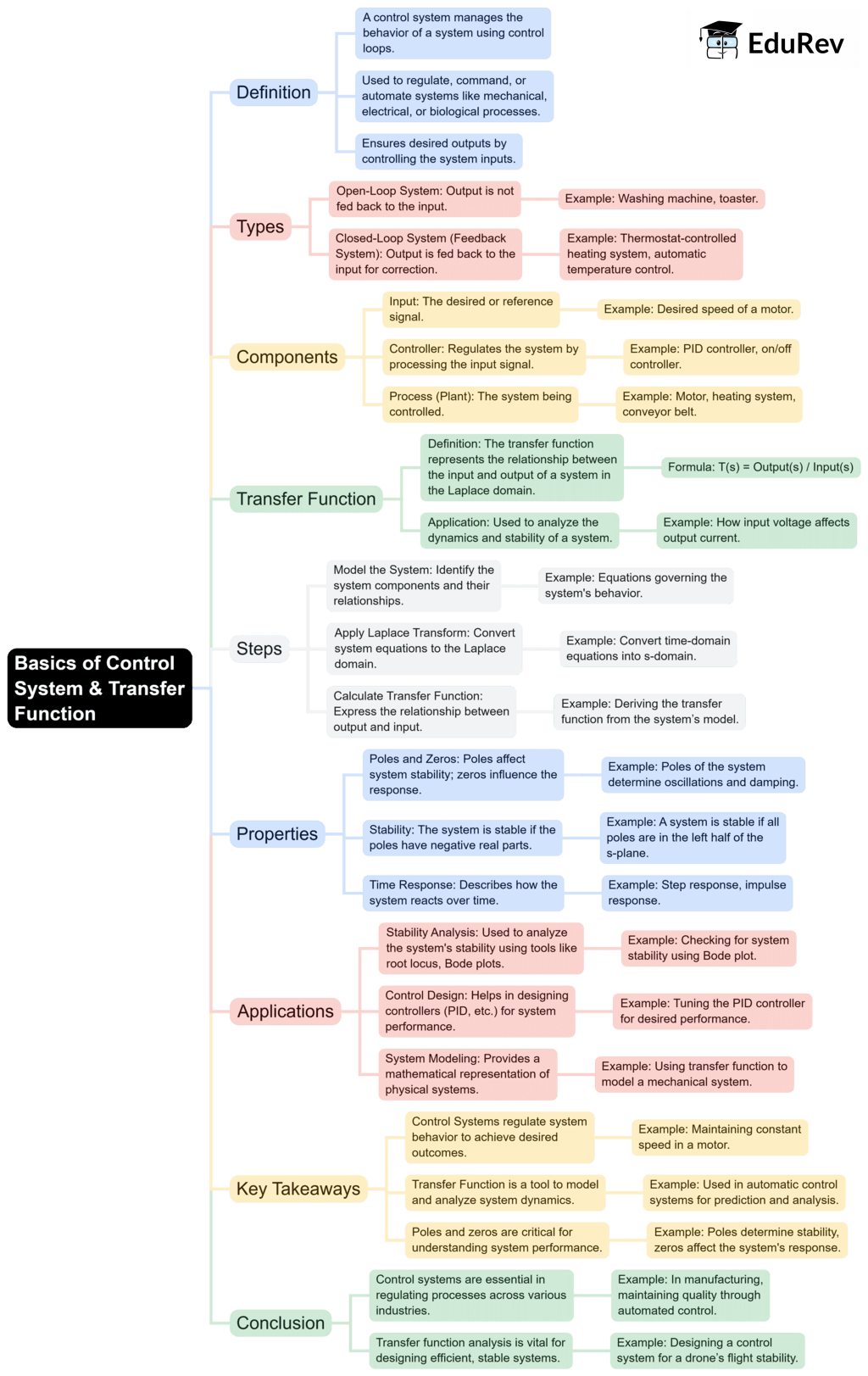
The document Mind Map: Basics of Control System & Transfer Function is a part of the Electrical Engineering (EE) Course Control Systems.
All you need of Electrical Engineering (EE) at this link: Electrical Engineering (EE)
FAQs on Mind Map: Basics of Control System & Transfer Function
| 1. What is a control system and why is it important in engineering? |  |
Ans. A control system is a set of devices or algorithms that manage, command, direct, or regulate the behavior of other devices or systems. It is important in engineering because it ensures that systems operate efficiently and reliably, allowing for automation and precise control in applications ranging from industrial processes to consumer electronics.
| 2. What is a transfer function in control systems? | |
Ans. A transfer function is a mathematical representation that relates the output of a system to its input, typically expressed in the Laplace transform domain. It provides insight into the dynamics of the system, allowing engineers to analyze stability, frequency response, and system behavior under various conditions.
| 3. How do you determine the stability of a control system using its transfer function? | |
Ans. The stability of a control system can be determined by analyzing the poles of its transfer function. If all poles have negative real parts, the system is stable. Conversely, if any poles have positive real parts or lie on the imaginary axis, the system is unstable. Techniques like the Routh-Hurwitz criterion can also be used for stability analysis.
| 4. What are the different types of control systems? | |
Ans. The main types of control systems are open-loop and closed-loop systems. Open-loop systems operate without feedback, meaning the control action is independent of the output. Closed-loop systems, on the other hand, use feedback to adjust the control action based on the output, enhancing accuracy and stability.
| 5. How can transfer functions be used to design controllers for control systems? | |
Ans. Transfer functions can be used to design controllers by allowing engineers to model the system's dynamics and predict how it will respond to various inputs. Controllers like Proportional-Integral-Derivative (PID) can be designed using transfer functions to optimize system performance, improve stability, and achieve desired response characteristics.
About this Document

4.69/5 Rating

Apr 19, 2026 Last updated
Document Description: Mind Map: Basics of Control System & Transfer Function for Electrical Engineering (EE) 2026 is part of Control Systems preparation. The notes and questions for Mind Map: Basics of Control System & Transfer Function have been prepared according to the Electrical Engineering (EE) exam syllabus. Information about Mind Map: Basics of Control System & Transfer Function covers topics like and Mind Map: Basics of Control System & Transfer Function Example, for Electrical Engineering (EE) 2026 Exam. Find important definitions, questions, notes, meanings, examples, exercises and tests below for Mind Map: Basics of Control System & Transfer Function.
Introduction of Mind Map: Basics of Control System & Transfer Function in English is available as part of our Control Systems for Electrical Engineering (EE) & Mind Map: Basics of Control System & Transfer Function in Hindi for Control Systems course. Download more important topics related with notes, lectures and mock test series for Electrical Engineering (EE) Exam by signing up for free. Electrical Engineering (EE): Mind Map: Basics of Control System & Transfer Function
Description
Mind Map: Basics of Control System & Transfer Function of Control Systems provides you one-page visual summary of the chapter covering all the important topics. Download the PDF from EduRev.
Information about Mind Map: Basics of Control System & Transfer Function
In this doc you can find the meaning of Mind Map: Basics of Control System & Transfer Function defined & explained in the simplest way possible. Besides explaining types of Mind Map: Basics of Control System & Transfer Function theory, EduRev gives you an ample number of questions to practice Mind Map: Basics of Control System & Transfer Function tests, examples and also practice Electrical Engineering (EE) tests
 | Explore Courses for Electrical Engineering (EE) exam |  |
 | Get EduRev Notes directly in your Google search | |
Related Searches
Previous Year Questions with Solutions, practice quizzes, ppt, Viva Questions, shortcuts and tricks, Sample Paper, Free, Mind Map: Basics of Control System & Transfer Function, Summary, MCQs, Exam, video lectures, Mind Map: Basics of Control System & Transfer Function, mock tests for examination, past year papers, pdf , Mind Map: Basics of Control System & Transfer Function, Extra Questions, Semester Notes, study material, Important questions, Objective type Questions;