Electronics and Communication Engineering (ECE) Exam > Electronics and Communication Engineering (ECE) Notes > Mind Map: Number System & Representation
Mind Map: Number System & Representation

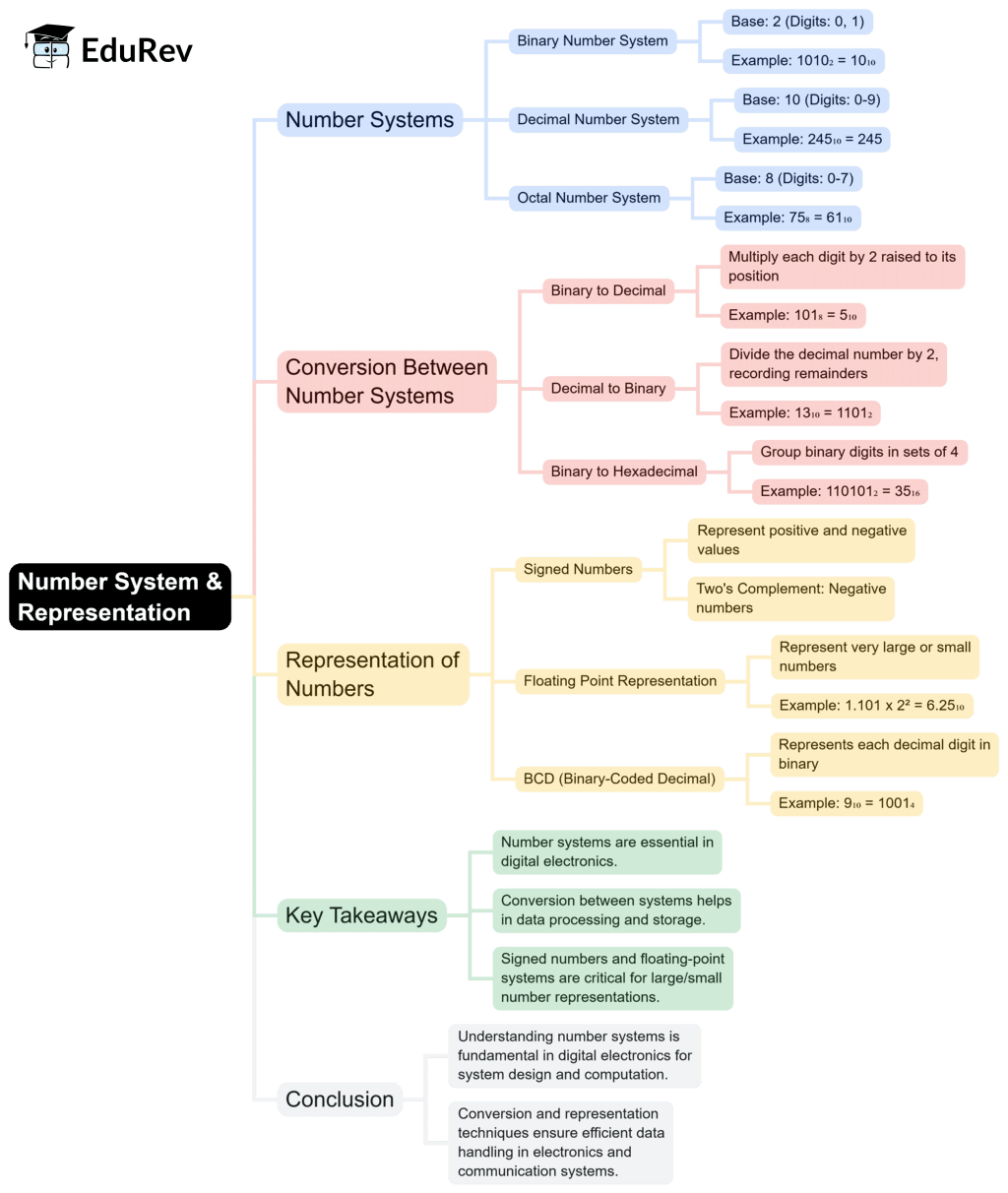
The document Mind Map: Number System & Representation is a part of Electronics and Communication Engineering (ECE) category.
All you need of Electronics and Communication Engineering (ECE) at this link: Electronics and Communication Engineering (ECE)
FAQs on Mind Map: Number System & Representation
| 1. What are the different types of number systems used in electronics? |  |
Ans. The most common number systems used in electronics are binary, decimal, octal, and hexadecimal. The binary system uses two digits (0 and 1) and is the foundation of digital electronics. The decimal system, which uses ten digits (0-9), is what humans typically use. The octal system, using eight digits (0-7), and the hexadecimal system, using sixteen digits (0-9 and A-F), are often used in computing to simplify binary representations.
| 2. How is binary representation used in digital circuits? | |
Ans. In digital circuits, binary representation is used to process information. Each bit in a binary number represents a state of a switch (ON or OFF). Logic gates, which are the building blocks of digital circuits, manipulate these binary values to perform operations such as addition, subtraction, and more complex functions, allowing computers and other digital devices to perform calculations and process data.
| 3. What is the significance of the hexadecimal number system in programming? | |
Ans. The hexadecimal number system is significant in programming because it provides a more compact representation of binary numbers. Since one hexadecimal digit represents four binary digits (bits), it reduces the length of binary strings, making it easier to read and write code. Hexadecimal is widely used in programming languages and computer systems for memory addresses, color codes in web design, and debugging.
| 4. Can you explain how to convert a binary number to decimal? | |
Ans. To convert a binary number to decimal, each bit is multiplied by 2 raised to the power of its position, starting from 0 on the right. For example, the binary number 1011 can be converted as follows: (1 × 2^3) + (0 × 2^2) + (1 × 2^1) + (1 × 2^0) = 8 + 0 + 2 + 1 = 11 in decimal.
| 5. What are the applications of number systems in communication systems? | |
Ans. Number systems play a crucial role in communication systems by enabling the encoding, transmission, and decoding of information. For example, binary encoding is used in digital communication to represent data, while error detection and correction mechanisms often rely on number systems to ensure data integrity. Additionally, modulation techniques in communication systems utilize different number representations to convey information over various channels.
About this Document

4.1/5 Rating

Apr 29, 2026 Last updated
Related Exams
Document Description: Mind Map: Number System & Representation for Electronics and Communication Engineering (ECE) 2026 is part of Electronics and Communication Engineering (ECE) preparation. The notes and questions for Mind Map: Number System & Representation have been prepared according to the Electronics and Communication Engineering (ECE) exam syllabus. Information about Mind Map: Number System & Representation covers topics like and Mind Map: Number System & Representation Example, for Electronics and Communication Engineering (ECE) 2026 Exam. Find important definitions, questions, notes, meanings, examples, exercises and tests below for Mind Map: Number System & Representation.
Introduction of Mind Map: Number System & Representation in English is available as part of our Electronics and Communication Engineering (ECE) preparation & Mind Map: Number System & Representation in Hindi for Electronics and Communication Engineering (ECE) courses. Download more important topics, notes, lectures and mock test series for Electronics and Communication Engineering (ECE) Exam by signing up for free. Electronics and Communication Engineering (ECE): Mind Map: Number System & Representation
Description
Mind Map: Number System & Representation of covers all the important topics, helping you prepare for the Electronics & Communication Engineering (ECE) exam on EduRev.
Information about Mind Map: Number System & Representation
In this doc you can find the meaning of Mind Map: Number System & Representation defined & explained in the simplest way possible. Besides explaining types of Mind Map: Number System & Representation theory, EduRev gives you an ample number of questions to practice Mind Map: Number System & Representation tests, examples and also practice Electronics and Communication Engineering (ECE) tests.
Download as PDF
Top Courses for Electronics and Communication Engineering (ECE)
Related Searches
Previous Year Questions with Solutions, Summary, video lectures, pdf , Semester Notes, MCQs, Objective type Questions, Extra Questions, ppt, Mind Map: Number System & Representation, practice quizzes, Exam, Mind Map: Number System & Representation, past year papers, Important questions, shortcuts and tricks, mock tests for examination, Sample Paper, Mind Map: Number System & Representation, Viva Questions, Free, study material;