CBSE Class 5 > Class 5 Notes > Mathematics > Learning Poster: Place Value
Learning Poster: Place Value

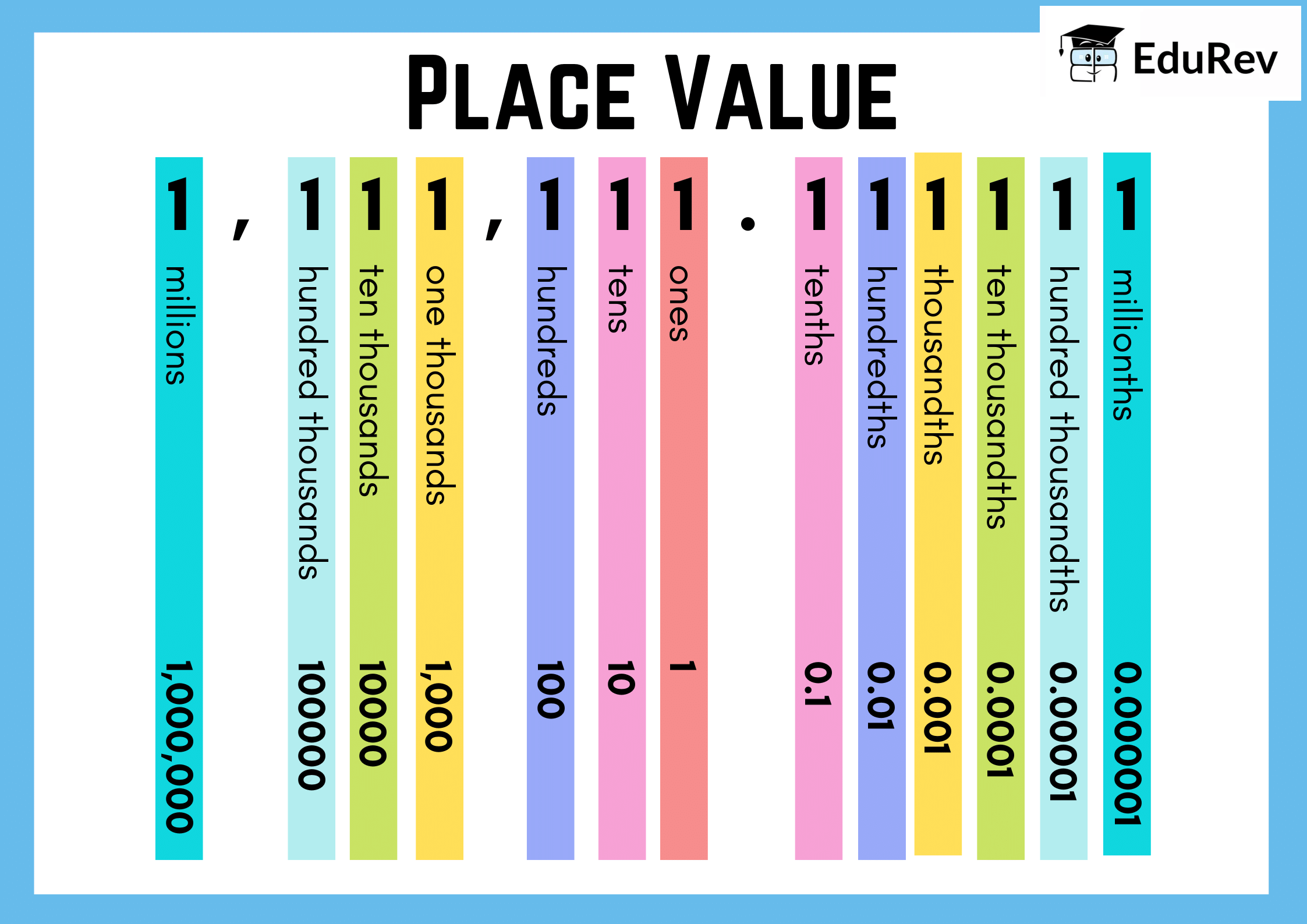
The document Learning Poster: Place Value is a part of the Class 5 Course Mathematics for Class 5.
All you need of Class 5 at this link: Class 5
FAQs on Learning Poster: Place Value
| 1. How do I identify the place value of each digit in a number? |  |
Ans. Place value refers to the value a digit holds based on its position in a number. In the number 5,432, the digit 5 is in the thousands place (worth 5,000), 4 is in the hundreds place (worth 400), 3 is in the tens place (worth 30), and 2 is in the ones place (worth 2). Understanding positional notation helps students read, write, and compare large numbers accurately in CBSE Class 5 Mathematics.
| 2. What's the difference between face value and place value that I keep getting confused about? | |
Ans. Face value is simply the digit itself, regardless of position, while place value is what that digit is worth based on where it sits. For example, in 7,890, the face value of 7 is 7, but its place value is 7,000. Many students mix these up during exams-remembering that face value never changes but place value depends on position prevents common mistakes when solving place value problems.
| 3. Why do we use expanded form and how does it help me understand numbers better? | |
Ans. Expanded form breaks a number into the value of each digit, showing exactly what each position contributes. Writing 3,456 as 3,000 + 400 + 50 + 6 makes the structure of numbers transparent and helps students grasp how place value systems work. This method is essential for mental maths, estimation, and recognising patterns in the Indian numbering system taught in CBSE curricula.
| 4. How do I compare and order numbers using place value correctly for my Class 5 exams? | |
Ans. Start by comparing the leftmost (highest) place value first. In comparing 4,567 and 4,389, both have 4 thousands, so check the hundreds: 5 hundreds is greater than 3 hundreds, making 4,567 larger. This method prevents errors when arranging numbers in ascending or descending order, and is frequently tested in Class 5 Mathematics assessments.
| 5. What are the different place value periods and how do they work in Indian numbering? | |
Ans. The Indian numbering system groups digits into periods: ones (units, tens, hundreds), thousands (thousands, ten-thousands, lakhs), and millions (ten-lakhs, crores). Each period contains three digits except the leftmost one. Understanding these periods helps students read large numbers correctly-for instance, 25,43,678 is read as twenty-five lakhs forty-three thousand six hundred seventy-eight using the Indian convention taught in CBSE.
About this Document

4.7K Views

4.68/5 Rating

Apr 29, 2026 Last updated
Related Exams
Document Description: Learning Poster: Place Value for Class 5 2026 is part of Mathematics for Class 5 preparation. The notes and questions for Learning Poster: Place Value have been prepared according to the Class 5 exam syllabus. Information about Learning Poster: Place Value covers topics like and Learning Poster: Place Value Example, for Class 5 2026 Exam. Find important definitions, questions, notes, meanings, examples, exercises and tests below for Learning Poster: Place Value.
Introduction of Learning Poster: Place Value in English is available as part of our Mathematics for Class 5 for Class 5 & Learning Poster: Place Value in Hindi for Mathematics for Class 5 course. Download more important topics related with notes, lectures and mock test series for Class 5 Exam by signing up for free. Class 5: Learning Poster: Place Value
Description
Learning Poster: Place Value of Mathematics covers all the important topics, helping you prepare for the Class 5 exam on EduRev. Start for free!
Information about Learning Poster: Place Value
In this doc you can find the meaning of Learning Poster: Place Value defined & explained in the simplest way possible. Besides explaining types of Learning Poster: Place Value theory, EduRev gives you an ample number of questions to practice Learning Poster: Place Value tests, examples and also practice Class 5 tests



Related Searches
pdf , practice quizzes, study material, Learning Poster: Place Value, MCQs, Learning Poster: Place Value, shortcuts and tricks, Exam, Extra Questions, Summary, mock tests for examination, Learning Poster: Place Value, Objective type Questions, Semester Notes, video lectures, Sample Paper, Previous Year Questions with Solutions, Viva Questions, ppt, past year papers, Free, Important questions;