CBSE Class 5 > Class 5 Notes > Mathematics > Learning Poster: Fractions
Learning Poster: Fractions

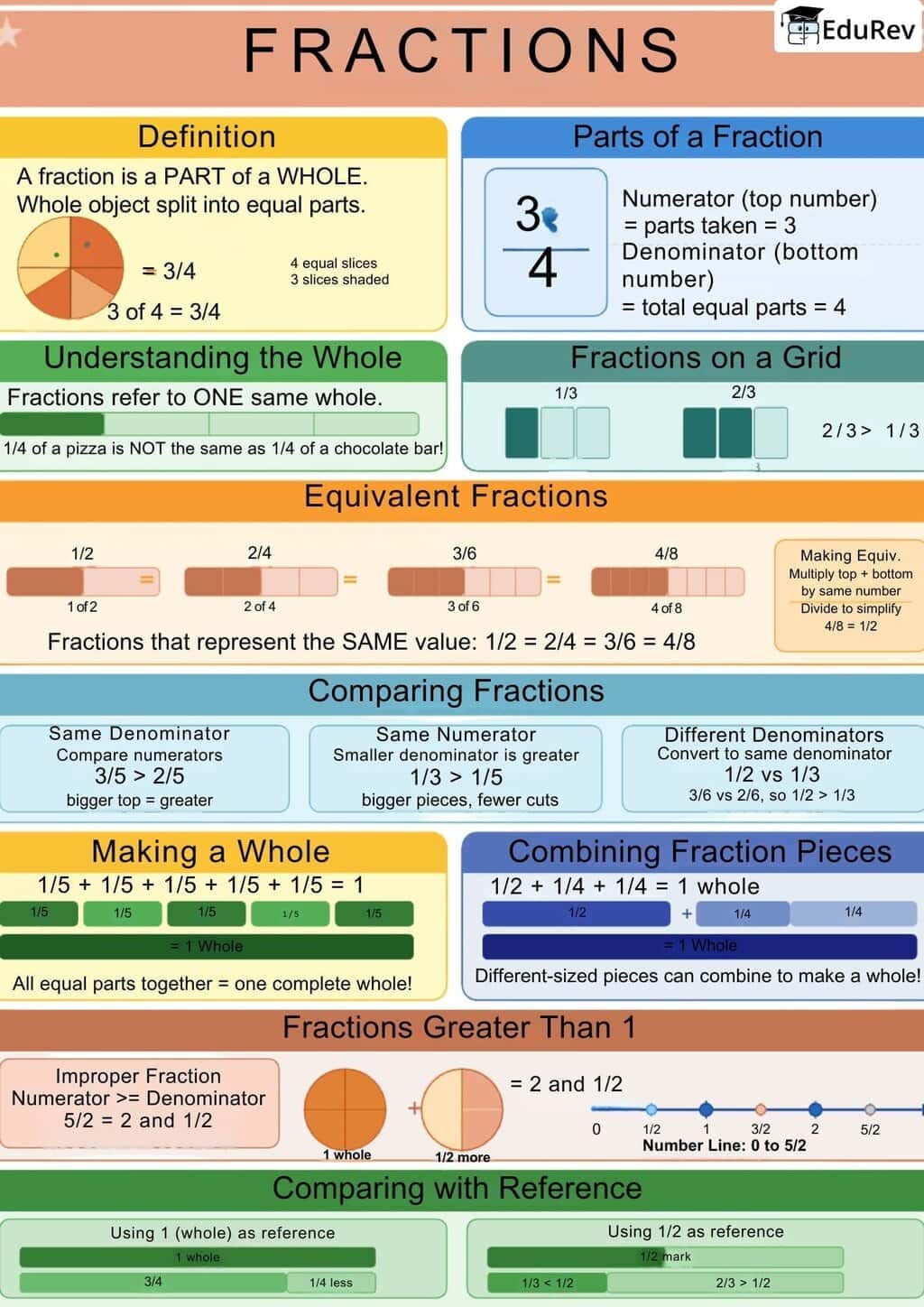
The document Learning Poster: Fractions is a part of the Class 5 Course Mathematics for Class 5.
All you need of Class 5 at this link: Class 5
FAQs on Learning Poster: Fractions
| 1. What are fractions? |  |
Ans. Fractions represent a part of a whole or a division of quantities. They consist of two numbers: the numerator, which indicates how many parts we have, and the denominator, which shows how many equal parts the whole is divided into. For example, in the fraction ¾, 3 is the numerator and 4 is the denominator.
| 2. How do you add and subtract fractions? | |
Ans. To add or subtract fractions, they must have a common denominator. If the denominators are different, find the least common multiple (LCM) of the denominators to create equivalent fractions. Once the fractions have the same denominator, add or subtract the numerators while keeping the denominator the same. For example, to add ⅓ and ¼, convert them to ⅓ = ⁴⁄₁₂ and ¼ = ³⁄₁₂, then sum the numerators: ⁴ + ³ = ⁷, giving ⁷⁄₁₂.
| 3. What is the difference between proper and improper fractions? | |
Ans. Proper fractions are those where the numerator is less than the denominator, indicating a value less than one, such as ⅗. Improper fractions have a numerator that is greater than or equal to the denominator, such as ⁵⁄₄, which can also be expressed as a mixed number (1 ¼).
| 4. How do you convert a mixed number to an improper fraction? | |
Ans. To convert a mixed number to an improper fraction, multiply the whole number by the denominator, then add the numerator. This sum becomes the new numerator, while the denominator remains the same. For example, to convert 2 ⅗ to an improper fraction: (2 × 5) + 3 = 10 + 3 = 13, so 2 ⅗ = ¹³⁄₅.
| 5. What are equivalent fractions? | |
Ans. Equivalent fractions are different fractions that represent the same value or proportion of a whole. For instance, ½, ²⁄₄, and ⁴⁄₈ are all equivalent because they represent the same part of a whole, even though they have different numerators and denominators. To determine if two fractions are equivalent, cross-multiply and check if the products are equal.
About this Document

4.82/5 Rating

Apr 20, 2026 Last updated
Document Description: Learning Poster: Fractions for Class 5 2026 is part of Mathematics for Class 5 preparation. The notes and questions for Learning Poster: Fractions have been prepared according to the Class 5 exam syllabus. Information about Learning Poster: Fractions covers topics like and Learning Poster: Fractions Example, for Class 5 2026 Exam. Find important definitions, questions, notes, meanings, examples, exercises and tests below for Learning Poster: Fractions.
Introduction of Learning Poster: Fractions in English is available as part of our Mathematics for Class 5 for Class 5 & Learning Poster: Fractions in Hindi for Mathematics for Class 5 course. Download more important topics related with notes, lectures and mock test series for Class 5 Exam by signing up for free. Class 5: Learning Poster: Fractions
Description
Learning Poster: Fractions of Mathematics covers all the important topics, helping you prepare for the Class 5 exam on EduRev. Start for free!
Information about Learning Poster: Fractions
In this doc you can find the meaning of Learning Poster: Fractions defined & explained in the simplest way possible. Besides explaining types of Learning Poster: Fractions theory, EduRev gives you an ample number of questions to practice Learning Poster: Fractions tests, examples and also practice Class 5 tests



Related Searches
ppt, Learning Poster: Fractions, MCQs, Learning Poster: Fractions, Important questions, Summary, Viva Questions, pdf , Semester Notes, Objective type Questions, Extra Questions, mock tests for examination, Sample Paper, study material, practice quizzes, video lectures, past year papers, shortcuts and tricks, Exam, Free, Previous Year Questions with Solutions, Learning Poster: Fractions;