Mind Map: Nuclear Chemistry

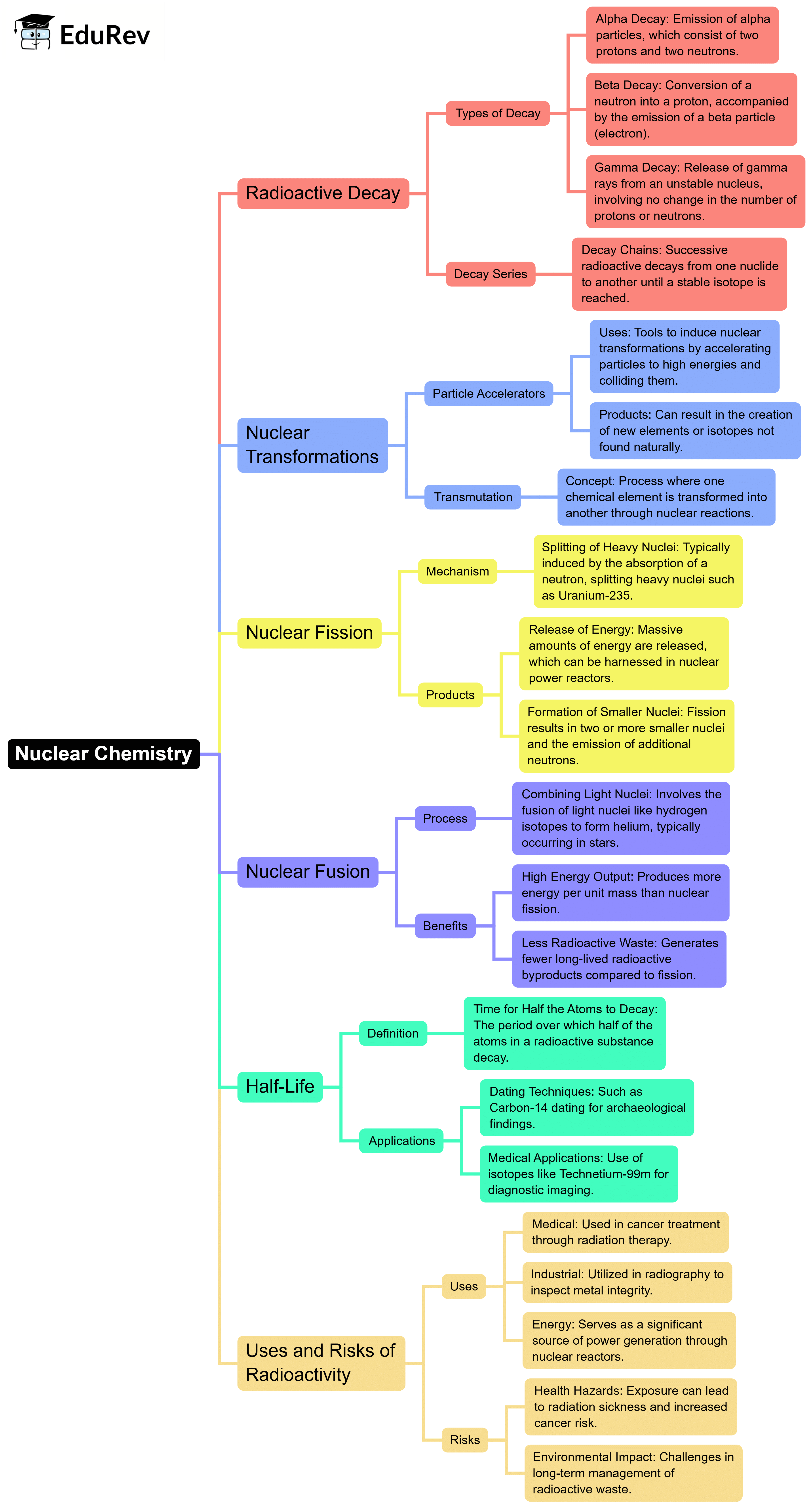
The document Mind Map: Nuclear Chemistry is a part of the ACT Course Science for ACT.
All you need of ACT at this link: ACT
FAQs on Mind Map: Nuclear Chemistry
| 1. What is nuclear chemistry and why is it important? |  |
Ans.Nuclear chemistry is the study of the chemical and physical properties of elements as influenced by changes in the structure of the atomic nucleus. It plays a crucial role in various fields, including energy production, medical applications, and environmental science. Understanding nuclear reactions helps in the development of nuclear energy, the production of radioisotopes for medical imaging, and the management of nuclear waste.
| 2. What are the main types of nuclear reactions? | |
Ans.There are primarily three types of nuclear reactions: fusion, fission, and radioactive decay. Fusion is the process where two light nuclei combine to form a heavier nucleus, releasing energy. Fission involves the splitting of a heavy nucleus into smaller nuclei, also releasing energy. Radioactive decay is the process by which unstable nuclei lose energy by emitting radiation, transforming into different elements or isotopes.
| 3. How are isotopes used in nuclear chemistry? | |
Ans.Isotopes are variants of elements that have the same number of protons but different numbers of neutrons. They are widely used in nuclear chemistry for various applications, such as radiocarbon dating in archaeology, tracers in biochemical research, and in medical treatments like cancer therapy. Stable and radioactive isotopes help scientists understand chemical processes and track the movement of substances in the environment.
| 4. What safety measures are taken in nuclear chemistry? | |
Ans.Safety measures in nuclear chemistry are crucial to minimize the risks associated with radiation exposure. These include using protective gear, maintaining safe distances from radioactive materials, implementing proper storage and disposal methods for nuclear waste, and conducting regular safety training for personnel. Additionally, monitoring radiation levels and having emergency protocols in place are essential to ensure the safety of both workers and the public.
| 5. What role does nuclear chemistry play in energy production? | |
Ans.Nuclear chemistry plays a vital role in energy production through nuclear fission, where heavy atomic nuclei are split to release a significant amount of energy. This process is harnessed in nuclear power plants to generate electricity. Understanding the chemical reactions involved in fission, as well as managing the byproducts and waste, is essential for the sustainable and safe use of nuclear energy as a power source.
About this Document

4.78/5 Rating

Apr 30, 2026 Last updated
Related Exams
Document Description: Mind Map: Nuclear Chemistry for ACT 2026 is part of Science for ACT preparation. The notes and questions for Mind Map: Nuclear Chemistry have been prepared according to the ACT exam syllabus. Information about Mind Map: Nuclear Chemistry covers topics like and Mind Map: Nuclear Chemistry Example, for ACT 2026 Exam. Find important definitions, questions, notes, meanings, examples, exercises and tests below for Mind Map: Nuclear Chemistry.
Introduction of Mind Map: Nuclear Chemistry in English is available as part of our Science for ACT for ACT & Mind Map: Nuclear Chemistry in Hindi for Science for ACT course. Download more important topics related with notes, lectures and mock test series for ACT Exam by signing up for free. ACT: Mind Map: Nuclear Chemistry
Description
Mind Map: Nuclear Chemistry of Science provides you one-page visual summary of the chapter covering all the important topics. Download the PDF from EduRev.
Information about Mind Map: Nuclear Chemistry
In this doc you can find the meaning of Mind Map: Nuclear Chemistry defined & explained in the simplest way possible. Besides explaining types of Mind Map: Nuclear Chemistry theory, EduRev gives you an ample number of questions to practice Mind Map: Nuclear Chemistry tests, examples and also practice ACT tests



Related Searches
ppt, Mind Map: Nuclear Chemistry, Exam, Objective type Questions, study material, Important questions, past year papers, Viva Questions, mock tests for examination, MCQs, Previous Year Questions with Solutions, practice quizzes, Sample Paper, Free, Mind Map: Nuclear Chemistry, shortcuts and tricks, Summary, Mind Map: Nuclear Chemistry, Semester Notes, pdf , video lectures, Extra Questions;