NCERT Solutions: Best Friends


Let Us Think
[Page no 29]
A. Answer the following.1. Who were the four friends?
Ans: Circle, triangle, rectangle, and square were the four friends.
![[Page no 29]](https://cn.edurev.in/ApplicationImages/Temp/e817beb5-87ed-4a34-ab1a-cb4b27c9c5c2_lg.jpg)
2. Why were they fighting?
Ans: They were fighting because they could not decide who is the best.
3. Who helped them to end their fight?
Ans: The star helped them to end their fight.
4. What lesson did the friends learn in the end?
Ans: They learn that if they join together, they can create wonderful shapes.
5. Write 'T' for true and 'F' for false.
(a) The circle does not have sharp edges. ________
(b) A square has four sides but not all of them are equal in size. ________
(c) The triangle has two sides. ________
(d) The friends could decide who was the best among them. ________
Ans: (a) T
(b) F
(c) F
(d) F
6. Who is your friend? What are the things you can do when your friend helps you?
Ans: My friend is Adhyata.
When she helps me, I can say thank you, share my toys, play together, and be kind to them.
7. Look around you. Talk about the shapes of what you see.
Ans: Sample answer:
I see many shapes around me. The clock on the wall is a circle. The door is a rectangle. The roof of the house is a triangle. The table is a square.
Let Us Speak
[Page no 30]
Divide into groups of 5. Each of you will be one character in the story - circle, square, triangle, rectangle and the star. Take turns and read out the story. Enjoy by adding actions to what you say.
Ans. Refer to the instructions below:
- Circle: "Hello! I am Circle. I am round. I can roll on the floor!"
Action: Roll your hands like a ball or roll a small ball on the floor.![[Page no 30]](https://cn.edurev.in/ApplicationImages/Temp/2a241034-e522-4a88-8dfb-bc9857845963_lg.jpg)
- Square: "Hi! I am Square. I have four equal sides. I can stand tall like a box!"
Action: Make a square shape with your hands or pretend to be a big box.![[Page no 30]](https://cn.edurev.in/ApplicationImages/Temp/857dd0cd-a271-4158-8fbf-656c38f7d878_lg.jpg)
Triangle: "Hello! I am Triangle. I have three sides. I can stand like a roof!"
Action: Put your hands above your head to make a triangle shape.![[Page no 30]](https://cn.edurev.in/ApplicationImages/Temp/9259170b-e5ab-4eee-a316-c2b2442248b8_lg.jpg)
Rectangle: "Hi! I am Rectangle. I have four sides. I can be a door or a book!"
Action: Stretch your arms to show a rectangle shape or pretend to open a door.![[Page no 30]](https://cn.edurev.in/ApplicationImages/Temp/5474bf37-6055-4084-96b9-28e23c2e0ae0_lg.jpg)
- Star: "Hello! I am Star. I shine bright in the sky!"
Action: Stretch your arms and wiggle your fingers like shining stars.![[Page no 30]](https://cn.edurev.in/ApplicationImages/Temp/f4905aa8-d534-41de-9585-d099e6041d22_lg.jpg)
Let Us Learn
Read the following lines.
A pigeon and an ant became friends.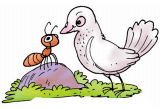 Notice that we used 'a' before pigeon and 'an' before 'ant'.
We use 'a' before singular nouns that begin with consonants. 'An' is used before singular nouns that begin with vowel sounds (a, e, i, o, u).
Using this information, fill up the following blanks.
A. Fill in the blanks using 'a'.
1. ________ dog is barking at the postman.
Ans: A dog is barking at the postman.
2. My mother gives chapattis to ________ cow every day.
Ans: My mother gives chapattis to a cow every day.
3. In summer, ________ sparrow builds its nest on the mango tree near our house.
Ans: In summer, a sparrow builds its nest on the mango tree near our house.
[Page no 31]
B. Fill in the blanks using 'an'.
![[Page no 31]](https://cn.edurev.in/ApplicationImages/Temp/4794054_88ae2bd4-ebf5-4e89-acea-390589cbd9fa_lg.png) 1. I saw ________ eagle yesterday.
1. I saw ________ eagle yesterday.Ans: I saw an eagle yesterday.
2. Maya bought ________ umbrella for the monsoon.
Ans: Maya bought an umbrella for the monsoon.
3. _________ cream man brings his cart in the evenings.
Ans: An ice cream man brings his cart in the evenings.
C. Fill in the blanks using 'a' or 'an'.
1. ________ brown hen laid ________ egg.
Ans: A brown hen laid an egg.
2. ________ eagle sat on ________ building.
Ans: An eagle sat on a building.
3. Mary ate ________ apricot, ________ chikoo, and ________ orange.
Ans: Mary ate an apricot, a chikoo, and an orange.
Let Us Write
[Page no 31]
A. Paste a picture of your friend.
![[Page no 31]](https://cn.edurev.in/ApplicationImages/Temp/4794054_e8951c29-807d-4dfa-a31a-812c9eab974f_lg.png) Ans: Take a photo of your friend. Print it from a shop or studio and paste it in the box provided. Make sure your friend is smiling!
Ans: Take a photo of your friend. Print it from a shop or studio and paste it in the box provided. Make sure your friend is smiling!B. Write a few lines about your friend by filling in the blanks.
![[Page no 31]](https://cn.edurev.in/ApplicationImages/Temp/4794054_5e7aec71-74c9-414b-8d8b-fc32c1714d16_lg.png) My Friend
My Friend
1. My friend's name is ________
2. He/She is a boy/girl.
3. He/She is ________ years old.
4. His/Her favourite colour is ________
5. He/She likes to play ________
6. He/She wants to become ________
I love my friend.
Ans: 1. My friend's name is Kritika.
2. He/She is a girl.
3. He/She is 11 years old.
4. His/Her favourite colour is black.
5. He/She likes to play Basketball.
6. He/She wants to become a teacher.
I love my friend.
Let Us Do
[Page no 32]
A. Use the space given below to draw the four friends you met in Chapter 3.
![[Page no 32]](https://cn.edurev.in/ApplicationImages/Temp/4794054_5160384a-2e02-4cca-82e6-99faca477fd0_lg.png)
Ans:
![[Page no 32]](https://cn.edurev.in/ApplicationImages/Temp/4794054_b41ae470-23ba-496d-9041-699aecbb2786_lg.png)
Let Us Explore
[Page no 33]
A. Draw pictures using the four friends mentioned in Chapter 3. You can use the pictures given below for ideas.
![[Page no 33]](https://cn.edurev.in/ApplicationImages/Temp/4794054_0998e8d5-67a5-472a-ac0d-939243713f39_lg.png)
![[Page no 33]](https://cn.edurev.in/ApplicationImages/Temp/4794054_ab2f9952-9902-4cc9-8a6f-dbfc4ab73fd9_lg.png)
Ans: ![[Page no 33]](https://cn.edurev.in/ApplicationImages/Temp/4794054_47512adc-84b1-4dbd-aee7-3e440d034fd2_lg.png)
FAQs on NCERT Solutions: Best Friends
| 1. Who are the main characters in the Best Friends story and what makes their friendship special? |  |
| 2. What lessons about friendship does the Best Friends chapter teach for everyday life? | |
| 3. What are the key events and turning points in the Best Friends story? | |
| 4. How does the Best Friends chapter help improve reading comprehension skills for Class 3 students? | |
| 5. What character traits and values should students learn from the Best Friends chapter? | |