NCERT Solutions: Chandrayaan


Let us think
[Page no 122]
A. Answer the following.
![[Page no 122]](https://cn.edurev.in/ApplicationImages/Temp/4794054_53c686d7-f18c-4aa9-956c-5a2bb7ea44c1_lg.png)
1. Rani was very curious. How do you know?
Ans: Rani asked many questions and wanted to know more about everything; she kept asking questions because she was curious.
![[Page no 122]](https://cn.edurev.in/ApplicationImages/Temp/06f6500e-4e41-4c5a-a714-5c1cc00429b9_lg.jpg)
2. What did Pratik say in excitement?
Ans: Pratik shouted with excitement that India had landed on the Moon.
3. Who was Nandini Aunty?
Ans: Nandini Aunty was a scientist and she was Vivaan's mother.
![[Page no 122]](https://cn.edurev.in/ApplicationImages/Temp/8caf8c0d-1ea5-4303-9fb8-d04b09d5d792_lg.jpg)
4. What do the words Chandra and Yaan mean?
Ans: Chandra means moon and yaan means vehicle.
![[Page no 122]](https://cn.edurev.in/ApplicationImages/Temp/0eac268b-c6de-4903-af62-30cf99317c8f_lg.jpg)
5. Complete the sentence:
Chandrayaan-3 landed on the Moon on ____________
Ans: Chandrayaan-3 landed on the Moon on 14 July 2023.
B. Think and say.
Imagine you are invited by the scientists to spend 10 days on the moon. Make a list of items that you would like to take with you.
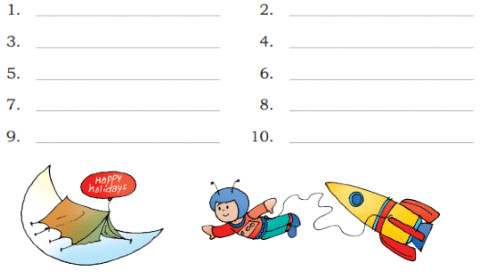
Ans: 1. Binoculars
2. Camera
3. Water
4. Food
5. Medicine
6. Spacesuit
7. Joystick
8. Drawing book
9. Ball
10. Umbrella
Let us speak
[Page no 123]
![[Page no 123]](https://cn.edurev.in/ApplicationImages/Temp/4794054_9118a4b8-3a7f-40f2-b112-3fd0e72fb38a_lg.png)
1. Chandrayaan travelled the distance between the Earth and the Moon. You may ask elders at home about their experiences of travelling to places that are far from home.
Ans: Talk to your elders about a long journey they have made and then share what you learn with your teacher.
2. Have you ever travelled to far-off places yourselves? If yes, share your experience with others.
Ans: Tell your classmates and teacher about any long trip you have taken, what you saw and how you felt.
Let us learn
Read the following lines.
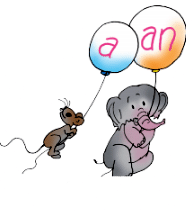
There was a girl named Rani who lived in a village.A hanky for an elephant.
Notice that we used 'a' before girl, village, and hanky, and 'an' before an elephant.
We use 'a' before singular nouns that begin with consonants.
'An' is used before singular nouns that begin with vowel sounds (a, e, i, o, u).
A. Fill in the blanks using 'a'.
1. _________ dog is barking at the postman.
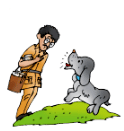
Ans: A dog is barking at the postman.
2. My mother gives chapattis to _________ cow every day.
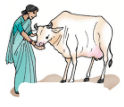
Ans: My mother gives chapattis to a cow every day.
3. In summer, _________ sparrow builds its nest on the mango tree near our house.
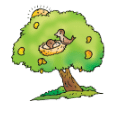
Ans: In summer, a sparrow builds its nest on the mango tree near our house.
B. Fill in the blanks using 'an'.
1. I saw _________ eagle yesterday.

Ans: I saw an eagle yesterday.
2. Maya bought _________ umbrella for the monsoon.

Ans: Maya bought an umbrella for the monsoon.
3. _________ ice-cream man brings his cart in the evenings.
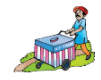
Ans: An ice cream man brings his cart in the evenings.
C. Fill in the blanks using 'a' or 'an'.
1. _________ brown hen laid _________ egg.
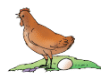
Ans: A brown hen laid an egg.
2. _________ eagle sat on _________ building.

Ans: An eagle sat ona building.
3. Mary ate _________ apricot, _________ chikoo, and _________ orange.
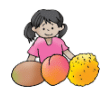
Ans: Mary ate an apricot, a chikoo, and an orange.
Let us write
[Page no 125]
A. Fill in the blanks by forming words using 'sk', 'sw', 'sp', and 'st'.(One is do for you)
![[Page no 125]](https://cn.edurev.in/ApplicationImages/Temp/4794054_ec3562af-f64b-4b61-8b0f-46ea7aa014fe_lg.png)
1. There are swings in the park.
Ans: There are swings in the park.
2. The children throw _______ones in the river.
Ans: The children throw stones in the river.
3. I need a _______oon and a bowl for soup.
Ans: I need a spoon and a bowl of soup.
4. Have you heard the _______ory of the boy who cried wolf?
Ans: Have you heard the story of the boy who cried wolf?
5. The blue _______irt matched with the pink shirt.
Ans: The blue skirt matched with the pink shirt.
B. Describing the Moon.
Draw a picture of the Moon. With the help of your teacher, write a few lines about the Moon.
Ans:
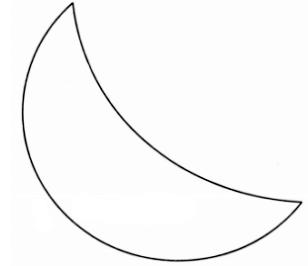
The Moon is Earth's nearest neighbour in space and it moves around our planet. It looks like a big, round rock and has many round holes called craters. At night the Moon can look bright and it seems to change shape from a thin line to a full circle.
Fun with Words
[Page no 126]
A. Read these sentences aloud with your teacher.
There are seven days in a week.
Sunday is the first day of the week.
Monday is the second day of the week.
Tuesday is the third day of the week.
Wednesday is the fourth day of the week.
Thursday is the fifth day of the week.
Friday is the sixth day of the week.
Saturday is the seventh day of the week.
Ans: Read these sentences aloud with your teacher.
B. Look at the words given below. Read them aloud. Find their position in a week using the text given above. One has been done for you.
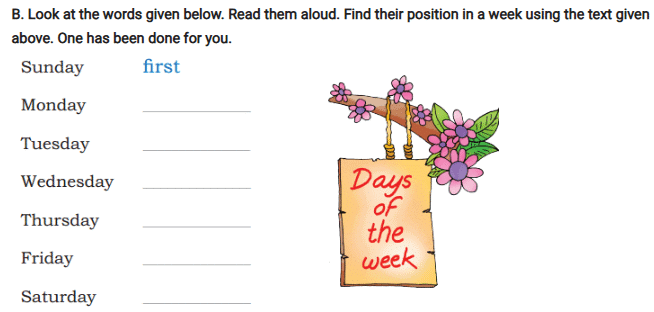
Ans: Sunday - first
Monday - second
Tuesday - third
Wednesday - fourth
Thursday - fifth
Friday - sixth
Saturday - seventh
Let us do
[Page no 127]
A. Divide yourselves into small groups. Each group shall collect newspaper or magazine clippings related to the Chandrayaan-3 mission. Paste it on a chart paper and display it in your class.
![[Page no 127]](https://cn.edurev.in/ApplicationImages/Temp/4794054_6b958e81-f146-4a16-bee7-6fef9d139e4e_lg.png)
Ans: Work in small groups in class. Collect clippings with your teacher's help, paste them on chart paper and display your work in the classroom.
Let us explore
[Page no 127]
A. Do you know a song or a story about the moon in your mother tongue? If not, ask your family members and share it in the class.
![[Page no 127]](https://cn.edurev.in/ApplicationImages/Temp/4794054_45c94a88-28c8-4cec-88c6-526da28120ee_lg.png)
Ans: Moon up high, so round and bright,
You're my lantern in the night.
We play peek-a-boo with the clouds, softly whispering, never loud.
Self Assessment
[Page no 128]
1. I can recite the poems:
In a group
In pairs
By repeating after my teacher
By myself
Ans: I can recite the poems:
In a group.
In pairs.
By repeating after my teacher.
By myself.
2. I can read the stories:
By myself.
With my classmates.
With the help of my teacher.
Ans: I can read the stories:
By myself.
With my classmates.
With the help of my teacher.
3. I can write:
By copying from the book or the board.
As my teacher speaks.
With the help of my classmates.
By myself.
Ans: I can write:
By copying from the book or the board.
As my teacher speaks.
With the help of my classmates.
By myself.
4. I can tell the stories that I have read or listened:
To by myself (without any help).
With the help of the teacher.
By using the book.
Ans: I can tell the stories that I have read or listened:
To by myself (without any help).
With the help of the teacher.
By using the book.
5. I was able to do:
All the exercise questions.
Most of the exercise questions.
A few exercise questions.
Ans: I was able to do:
All the exercise questions.
Most of the exercise questions.
A few exercise questions.
FAQs on NCERT Solutions: Chandrayaan
| 1. What is Chandrayaan and why is it important? |  |
| 2. What were the main objectives of the Chandrayaan missions? | |
| 3. How did Chandrayaan-1 contribute to lunar research? | |
| 4. What challenges did the Chandrayaan missions face? | |
| 5. How can students learn more about Chandrayaan and space exploration? | |