NCERT Solutions: Night

Picture Reading
[Page no 103]
Look at the picture and answer.
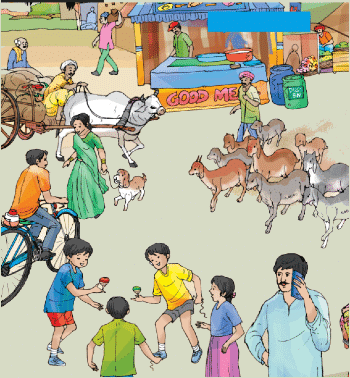
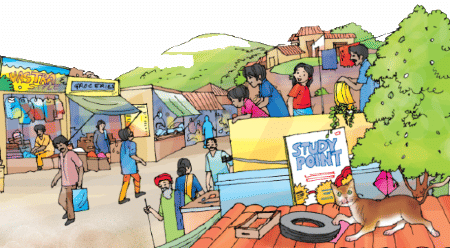
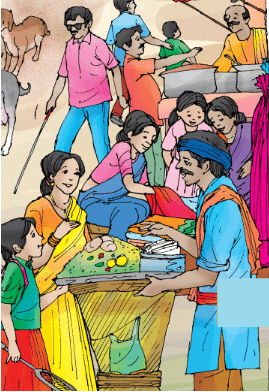
1. What can you see on both sides of the street?
Ans: I can see shops and people moving around on both sides of the street.
2. Why are there two dustbins? Do you know why one is blue and the other is green in colour?
Ans: There are two dustbins because of the two types of waste. The blue one is for dry waste and the green one is for wet waste.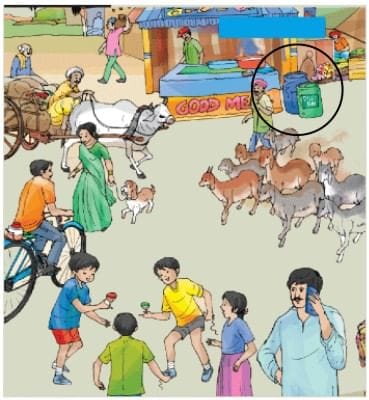
3. Why is the man in dark glasses holding a white stick?
Ans: The man in dark glasses is blind. He is holding a stick to find a way to move.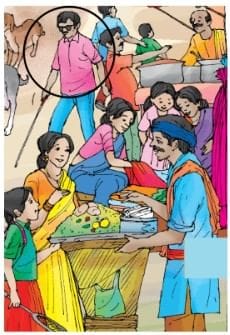
4. Do you know which toy the boys are playing with?
Ans: The boys are playing with spinning Tops.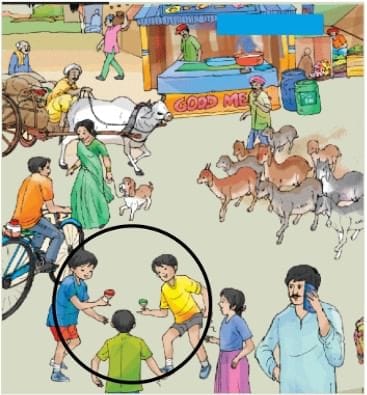
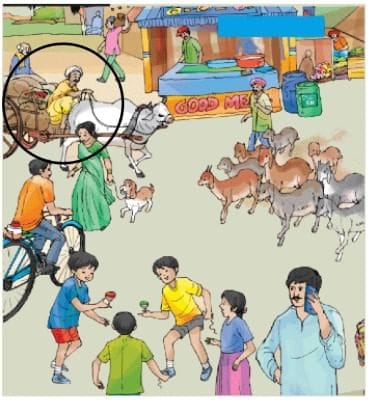
5. How many bullock carts are there in the picture?
Ans: There is one bullock cart in the picture.
 6. Name the different animals in the picture.
Ans: The different animals in the picture are cats, dogs, bulls, and goats.
Let us think
[Page no 106]
A. Answer the following.
1. Where does the Sun go after the end of the day?
Ans: The Sun sinks behind a distant hill after the end of the day.
2. Which among the following needs the Sun? Why?
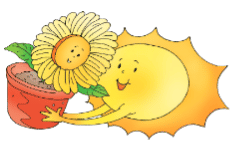
(a) sunflower
(b) toys
(c) plants
(d) table
(e) children
Ans: (a) Sunflower and (c) plants.
Sunflowers and plants require sunlight to make their food and grow.
3. The poem talks about the Sun in the sky. What else do you see when you look up at the sky?
Ans: When you look up at the sky, you may see clouds, birds, aeroplanes, stars, and the moon.
B. Think and answer.
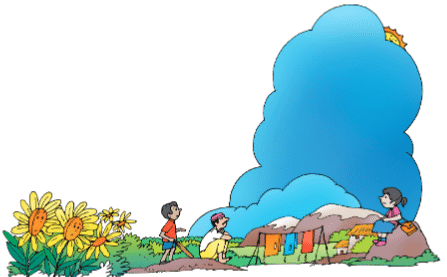
1. What different colours do we get to see during sunrise and sunset?
Ans: During sunrise and sunset, we get to see many colours like red, orange, pink, purple and yellow, etc.
2. What do you see when you look at the sky at night?
Ans: When we look at the sky at night, we can see stars, the moon, planets, etc.
3. How do you feel when you open your eyes in the morning?
Ans: When we open our eyes in the morning, we feel refreshed, and energized.
4. Imagine a day when the Sun doesn't come out. Talk about how the day would be.
Ans: It would be dark all day if the Sun didn't rise.
Let us do
Let us play a game. Let's play a fun game called "I Spy"! We are going to take turns to be Spies. The Spy secretly chooses something in the room and gives everyone a clue. The Spy starts by saying, 'I spy with my little eye something that is ...' and gives a clue. 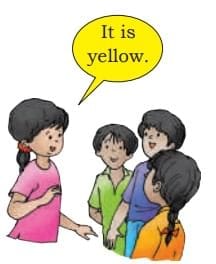 For example, 'I spy something that is blue!' Then, everyone looks around and tries to find something that is blue. Maybe it's a pen, a chair, or even someone's shirt! If it's tricky to guess the object right, the Spy can give more clues.
 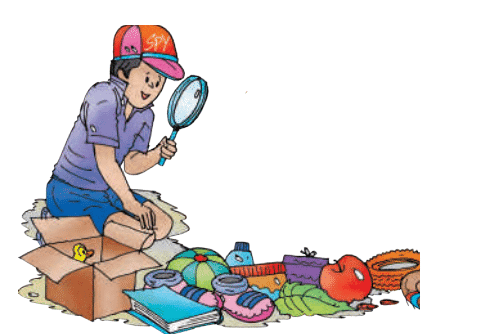 The child who guesses right becomes the new Spy! Keep playing, taking turns being Spies and guessing until everyone gets a chance to be the Spy.
Let us speak
[Page no 107]
Read the following sentence:
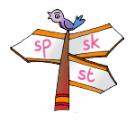
I spy a few stars in the sky.
The word spy begins with sp
The word stars begins with st
The word sky begins with sk
Ans: Do it yourself.
Now say these words aloud.
Ans: Do it yourself.
Let us learn
[Page no 108]
A. Read the following words and circle the words that are found in the sky.
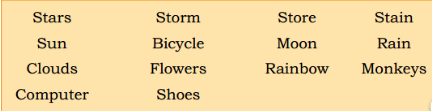
Ans: 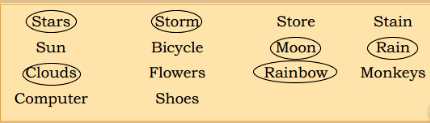
B. Add 'Sun' to the following words to make new words. Write them in the space given.
One has been done for you.
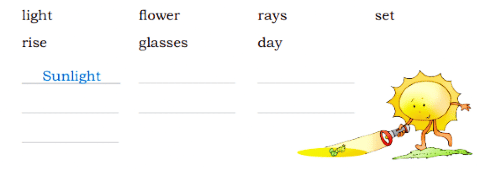
Ans:
FAQs on NCERT Solutions: Night
| 1. What is the main message or theme of the poem 'Night' in Class 3 English? |  |
| 2. What are the key poetic devices used in the 'Night' poem that Class 3 students should know? | |
| 3. Why does the poem describe night as a peaceful and calm time? | |
| 4. How should I answer comprehension questions about the 'Night' poem for CBSE exams? | |
| 5. What vocabulary words and descriptive language appear frequently in the 'Night' poem? | |