NCERT Solutions: Chanda Mama Counts the Stars

Let us think
[Page no112]
A. Answer the following.
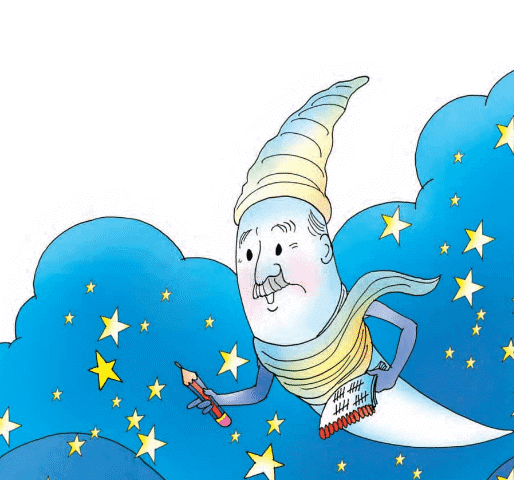
1. Does the Moon look the same every night?
Ans: No. The Moon does not look the same every night; its shape and apparent size seem to change from night to night, so we see it in different ways.
2. What did Chanda Mama try to count?
Ans: Chanda Mama tried to count the number of stars in the sky, but there were too many to count.
3. Why did Chanda Mama fall asleep?
Ans: Chanda Mama fell asleep because he became tired while trying to count the many stars; he began yawning and soon went to sleep.

4. Who helped Chanda Mama?
Ans: The Sun helped Chanda Mama.
5. Complete the sentence:
The number of stars in the sky is the same as __________
Ans: The number of stars in the sky is the same as the number of lovely children.

B. Think and say.
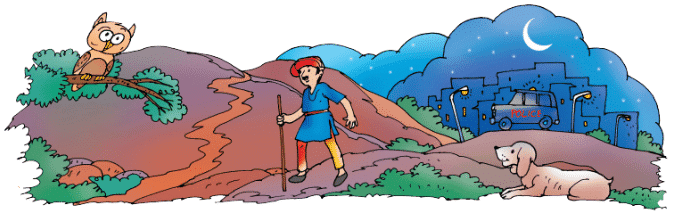
1. I call the Moon, Chanda Mama. What do you call him in your language?
Ans: In different Indian languages people lovingly call the Moon by many names. Here are some common names:
- Hindi: Chanda Mama (चंदा मामा) - "Uncle Moon"
- Bengali: Chand Mama (চাঁদ মামা)
- Tamil: Chandiran Mama (சந்திரன் மாமா)
- Telugu: Chanda Mama (చందమామ)
- Marathi: Chanda Mama (चंदा मामा)
- Gujarati: Chand Mama (ચાંદ મામા)
- Punjabi: Chann Mamma (ਚੰਨ ਮਾਮਾ)
- Urdu: Chaand Mian (چاند میاں) - "Mr. Moon"
In English, children sometimes call him "Mr. Moon" or "Uncle Moon".
2. Chanda Mama was not able to count the stars. What things can you not count?
Ans: I cannot count very large groups of things such as trees and plants in a forest, the birds in the sky, animals in a wild place, all the people in a city, the number of shops or vehicles on many roads, or very small things like all the ants on the ground.
3. The Moon is visible during the night. What can you see in the night sky?
Ans: At night we can see the Moon and many stars in the sky; sometimes we can also see a few bright planets and clouds.
Let us learn
[Page no114]
Here and There!
Look at the following sentences.
We are here on the Earth. The Moon is there in the sky.
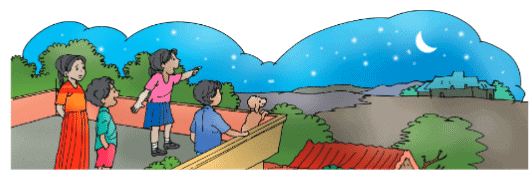
I have a sharpener here in my pencil box.
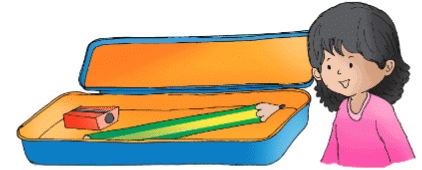
The crayons are there in the big box.
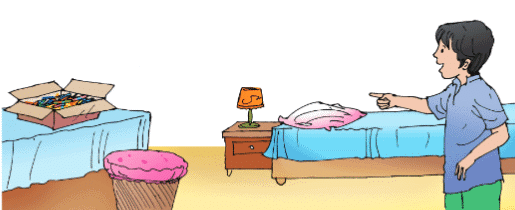
The underlined words in both sentences tell us about the location of the 'sharpener' and 'crayons'. The distance of the objects from the speaker helps us in choosing between the words 'here' and 'there'.
We use 'here' to tell the location of things that are near us. Similarly, 'there' is used to tell the location of things that are far from us.
Fill in the blanks with 'here' or 'there'.
One has been done for you.
1. The students are playing kabaddi there.
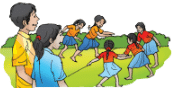
Ans: The students are playing kabaddi there.
2. _______________ is your shirt.
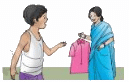
Ans: Here is your shirt.
3. _______________ is my bicycle.
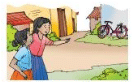
Ans: There is my bicycle.
4. I went to Chandigarh last year. My brother lives _______________.

Ans: I went to Chandigarh last year. My brother lives there.
5. This is my bench. I sit _______________ with my friends.
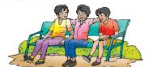
Ans: This is my bench. I sit here with my friends.
Let us listen
[Page no 115]
A. In this story, we read that the stars were too many to be counted.![[Page no 115]](https://cn.edurev.in/ApplicationImages/Temp/4794054_21582df5-c31c-4485-aa2d-6e4b70771b39_lg.png)
Now, your teacher will read out a list of items for you. Put the items in the correct column in the given table.
1. Children in the classroom.
2. Flowers in a garden.
3. Books in the library.
4. Pencils in your pencil box.
5. Fingers on your right hand.
6. Children in your city or town.
7. Pages in your English notebook.
8. The hairs on your head.
![[Page no 115]](https://cn.edurev.in/ApplicationImages/Temp/4794054_c21e15d2-a211-46f5-84da-3cb51dd6a64f_lg.png)
Ans:
![[Page no 115]](https://cn.edurev.in/ApplicationImages/Temp/4794054_c1fac27c-9b67-4571-bfa9-87e1a44f7ae4_lg.png)
Let us write
[Page no 116]
A. It was a full moon night. Children had come out to see the Moon. Complete the conversation they had by picking the words from the help box.![[Page no 116]](https://cn.edurev.in/ApplicationImages/Temp/4794054_67e3f4af-3897-42c2-be47-77329a0e00ad_lg.png)
Govind: Wow, look!
Safura: The moon looks so big and bright.
Sukanya: Isn't it?
Dhruv: My grandfather _______________________________.
Ramani: Let us take a picture.
Safura: My mother has ________________________________.
Dhruv: Come. Stand here and ____________________________.
Govind: The moon is __________________________________.
Help Box
![[Page no 116]](https://cn.edurev.in/ApplicationImages/Temp/4794054_9b3e2cf1-6358-4a32-a9ef-d0ec4bf5e1c6_lg.png)
Ans: Govind: Wow, look!
Safura: The moon looks so big and bright.
Sukanya: Isn't it?
Dhruv: My grandfather says the full moon looks very beautiful.
Ramani: Let us take a picture.
Safura: My mother has a camera for taking pictures.
Dhruv: Come. Stand here and let us take a picture.
Govind: The moon is so bright and big.
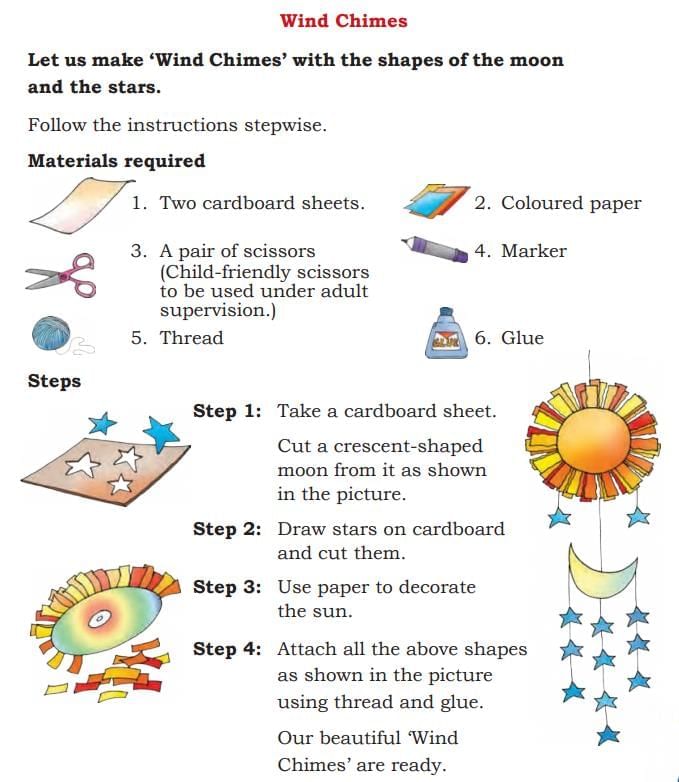
Let us do
FAQs on NCERT Solutions: Chanda Mama Counts the Stars
| 1. What is the main theme of "Chanda Mama Counts the Stars"? |  |
| 2. How does the story introduce children to the concept of counting? | |
| 3. What messages does the story convey about friendship and companionship? | |
| 4. In what ways does "Chanda Mama Counts the Stars" stimulate a child's imagination? | |
| 5. How can parents use this story to enhance their child's learning experience? | |