Important Formulas: Matrices


Matrices
A matrix is a rectangular arrangement of numbers in m rows and n columns, referred to as a matrix of order m × n.
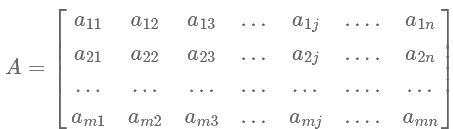
In this matrix, aij represents the element in the ith row and jth column. This matrix is denoted as [aij]m×n. The elements a11, a22, a33, etc., are the diagonal elements. The sum of these diagonal elements is referred to as the trace of A, symbolized by Tr(A).
Fundamental Definitions
- Row matrix: A matrix with only one row.
- Column matrix: A matrix with only one column.
- Square matrix: A matrix of order m×n where m = n.
- Zero matrix: A = [aij]m×n is a zero matrix if aij = 0 for all i and j.
- Upper triangular matrix: A = [aij]m×n is an upper triangular matrix if aij = 0 for i > j.
- Lower triangular matrix: A = [aij]m×n is a lower triangular matrix if aij = 0 for i < j.
- Diagonal matrix: A square matrix [aij]m×n is a diagonal matrix if aij = 0 for i ≠ j.
- Scalar matrix: A diagonal matrix A = [aij]m×n is a scalar matrix if aij = k for i = j.
- Unit matrix (Identity matrix): A diagonal matrix A = [aij]n is a unit matrix if aij = 1 for i = j.
- Comparable matrices: Two matrices A and B are comparable if they have the same order.
Important Concepts and Operations
1. Equality of matrices: Two matrices A = [aij]m×n and B = [bij]p×q are equal if m = p and n = q and aij = bij for all i and j.
2. Scalar multiplication of a matrix: If λ is a scalar, then λA = [bij]m×n where bij = λaij for all i and j.
3. Addition of matrices: If A = [aij]m×n and B = [bij]m×n are two matrices, then A+B = [aij]m×n + [bij]m×n = [cij]m×n where cij = aij +bij for all i and j.
4. Subtraction of matrices: A-B = A+(-B), where -B = ( -1)B.
5. Properties of addition and scalar multiplication:
- λ(A+B) = λA+λB
- λA = Aλ
- (λ1+λ2)A = λ1A+λ2A
6. Multiplication of matrices: If A = [aij]m×p and B = [bij]p×n, then AB = [cij]m×n where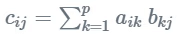
7. Properties of matrix multiplication:
- AB ≠ BA
- (AB)C = A(BC)
- AIn = A = InA
- For every non singular square matrix A (i.e., | A |≠ 0 ) there exists a unique matrix B such that AB = In = BA. We say that A and B are multiplicative inverses of each other. That is, B = A-1 or A = B-1.
8. Transpose of a Matrix.
If A = [aij]m×n then the transpose of A, represented by A' or AT, is defined as A' = [aji]n×m.
- (A')' = A
- (λA)' = λA'
- (A+B)' = A'+B'
- (A-B)' = A'-B'
- (AB)' = A'B'
- For a square matrix A, if A' = A, then A is a symmetric matrix.
- For a square matrix A, if A' = -A, then A is a skew symmetric matrix.
9. Submatrix of a matrix: A submatrix is the matrix obtained by deleting certain rows and columns from a given matrix A.
10. Properties of determinant:
- | A | = | A' | for any square matrix A.
- If two rows or two columns are identical, then | A | = 0.
- | λA | = λn| A |, when A = [aij]n×n.
- If A and B are two square matrices of the same order, then | AB |= | A || B |
11. Singular and Non-singular matrix: A square matrix A is singular if | A | = 0 and non-singular if | A | ≠ 0.
12. Cofactor and adjoint matrix.
The cofactor matrix of a square matrix A = [aij]n×n is obtained by replacing each element of A by its corresponding cofactor. The transpose of the cofactor matrix of A is called the adjoint of A, denoted as adj A.
13. Properties of adj A.
- A . adj A = | A |In = (adj A)A where A = [aij]n×n.
- | adj A | = | A |n-1, where n is the order of A.
- If A is a symmetric matrix, adj A is also symmetric.
- If A is singular, adj A is also singular.
- For a non singular matrix A, the multiplicative inverse of A is given by

- (A-1)T = (AT)-1 for any non singular matrix.
- (A-1)-1 = A, if A is non singular.
- A-1 is always non singular.
- (adj AT) = (adj A)T
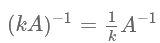
- For a non zero scalar k and a non singular matrix A,
- |A-1| = 1/|A| for | A | ≠ 0.
- For a non singular matrix A, if AB = AC, then B = C and if BA = CA, then B = C.
14. System of linear equations and matrices: A system of linear equations AX = B is consistent if it has at least one solution.
(i) System of linear equations and matrix inverse:
- If A is non-singular, the solution is given by X = A-1B.
- If A is singular, adj(A) B = 0 and no two columns of A are proportional, the system has infinitely many solutions.
- If A is singular and (adj A)B ≠ 0, the system has no solution.
(ii) Homogeneous system and matrix inverse:
- If the above system is homogeneous (i.e., b1 = b2 =..... bn = 0), then in the matrix form it is AX = 0, where A is a square matrix.
- If A is non-singular, the system has only one trivial solution, X = 0.
- If A is singular, then the system has infinitely many solutions, including the trivial solution, hence it has non-trivial solutions.
(iii) Elementary row transformation of Matrix:
Elementary row transformations of a matrix include the following operations:
- Interchanging two rows.
- Multiplying all the elements of a row by a non zero scalar.
- Adding a constant multiple of a row to another row.
15. Characteristic Polynomial and characteristic equation.
For a square matrix A, the polynomial | A-xI | is the characteristic polynomial of A and the equation | A-xI | = 0 is the characteristic equation of A.
16. Cayley Hamilton theorem:
Every square matrix A satisfies its characteristic equation. That is, if a0xn + a1xn-1 + ..... + an-1x + an = 0 is the characteristic equation of A, then a0An + a1An-1 + ........+ an-1A + anI = 0.
17. More definitions on matrices:
- Nilpotent matrix: A square matrix A is nilpotent if Ap = 0 for some positive integer p. If p is the smallest such positive integer, then p is its nilpotency.
- Idempotent matrix: A square matrix A is idempotent if A2 = A.
- Involutory matrix: A square matrix A is involutory if A2 = I.
- Orthogonal matrix: A square matrix A is orthogonal if ATA = I = AAT.
- Unitary matrix: A square matrix A is unitary if A(Ā)T = I, where Ā is the complex conjugate of A.
FAQs on Important Formulas: Matrices
| 1. What are matrices and why are they important in JEE preparation? |  |
| 2. How do you calculate the determinant of a 2x2 matrix? | |
| 3. What properties of determinants should I know for the JEE exam? | |
| 4. How can I find the inverse of a matrix using determinants? | |
| 5. What types of questions related to matrices and determinants are commonly asked in the JEE? | |