Derivation/Proof of Theorems: Coordinate Geometry

This section derives and explains the distance formula in two-dimensional Cartesian coordinates. The derivation uses the Pythagorean theorem and gives simple examples, special cases and brief applications so that the result is clear and useful for problem solving.
Theorem: Distance Formula
Statement:
f P(x1,y1) and Q(x2,y2) are two points in the Cartesian plane, then the distance between them is

Given: Two points P and Q with coordinates (x1,y1) and (x2,y2) respectively.
To prove: 
Proof
Consider points P(x1,y1) and Q(x2,y2) plotted on the Cartesian plane.
Construct point R so that R has the same x-coordinate as Q and the same y-coordinate as P.
The coordinates of R are (x2,y1).
Triangle PQR is a right triangle with the right angle at R.
The horizontal side PR is the difference of x-coordinates in magnitude.
PR = x2 - x1
The vertical side RQ is the difference of y-coordinates in magnitude.
RQ =y2 - y1
By the Pythagorean theorem applied to right triangle PQR:
PQ2 = PR2 + RQ2.
Substitute the expressions for \(PR\) and \(RQ\):
PQ2 = (x2 - x1)2 + (y2 - y1)2
Distance is a non-negative quantity; therefore take the positive square root: Conclusion: The distance between two points P(x1,y1) and Q(x2,y2) in the plane is:
Remarks and special cases
- If the points have the same x-coordinate, i.e., x1 = x2, then the segment is vertical and
PQ = y2 - y1.
- If the points have the same y-coordinate, i.e., y1 = y2, then the segment is horizontal and
PQ = x2 - x1.
- Distance from the origin O(0,0) to a point P(x,y) is
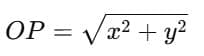
- Symmetry: The distance is symmetric in its arguments; PQ = QP.
- Metric property: This formula defines the Euclidean distance (or geometric length) in the plane and satisfies the triangle inequality.
Worked example
Example: Find the distance between A(1,2) and B(4,6).
Compute the difference in x-coordinates.
x2 - x1 = 4 - 1 = 3.
Compute the difference in y-coordinates.
y2 - y1 = 6 - 2 = 4.
Apply the distance formula:
Applications and uses
- Finding the length of a line segment between two coordinate points in geometry problems.
- Checking whether three points are vertices of a right triangle by comparing squared distances (Pythagorean test).
- Computing side lengths when using coordinate methods to find areas of polygons.
- Distance formula is used in analytic geometry, coordinate proofs, and in many real-life modelling problems requiring straight-line distances in a plane.
Understanding and applying the distance formula is a basic but powerful tool in coordinate geometry. Practice on several pairs of points, including integer and non-integer coordinates, to gain confidence in its use.
FAQs on Derivation/Proof of Theorems: Coordinate Geometry
| 1. What is the Distance Formula in coordinate geometry? |  |
| 2. How is the Distance Formula derived? | |
| 3. Can the Distance Formula be used in three-dimensional space? | |
| 4. What are the applications of the Distance Formula? | |
| 5. Are there any limitations to the Distance Formula? | |




