Revision Notes: Refraction Through A Lens


Lens
A lens is a transparent refracting medium bounded by two curved surfaces, of which one or both surfaces are spherical. Lenses change the direction of light rays by refraction and are widely used to form images in optical instruments.
Convex or Converging Lens
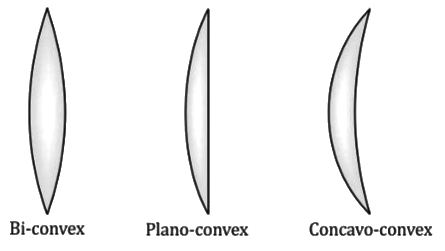
- A lens with both surfaces bulging outwards is called a double convex or convex lens.
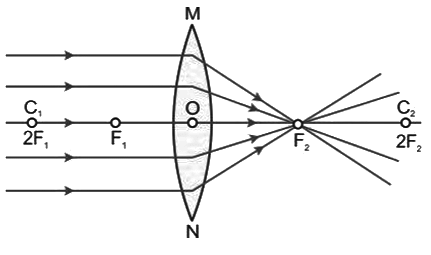
- A convex lens converges parallel rays of light to a point; hence it is also called a converging lens.
- Common types of convex lenses:
- Bi-convex (double convex or equi-convex): both surfaces convex.
- Plano-convex: one surface plane and the other convex.
- Convexo-concave (meniscus type thicker at centre): one surface convex and the other concave such that the lens is thicker in the middle than at the periphery.
Concave or Diverging Lens
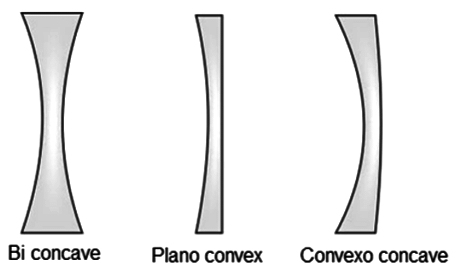
- A lens with both surfaces curving inwards is called a double concave or concave lens.
- A concave lens diverges parallel rays of light; hence it is also called a diverging lens.
- Common types of concave lenses:
- Bi-concave (double concave or equi-concave): both surfaces concave.
- Plano-concave: one surface plane and the other concave.
- Convexo-concave (meniscus type thicker at periphery): one surface concave and the other convex such that the lens is thicker at the periphery than at the middle.
Sign convention for measurement of distances
- The origin for measurement of distances is the optical centre of the lens.
- To match the Cartesian sign convention, the object is considered to be placed on the left of the lens and the incident light travels from left to right.
- The line joining the centres of curvature of the two surfaces is the principal axis. Distances are measured along this axis from the optical centre.
- Distances measured along the direction of the incident ray (to the right) are taken positive; distances measured opposite to the direction of the incident ray (to the left) are taken negative.
- Heights measured above the principal axis are taken positive; heights below the principal axis are taken negative.
- The focal length of a convex lens is taken positive and that of a concave lens is taken negative.
Technical terms related to lenses
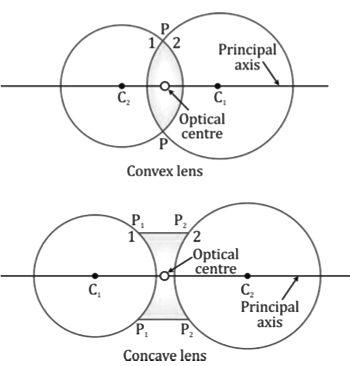
- Centre of curvature (C₁, C₂): Each spherical surface of a lens is part of a sphere; the centre of that sphere is the centre of curvature of that surface.
- Radius of curvature: The radius of the sphere of which the lens surface is a part. It is the distance PC₁ or PC₂ measured from the pole of the surface.
- Principal axis: The straight line joining the centres of curvature of the two surfaces of the lens.
- Optical centre (O): A point in the lens such that a ray passing through it emerges undeviated (for a thin lens we treat the ray as undeviated and undisplaced).
- Principal foci (F₁, F₂): A lens has two focal points, one on either side of the optical centre, situated at equal distances from it. These are the first focus F₁ and the second focus F₂.
Principal rays used in ray diagrams
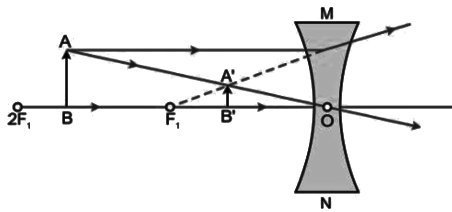
- First rule: A ray passing through the optical centre of a thin lens emerges without deviation.
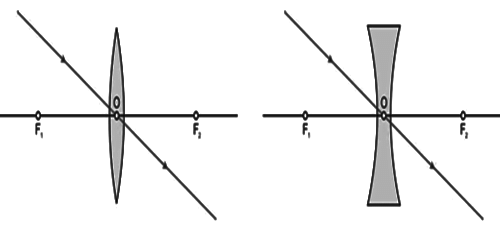
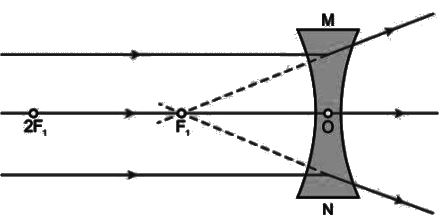
- Second rule: A ray incident parallel to the principal axis is refracted by a convex lens so that it passes through the focus on the opposite side (F₂). For a concave lens, the refracted ray appears to diverge from the focus on the same side (F₁).
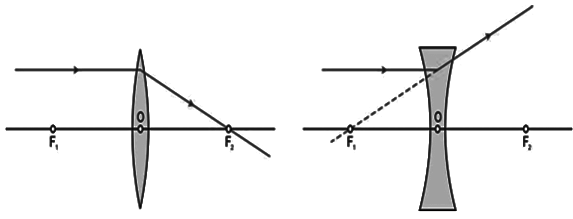
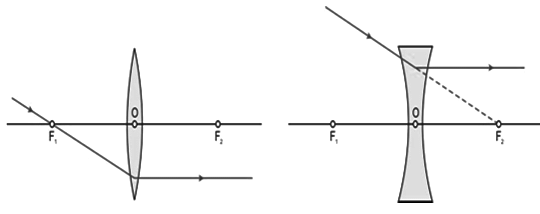
- Third rule: A ray passing through (or directed towards) a focus, after refraction through a convex lens, emerges parallel to the principal axis. For a concave lens, a ray that appears to come from the focus emerges parallel to the principal axis.
Types of images
- Real image: Formed when refracted rays actually converge and meet at a point. A real image can be obtained on a screen.
- Virtual image: Formed when refracted rays diverge and only appear to come from a point. A virtual image cannot be obtained on a screen but can be seen by an eye placed such that the lens (or eye lens) converges the diverging rays to form an image on the retina.
Characteristics and location of images formed by a convex lens
Depending on the position of the object relative to the focal point (F) and centre of curvature (C), a convex lens forms images with different characteristics. The common cases are listed below with the appropriate ray-diagram placeholders.
Case (i): Object at infinity

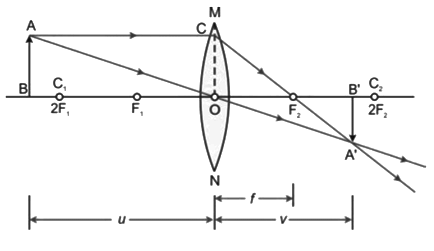
Case (ii): Object beyond C (i.e., object distance > 2f)

Case (iii): Object at C (object distance = 2f)

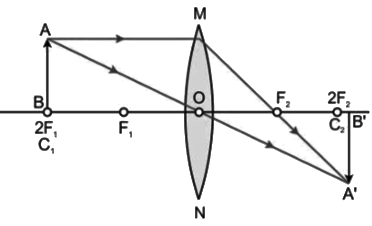
Case (iv): Object between C and F (f < object distance < 2f)

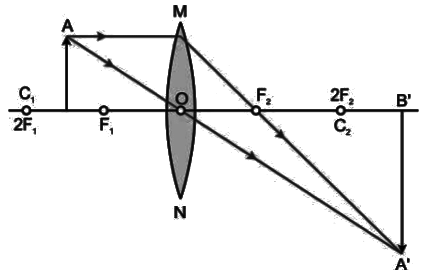
Case (v): Object at F (object distance = f)

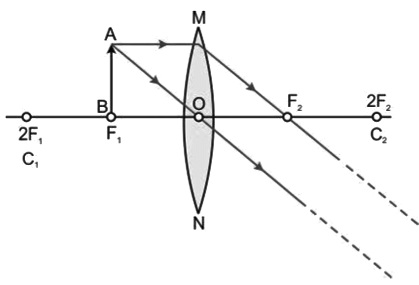
Case (vi): Object between F and O (object distance < f)

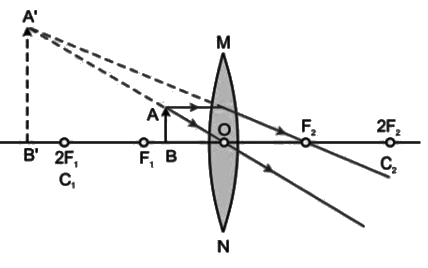
Characteristics and location of images formed by a concave lens
A concave lens always forms a virtual, erect and diminished image for a real object placed anywhere in front of it. Typical ray-diagram cases are shown below.
Case (i): Object at infinity

Case (ii): Object at a finite distance

Lens formula and magnification
The relationship between the object distance (u), image distance (v) and focal length (f) for a thin lens (Cartesian sign convention) is given by the lens formula:
1/f = 1/v - 1/u
Here all distances are measured from the optical centre O. The signs follow the sign convention described earlier.
The linear magnification produced by a lens is the ratio of the image height (h′) to the object height (h). It is also related to object and image distances by:
m = h′/h = v/u
Notes on signs and interpretation
- If v is positive, the image is formed on the right side of the lens (real image for a converging lens). If v is negative, the image is on the left side (virtual image).
- For a convex lens f is positive; for a concave lens f is negative.
- A negative magnification indicates that the image is inverted with respect to the object; a positive magnification indicates an upright image.
Power of a lens
- The power of a lens is a measure of its ability to converge or diverge light rays.
- The power P of a lens is defined as the reciprocal of its focal length (in metres):
P = 1/f
- The SI unit of power is the dioptre (D), where 1 D = 1 m-1.
- By convention, a convex (converging) lens has positive power; a concave (diverging) lens has negative power.
Magnifying glass or simple microscope
A magnifying glass (simple microscope) is a convex lens used to produce a magnified image of a small object so that fine details can be seen by the eye.
Magnifying power
The magnifying power (angular magnification) is the ratio of the angle subtended at the eye by the image formed through the lens to the angle subtended at the unaided eye by the object when the object is at the least distance of distinct vision.
Let the least distance of distinct vision (near point) be D (typically taken as 25 cm for a normal eye).
There are two commonly used arrangements:
- Image formed at infinity (relaxed eye):
The magnifying power is
M = D / f
where f is the focal length of the lens and D is the least distance of distinct vision (≈ 25 cm).
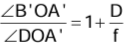
- Image formed at the near point (maximum angular magnification):
The magnifying power is
M = 1 + D / f
This occurs when the object is placed slightly within the focal length so that the virtual image is at the near point D.
Worked example (simple)
Calculate the power of a convex lens whose focal length is 50 cm.
Solution
Convert focal length to metres.
f = 50 cm = 0.50 m
Power P is the reciprocal of focal length (in metres).
P = 1 / f
Substitute the value of f.
P = 1 / 0.50
P = 2.0 D
Thus, the power of the lens is +2.0 dioptres (positive because the lens is convex).
Final remarks
- Ray diagrams using the three principal rays (through optical centre, parallel → focus, and through focus → parallel) allow construction of image position and nature for thin lenses.
- Remember the signs and conventions carefully when applying the lens formula and magnification relation.
- Power, focal length and magnifying power are the practical quantities used in spectacles, microscopes and simple optical devices.
FAQs on Revision Notes: Refraction Through A Lens
| 1. What is the sign convention for measurement of distances in lens optics? |  |
| 2. What are the principal rays used in constructing a ray diagram for a convex lens? | |
| 3. What are the characteristics and location of the image formed by a convex lens when the object is placed beyond 2F? | |
| 4. What happens to the image characteristics when the object is placed at the focal point (F) of a convex lens? | |
| 5. Can you explain the different cases of image formation by a convex lens? | |




