Case Based Questions: Arithmetic Progressions

Q1: Read the source below and answer the questions that follow:
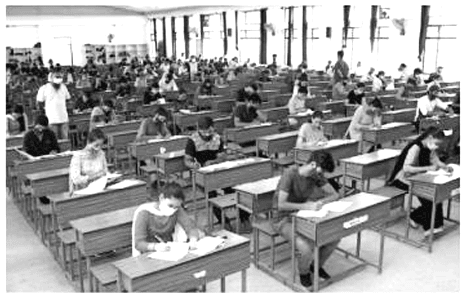
In an examination hall, the examiner makes students sit in such a way that no students can cheat from other student and make no student sit uncomfortably. So, the teacher decides to mark the numbers on each chair from 1, 2, 3, ...... There are 25 students and each student is seated at alternate position in examination room such that the sequence formed is 1, 3, 5,...
i. What type of sequence is formed, to follow the seating arrangement of students in the examination room? (1 mark)
ii. Find the seat number of the last student in the examination room. (1 mark)
iii. Find the seat number of 10th vacant seat in the examination room. (1 mark)
iv. Which number of student will seat on the 27th seat number. (1 mark)
Ans:
i. The sequence 1, 3, 5, ... is an arithmetic progression (AP) with first term a = 1 and common difference d = 3 - 1 = 2.
ii. For 25 students, the last student is at the 25th term of the AP.
Tn = a+ (n-1)d
T25 = a + (25 - 1)d
= 1 + 24 × 2
= 1 + 48 = 49
Hence, the last student sits on seat number 49.
iii. Vacant seats form the sequence 2, 4, 6, ... (even numbers). Here a = 2 and d = 2.
Tn = a+ (n-1)d
T10 = a + (10 - 1)d
= 2 + 9 × 2
= 2 + 18 = 20
So, the 10th vacant seat is seat number 20.
iv. Occupied seats are odd numbers: 1, 3, 5, ... Let n be the student number who sits on seat 27.
:- Tn = a + (n - 1)d
:- 27 = 1 + (n - 1) (2)
⇒ n - 1 = 26 / 2
⇒ n = 13 + 1 = 14
Therefore, the 14th student will sit on seat number 27.
Q2: Read the source below and answer the questions that follow:
In a pathology lab, a culture test has been conducted. In the test, the number of bacteria taken into consideration in various samples are all three-digit numbers divisible by 7, taken in order.
i. How many bacteria are considered in the seventh sample? (1 mark)
ii. How many samples should be taken into consideration? (1 mark)
iii. Find the total number of bacteria in the first 15 samples. (1 mark)
iv. Find the number of samples in which the sum of bacteria is 840. (1 mark)
Ans:
The three-digit numbers divisible by 7 start at 105 and end at 994.
Thus the AP is 105, 112, 119, ..., 994 with first term a = 105 and common difference d = 7.
i. Seventh sample
a₇ = a + (7 - 1)d
= 105 + 6 × 7
= 105 + 42 = 147
ii. Total number of samples
aₙ = a + (n - 1)d
994 = 105 + (n - 1) × 7
n - 1 = (994 - 105) ÷ 7 = 889 ÷ 7 = 127
n = 127 + 1 = 128
iii. Total bacteria in first 15 samples
Sₙ = (n ÷ 2) [2a + (n - 1)d]
S15 = (15 / 2) [2a + (15 - 1)d]
= (15 / 2) [2 × 10⁵ + 14 × 7]
= (15 / 2) [210 + 98]
= (15 / 2) × 308 = 15 × 154 = 2310
iv. Number of samples for sum = 840
Sn = (n / 2) [2a + (n - 1)d]
840 = (n / 2) [210 + 7(n - 1)]
840 = (n / 2) (7n + 203)
Multiply both sides by 2: 1680 = n(7n + 203)
⇒ 7n² + 203n - 1680 = 0
Divide by 7: n² + 29n - 240 = 0
Discriminant Δ = 29² + 4 × 240 = 841 + 960 = 1801, which is not a perfect square.
Therefore, there is no positive integer value of n that gives a sum exactly 840.
Hence, no exact number of samples has a total of 840 bacteria.
Q3: Read the source below and answer the questions that follow:
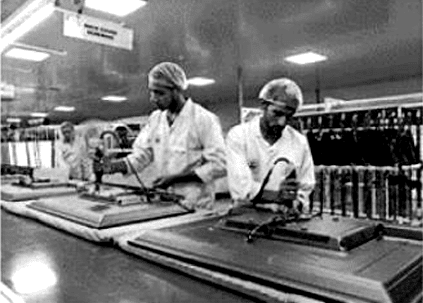
India is competitive manufacturing location due to the low cost of manpower and strong technical and engineering capabilities contributing to higher quality production runs. The production of TV sets in a factory increases uniformly by a fixed number every year. It produced 16000 sets in 6th year and 22600 in 9th year.
i. In which year, the production is Rs 29,200. (1 mark)
ii. Find the difference of the production during 7th year and 4th year. (1 mark)
iii. Find the production during 8th year. (1 mark)
iv. Find the production during first 3 years. (1 mark)
Ans:
Let the yearly productions form an AP with first term a and common difference d.
Given: a₆ = a + 5d = 16000 ...(1)
and a₉ = a + 8d = 22600 ...(2)
Subtract (1) from (2): 3d = 6600 ⇒ d = 6600 ÷ 3 = 2200
Substitute in (1): a + 5 × 2200 = 16000 ⇒ a = 16000 - 11000 = 5000.
i. Find n such that aₙ = 29200:
5000 + (n - 1)·2200 = 29200
(n - 1)·2200 = 24200 ⇒ n - 1 = 11 ⇒ n = 12
Thus, production is 29,200 in the 12th year.
ii.Now, the production during 7th year is
a7 = a + (7 - 1)d
= 5000 + 6(2200)
= 5000 + 13200 = 18200
and the production during 4th year is
a4 = a + (4 - 1)d
= 5000 + 3(2200)
= 5000 + 6600 = 11600.
Difference = 18200 - 11600 = 6600.
iii. Production in 8th year: a8 = a + (8 - 1)d
= 5000 + 7 x 2200
= 5000 + 15400 = 20400.
iv. Total production in first 3 years:
S₃ = (3 / 2) [2a + (3 - 1)d]
= (3 / 2) [2 × 5000 + 2 × 2200]
= (3 / 2) [10000 + 4400] = (3 / 2) × 14400 = 3 × 7200 = 21600.
Q4: Read the source below and answer the questions that follow:
Aahana being a plant lover decides to convert her balcony into beautiful garden full of plants. She bought few plants with pots for her balcony. She placed the pots in such a way that number of pots in the first row is 2, second row is 5, third row is 8 and so on.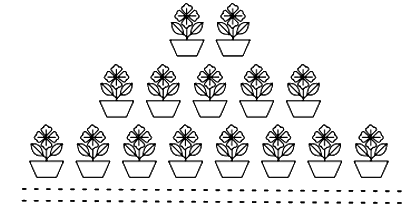
i. Find the number of pots placed in the 10th row. (1 mark)
ii. Find the difference in the number of pots placed in 5th row and 2nd row. (1 mark)
iii. If Aahana wants to place 100 pots in total, then find the total number of rows formed in the arrangement. (1 mark)
iv. If Aahana has sufficient space for 12 rows, then how many total number of pots are placed by her with the same arrangement?
(1 mark)
Ans:
The sequence of pots per row is 2, 5, 8, ... which is an AP with a = 2 and d = 3.
i. Number in 10th row: a10 = a + (10 - 1)d = 2 + 9 × 3 = 2 + 27 = 29.
ii. The number of pots placed in 5th row is,
a5 = a + (5 - 1)d
=2 + 4 x 3 = 2 + 12 = 14.
and the number of pots placed in 2nd row is,
a₂ = a + (2 - 1)d
= a + d = 2 + 3 = 5.
Difference = 14 - 5 = 9.
iii. Let n be the number of rows with total Sₙ = 100:
100 = (n / 2) [2a + (n - 1)d] = (n / 2) [4 + (n - 1)·3]
200 = n (3n + 1)
⇒ 3n² + n - 200 = 0
Solving: (3n + 25)(n - 8) = 0 ⇒ n = 8 or n = -25/3 (reject)
So, n = 8 rows.
iv. Total pots for 12 rows:
S₁₂ = (12 / 2) [2 × 2 + (12 - 1) × 3]
= 6 [4 + 33] = 6 × 37 = 222.
Thus, 222 pots are placed in 12 rows.
FAQs on Case Based Questions: Arithmetic Progressions
| 1. What is an arithmetic progression and how is it defined? |  |
| 2. How can I find the nth term of an arithmetic progression? | |
| 3. What is the formula for the sum of the first n terms of an arithmetic progression? | |
| 4. Can you give an example of an arithmetic progression? | |
| 5. How do you determine if a sequence is an arithmetic progression? | |





