Case Based Questions: Introduction to Trigonometry

Q1: Read the source below and answer the questions that follow:
In structural engineering, many structures are made up of interconnecting triangles. A truss is a framework consisting of a series of triangles lying in the same plane and is one of the major types of engineering structures used in the construction of bridges and buildings. Trusses are designed to support loads such as the weight of people and materials. A truss is made of long, straight members connected at their ends by joints. The figure shows a single repeating triangular unit of a truss system.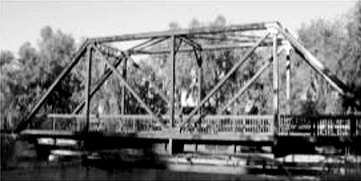
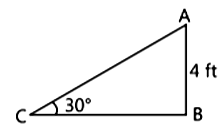 This is a single repeating triangle in a truss system.
i. In the above triangle, what is the length of AC? (1 mark)
ii. In the above triangle, what is the length of BC? (1 mark)
iii. If sin A = sin C, what will be the length of BC? (1 mark)
iv. If the length of AB doubles, what will happen the Length of AC? Solutions (1 mark)
Ans:
i. In right-angled ΔABC,
sin 30° = AB / AC ⇒ 1 / 2 = 4 / AC
⇒ AC = 8 ft
ii. In right-angled ΔABC,
tan 30° = AB / BC ⇒ 1 / √3 = 4 / BC
⇒ BC = 4√3 ft
iii. Given: sin A = sin C
⇒ ∠A = ∠C
In a triangle, sides opposite equal angles are equal.
⇒ BC = AB = 4 ft
iv. Given, AB = 2 × 4 = 8 ft
∴ In right ΔABC, sin 30° = AB / AC
⇒ 1 / 2 = 8 / AC
⇒ AC = 16 ft
So, AC doubles the original length.
Q2: Read the source below and answer the questions that follow:
Soniya and her father went to her friend Ruhi's house to attend a party. When they reached Ruhi's house, Soniya noticed that the roof of the house was triangular in shape. She imagined the dimensions of the roof as shown in the given figure.
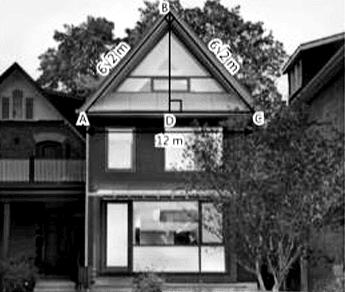
i. If D is the mid-point of AC, then find BD. (1 mark)
ii. Find the measure of ∠A and ∠C. (1 mark)
iii. Find the value of sin A + cos C. (1 mark)
iv. Find the value of tan² C + tan² A. (1 mark)
Ans:
i. We have, AB = BC = 6√2 m and AC = 12 m
D is the mid-point of AC.
∴ AD = DC = 12 / 2 = 6 m
In right-angled ΔADB, use Pythagoras theorem
AB² = BD² + AD²
⇒ BD² = (6√2)² - 6²
⇒ BD² = 72 - 36 = 36
⇒ BD = 6 m
ii. In right ΔADB, sin A = BD / AB = 6 / 6√2 = 1 / √2 (from part (1))
⇒ sin A = sin 45° ⇒ ∠A = 45°
In right ΔBDC, tan C = BD / DC = 6 / 6
⇒ tan C = 1 = tan 45° ⇒ ∠C = 45°
iii. Here, sin A = 1 / √2 and cos C = cos 45° = 1 / √2
∴ sin A + cos C = (1 / √2) + (1 / √2) = 2 / √2 = √2
iv. Here, tan C = 1 and tan A = tan 45° = 1
⇒ tan² C + tan² A = 1 + 1 = 2
Q3: Read the source below and answer the questions that follow:
Three friends - Sanjeev, Amit, and Digvijay - were playing hide-and-seek in a park. Sanjeev and Amit hid at two different locations, while Digvijay had to find them. The positions of the three friends are represented by points A, B, and C respectively, forming a right-angled triangle as shown in the figure, where AB = 9 m, BC = 3√3 m, and ∠B = 90°.
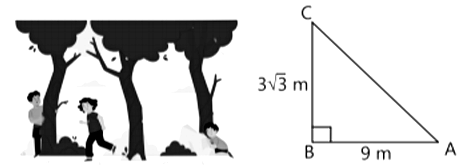
i. Find the measure of ∠A by using trigonometric ratio. (1 mark)
ii. Find the measure of ∠C by using trigonometric ratio. (1 mark)
iii. Find the length of AC. (1 mark)
iv. Find the value of cos 2A. (1 mark)
Or
iv. Find the value of sin(C / 2). (1 mark)
Ans:
i. We have, AB = 9 m, BC = 3√3 m
In right ΔABC, we have
tan A = BC / AB = (3√3) / 9 = 1 / √3
⇒ tan A = tan 30° ⇒ ∠A = 30°
ii. In right ΔABC,
We have, tan C = AB / BC = 9 / 3√3 = √3
⇒ tan C = tan 60° ⇒ ∠C = 60°
iii. In right ΔABC, sin A = BC / AC
⇒ sin 30° = BC / AC (from part (1))
⇒ 1 / 2 = (3√3) / AC ⇒ AC = 6√3 m
iv. ∴ ∠A = 30° (from part (1))
Or
∴ cos 2A = cos (2 × 30°) = cos 60° = 1 / 2
iv. ∴ ∠C = 60°
∴ sin (C / 2) = sin (60° / 2) = sin 30° = 1 / 2
FAQs on Case Based Questions: Introduction to Trigonometry
| 1. What are the basic trigonometric ratios? |  |
| 2. How is the unit circle used in trigonometry? | |
| 3. What is the Pythagorean theorem and its relationship with trigonometry? | |
| 4. What are the reciprocal trigonometric functions? | |
| 5. How do you convert between degrees and radians in trigonometry? | |





