JEE Exam > JEE Notes > Study Plans > 3 Days Timetable: Binomial Theorem & its Simple Applications
3 Days Timetable: Binomial Theorem & its Simple Applications

JEE Study Plan for "Binomial Theorem & its Simple Applications"
The Binomial Theorem is a fundamental concept in algebra with significant weightage in JEE (Main & Advanced). It is vital for solving problems related to series expansions, combinatorics, and probability. Historically, questions on this topic have appeared consistently in JEE papers, emphasising its importance. This structured revision plan will enable effective retention, enhance problem-solving speed, and build confidence.
Topics to Cover
- Introduction to Binomial Theorem
- General and Middle Terms
- Binomial Expansion
- Applications of Binomial Theorem
- Approximations and Exponential Series
The study plan will distribute these topics based on their conceptual depth and application in JEE.
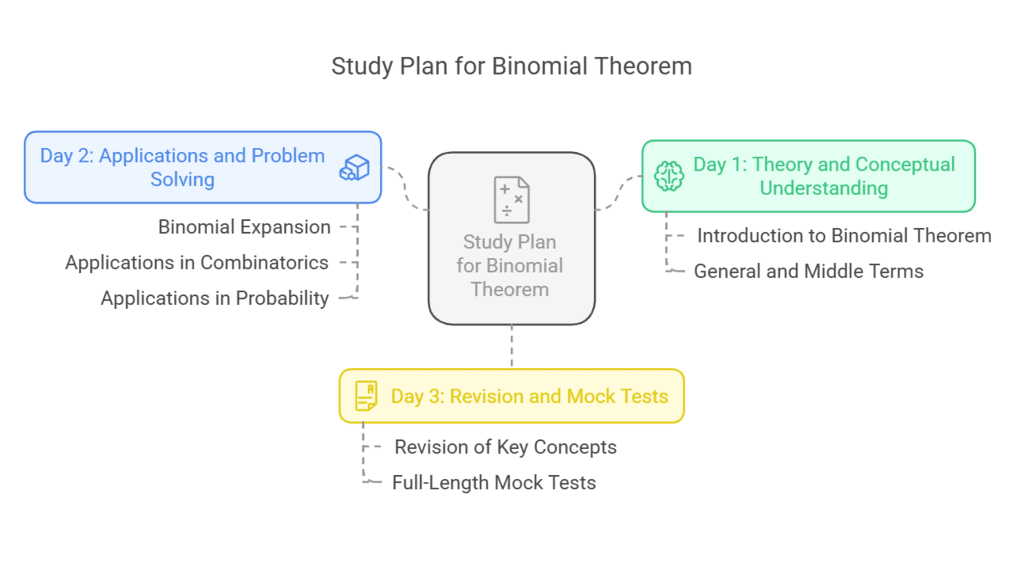 Study Plan for Binomial Theorem
Day 1: Theory and Conceptual Understanding
- What to Cover:
- Introduction to Binomial Theorem
- General and Middle Terms
- Daily Study Goals:
- Understand the statement and proof of the Binomial Theorem.
- Derive formulas for general and middle terms.
- Study Tips:
- Visualise Concepts: Use Mindmap to connect ideas.
- Summarise: Create concise notes from Detailed Notes.
- Engage with Interactive Materials: Utilise Flashcards for quick revision.
- Practice Questions:
Day 2: Applications and Problem Solving
- What to Cover:
- Binomial Expansion
- Applications of Binomial Theorem
- Daily Study Goals:
- Learn how to apply the theorem to solve problems.
- Practice applications in combinatorics and probability.
- Study Tips:
- Practice Derivations: Regularly derive formulas to reinforce understanding.
- Conceptual Questions: Solve Previous Year Questions (PYQs) from past JEE papers to identify patterns.
- Link Concepts: Use Important Formulas as a reference.
- Practice Questions:
- Complete NCERT Solutions and Exemplar Problems.
Day 3: Revision and Mock Tests
- What to Cover:
- Revision of all key concepts and formulas.
- Solve full-length mock tests.
- Daily Study Goals:
- Reinforce learning with quick revision methods.
- Attempt timed mock tests to simulate exam conditions.
- Study Tips:
- Quick Revision: Use Revision Notes to summarise key points.
- Mind Maps: Revisit the Mindmap for quick recall.
- Full-Length Tests: Engage in practice with Test: Binomial Theorem-1.
- Practice Questions:
- Review JEE Advanced PYQs and solve mock exams.
Last Day - Final JEE Revision
- Summarise all key concepts and formulas.
- Reinforce learning with mind maps, shortcuts, and revision flashcards.
- Solve previous years' JEE questions & full-length mock tests.
- Hyperlink additional resources:
The document 3 Days Timetable: Binomial Theorem & its Simple Applications is a part of the JEE Course Study Plans for JEE.
All you need of JEE at this link: JEE
FAQs on 3 Days Timetable: Binomial Theorem & its Simple Applications
| 1. What is the Binomial Theorem? |  |
Ans. The Binomial Theorem is a fundamental principle in algebra that describes the expansion of powers of a binomial expression. It states that for any positive integer \( n \) and any real numbers \( a \) and \( b \): \[ (a + b)^n = \sum_{k=0}^{n} \binom{n}{k} a^{n-k} b^k \] where \( \binom{n}{k} \) is the binomial coefficient, calculated as \( \frac{n!}{k!(n-k)!} \). This theorem allows us to expand expressions like \( (x + y)^n \) without directly multiplying the binomial \( n \) times.
| 2. How can the Binomial Theorem be applied in solving JEE problems? | |
Ans. The Binomial Theorem can be applied in various ways in JEE problems, including simplifying expressions, finding coefficients in expansions, and solving combinatorial problems. For example, you might be asked to find the coefficient of a specific term in the expansion of \( (x + y)^n \), or to calculate certain sums involving binomial coefficients. Understanding how to manipulate the theorem will provide a strong advantage in tackling these types of questions.
| 3. What are some common applications of the Binomial Theorem in mathematics? | |
Ans. Common applications of the Binomial Theorem include polynomial expansions, probability calculations, and combinatorics. In probability, it is used to determine the probability of obtaining a certain number of successes in a series of independent Bernoulli trials. In combinatorics, it helps in counting combinations and arrangements of objects. The theorem also plays a crucial role in calculus, particularly in Taylor series expansions.
| 4. Can you provide an example of a problem involving the Binomial Theorem? | |
Ans. Certainly! For example, expand \( (2x - 3)^4 \) using the Binomial Theorem. According to the theorem: \[ (2x - 3)^4 = \sum_{k=0}^{4} \binom{4}{k} (2x)^{4-k} (-3)^k \] Calculating each term gives us: \[ = \binom{4}{0} (2x)^4 (-3)^0 + \binom{4}{1} (2x)^3 (-3)^1 + \binom{4}{2} (2x)^2 (-3)^2 + \binom{4}{3} (2x)^1 (-3)^3 + \binom{4}{4} (2x)^0 (-3)^4 \] Upon simplifying, we find the expanded form.
| 5. What are binomial coefficients, and how are they calculated? | |
Ans. Binomial coefficients are the numerical factors that multiply the terms in the expansion of a binomial expression. They are denoted as \( \binom{n}{k} \), which represents the number of ways to choose \( k \) elements from a set of \( n \) elements without regard to the order of selection. They are calculated using the formula: \[ \binom{n}{k} = \frac{n!}{k!(n-k)!} \] where \( n! \) (n factorial) is the product of all positive integers up to \( n \). Understanding how to compute these coefficients is essential for applying the Binomial Theorem effectively.
About this Document

4.84/5 Rating

Apr 18, 2026 Last updated
Related Exams
Document Description: 3 Days Timetable: Binomial Theorem & its Simple Applications for JEE 2026 is part of Study Plans for JEE preparation. The notes and questions for 3 Days Timetable: Binomial Theorem & its Simple Applications have been prepared according to the JEE exam syllabus. Information about 3 Days Timetable: Binomial Theorem & its Simple Applications covers topics like and 3 Days Timetable: Binomial Theorem & its Simple Applications Example, for JEE 2026 Exam. Find important definitions, questions, notes, meanings, examples, exercises and tests below for 3 Days Timetable: Binomial Theorem & its Simple Applications.
Introduction of 3 Days Timetable: Binomial Theorem & its Simple Applications in English is available as part of our Study Plans for JEE for JEE & 3 Days Timetable: Binomial Theorem & its Simple Applications in Hindi for Study Plans for JEE course. Download more important topics related with notes, lectures and mock test series for JEE Exam by signing up for free. JEE: 3 Days Timetable: Binomial Theorem & its Simple Applications
Description
Study Plans 3 Days Timetable: Binomial Theorem & its Simple Applications - designed to help you cover important topics, manage time effectively, & stay consistent with your preparation. Dowload PDF & keep a track closely.
Information about 3 Days Timetable: Binomial Theorem & its Simple Applications
In this doc you can find the meaning of 3 Days Timetable: Binomial Theorem & its Simple Applications defined & explained in the simplest way possible. Besides explaining types of 3 Days Timetable: Binomial Theorem & its Simple Applications theory, EduRev gives you an ample number of questions to practice 3 Days Timetable: Binomial Theorem & its Simple Applications tests, examples and also practice JEE tests



Related Searches
Viva Questions, practice quizzes, 3 Days Timetable: Binomial Theorem & its Simple Applications, video lectures, Previous Year Questions with Solutions, shortcuts and tricks, study material, Semester Notes, Summary, 3 Days Timetable: Binomial Theorem & its Simple Applications, Sample Paper, Objective type Questions, Important questions, past year papers, Free, mock tests for examination, Extra Questions, 3 Days Timetable: Binomial Theorem & its Simple Applications, pdf , MCQs, Exam, ppt;