CBSE Class 9 > Class 9 Notes > Mathematics (Maths) > Mind Map: Number System
Mind Map: Number System

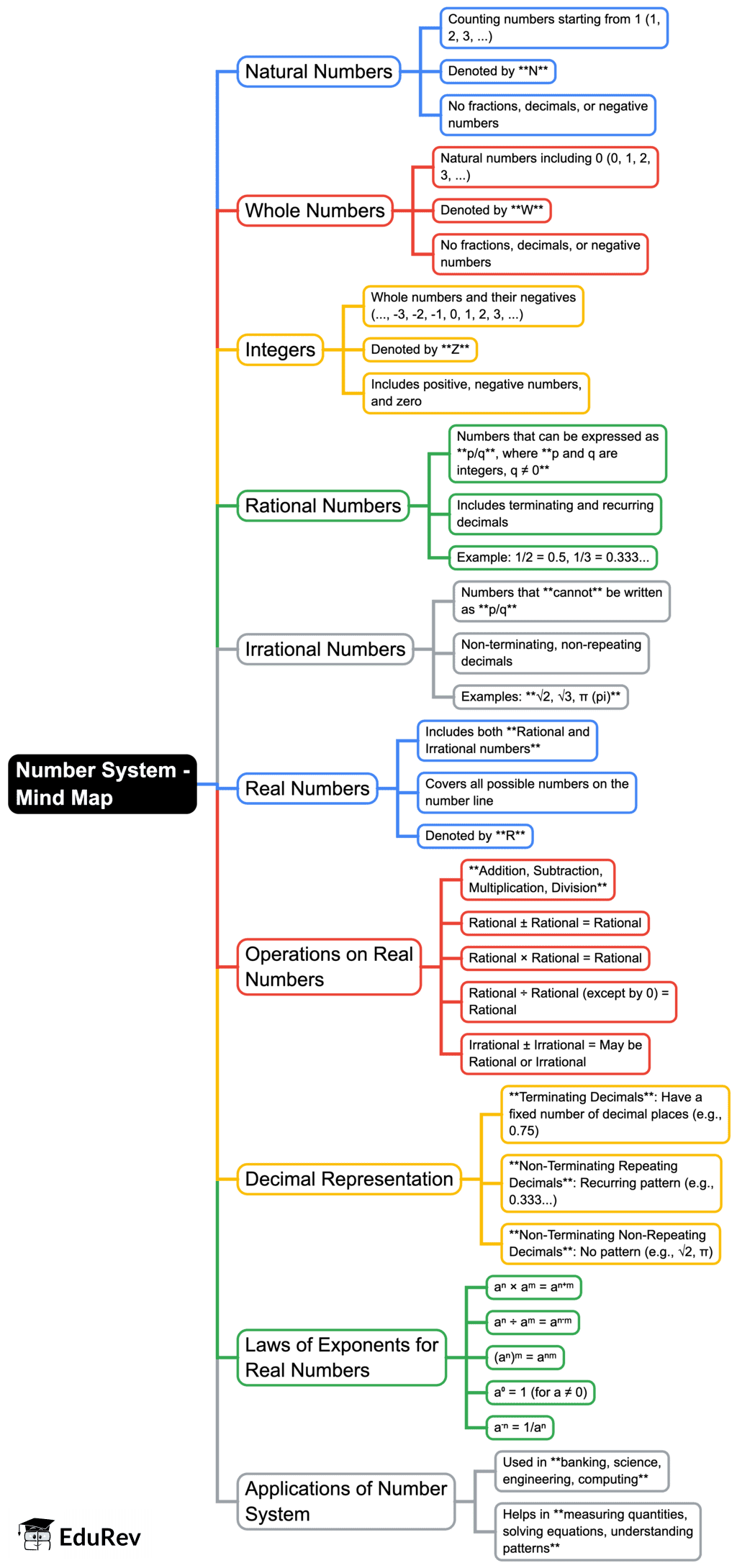
The document Mind Map: Number System is a part of the Class 9 Course Mathematics (Maths) Class 9.
All you need of Class 9 at this link: Class 9
FAQs on Mind Map: Number System
| 1. What are rational and irrational numbers, and how do I tell them apart? |  |
Ans. Rational numbers can be expressed as fractions (p/q) where both p and q are integers, like 3/4 or 5. Irrational numbers cannot be written as simple fractions; they're non-terminating and non-repeating decimals, such as π and √2. The key difference is that rationals have a defined fractional form while irrationals don't, making them distinct categories within the real number system.
| 2. Why do we need the number system classification with natural, whole, and integers? | |
Ans. Different number classifications serve specific mathematical purposes. Natural numbers (1, 2, 3...) count objects; whole numbers add zero for completeness; integers include negatives for representing losses or debts. This hierarchy builds from simple counting to handling real-world scenarios requiring negative values. Each category expands mathematical capability, forming the foundation of CBSE Class 9 mathematics and all higher operations.
| 3. How do I know if a square root is rational or irrational in CBSE exams? | |
Ans. Check if the number under the square root is a perfect square. If √9 or √16 equals a whole number (3 or 4), it's rational. If √2 or √7 doesn't simplify to a whole number, it's irrational. Perfect squares yield rational results; non-perfect squares yield irrational ones. This distinction frequently appears in Class 9 assessments and helps identify number types quickly.
| 4. What's the difference between terminating and non-terminating decimals for my maths exam? | |
Ans. Terminating decimals end after a finite number of digits (0.25, 0.5), while non-terminating decimals continue infinitely (0.333..., 0.142857...). Terminating decimals always represent rational numbers with denominators containing only factors of 2 and 5. Non-terminating decimals are either repeating rationals or irrational numbers, a crucial distinction for CBSE number system problems.
| 5. Can I use mind maps to understand all types of numbers and their relationships? | |
Ans. Yes, mind maps effectively visualise the number system hierarchy and relationships between natural, whole, integer, rational, and real numbers. They show how each category contains or extends the previous one, clarifying interconnections. Refer to mind maps and flashcards on EduRev to grasp these classifications quickly, helping consolidate understanding of how the entire number system branches and connects logically.
About this Document

5.2K Views

4.82/5 Rating

Apr 19, 2026 Last updated
Related Exams
Document Description: Mind Map: Number System for Class 9 2026 is part of Mathematics (Maths) Class 9 preparation. The notes and questions for Mind Map: Number System have been prepared according to the Class 9 exam syllabus. Information about Mind Map: Number System covers topics like and Mind Map: Number System Example, for Class 9 2026 Exam. Find important definitions, questions, notes, meanings, examples, exercises and tests below for Mind Map: Number System.
Introduction of Mind Map: Number System in English is available as part of our Mathematics (Maths) Class 9 for Class 9 & Mind Map: Number System in Hindi for Mathematics (Maths) Class 9 course. Download more important topics related with notes, lectures and mock test series for Class 9 Exam by signing up for free. Class 9: Mind Map: Number System
Description
Mind Map: Number System of Maths Class 9 provides you one-page visual summary of the chapter covering all the important topics. Download the PDF from EduRev.
Information about Mind Map: Number System
In this doc you can find the meaning of Mind Map: Number System defined & explained in the simplest way possible. Besides explaining types of Mind Map: Number System theory, EduRev gives you an ample number of questions to practice Mind Map: Number System tests, examples and also practice Class 9 tests



Related Searches
ppt, Objective type Questions, MCQs, pdf , Mind Map: Number System, study material, Mind Map: Number System, Viva Questions, Important questions, Extra Questions, past year papers, video lectures, Sample Paper, Summary, Exam, Semester Notes, Mind Map: Number System, Previous Year Questions with Solutions, shortcuts and tricks, Free, mock tests for examination, practice quizzes;