Chapter Notes: Let's Clean Up

Key Points of the Story
- Food Wastage in Britain: Every year, Britain throws away a significant amount of food, costing households a lot of money.
- Daily Waste Statistics: Daily, the country discards approximately 220,000 loaves of bread, 1.6 million bananas, 5,500 chickens, and many other food items.
- Financial Impact: The average British household loses about £420 each year due to food waste. For families with children, this cost increases to £610 a year.
- Kerala's Solution: In Kerala, a company called BIOTECH has successfully addressed the issue of food waste by creating biogas plants.
- Biogas Plants: These plants convert food waste into gas that can be used for cooking and sometimes for electricity. The leftover material is used as fertilizer.
- Number of Installations: BIOTECH has installed 12,000 domestic biogas plants, 220 for institutions, and 17 municipal plants that use waste from markets.
- Environmental Benefits: The biogas plants help save a considerable amount of LPG and diesel, leading to a reduction in carbon dioxide emissions and less methane production.
- Award for Sustainability: BIOTECH was recognized for its efforts in sustainable energy by winning an Ashden Award in 2007.
- Understanding Waste: Waste is anything that is thrown away or not used properly, which can harm the environment.
- Three Rs of Waste Management: People can reduce waste by following the three Rs: Reduce, Reuse, and Recycle.
- Impact of Recycling: Recycling paper can save trees, water, energy, and space in landfills, showing that recycling is very helpful.
Detailed Summary
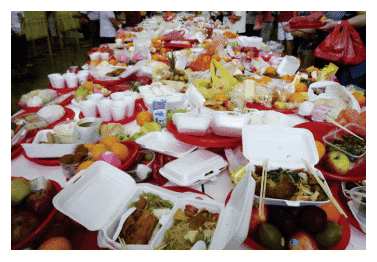
This chapter focuses on the significant issue of food waste, particularly in Britain, where a staggering amount of food is discarded annually. Key statistics reveal that each day, British households waste:
- 220,000 loaves of bread
- 1.6 million bananas
- 5,500 chickens
- 5.1 million potatoes
- 660,000 eggs
- 1.2 million sausages
- 1.3 million yoghurts
On average, families waste over £420 a year on uneaten food, which can rise to £610 for families with children, highlighting the financial impact of food waste.
In contrast, Kerala, India, presents an innovative solution through BIOTECH, which has established biogas plants. These facilities convert food waste into gas for cooking and can even generate electricity. They operate:
- 12,000 plants for homes
- 220 plants for schools and hospitals
- 17 large plants for city waste
These plants help reduce energy consumption and pollution by replacing harmful fuels and saving significant CO2 emissions.
The chapter emphasizes the importance of the three R's of waste management: reduce, reuse, and recycle. Reducing consumption, reusing items, and recycling materials like paper can conserve resources and protect the environment.
In conclusion, tackling food waste is crucial, and by learning from successful examples and adopting sustainable practices, we can contribute to a healthier planet for future generations.
Theme/ Message
- The main theme of the chapter is the importance of reducing food waste to protect our environment and save money.
- It highlights how individual actions, like reducing and recycling, can have a big impact on the planet.
- The message encourages everyone to be responsible and make choices that help reduce waste and promote sustainability.
- It shows that innovative solutions, like the biogas plants in Kerala, can effectively manage waste and create clean energy.
- Lastly, the chapter stresses that every little action counts and can lead to a healthier planet for everyone.
Difficult Words
- Wastage: The act of using something carelessly so that it is not needed or used properly.
- Statistics: Numbers that represent information, often collected to understand trends or facts.
- Household: A group of people living in the same home.
- Institutional: Related to organizations or large groups, such as schools or businesses.
- Municipal: Related to a city or town and its local government.
- Contamination: The act of making something dirty or harmful.
- Fertilizer: A substance added to soil to help plants grow better.
- Emissions: Pollutants released into the air from various sources, such as cars and factories.
- Sustainable: Able to be maintained without causing harm to the environment.
- Biogas: Gas produced from organic materials, such as food waste, that can be used for energy.
- Recycling: The process of converting waste into reusable material.
- Landfill: A place where waste is disposed of and buried in the ground.
- Decomposition: The process of breaking down organic matter into simpler substances.
- Innovative: Featuring new ideas or methods; creative in thinking.
- Responsible: Being accountable for one's actions and understanding their effects.
FAQs on Chapter Notes: Let's Clean Up
| $1. What is the main theme of the chapter "Let's Clean Up"? |  |
| $2. How does the chapter illustrate the significance of teamwork in cleaning efforts? | |
| $3. What are some of the difficult words found in the chapter, and what do they mean? | |
| $4. Can you provide a detailed summary of the chapter "Let's Clean Up"? | |
| $5. Why is it important for students to participate in cleaning activities? | |




