CBSE Class 6 > Class 6 Notes > English Grammar > Mind Map: Verbs
Mind Map: Verbs

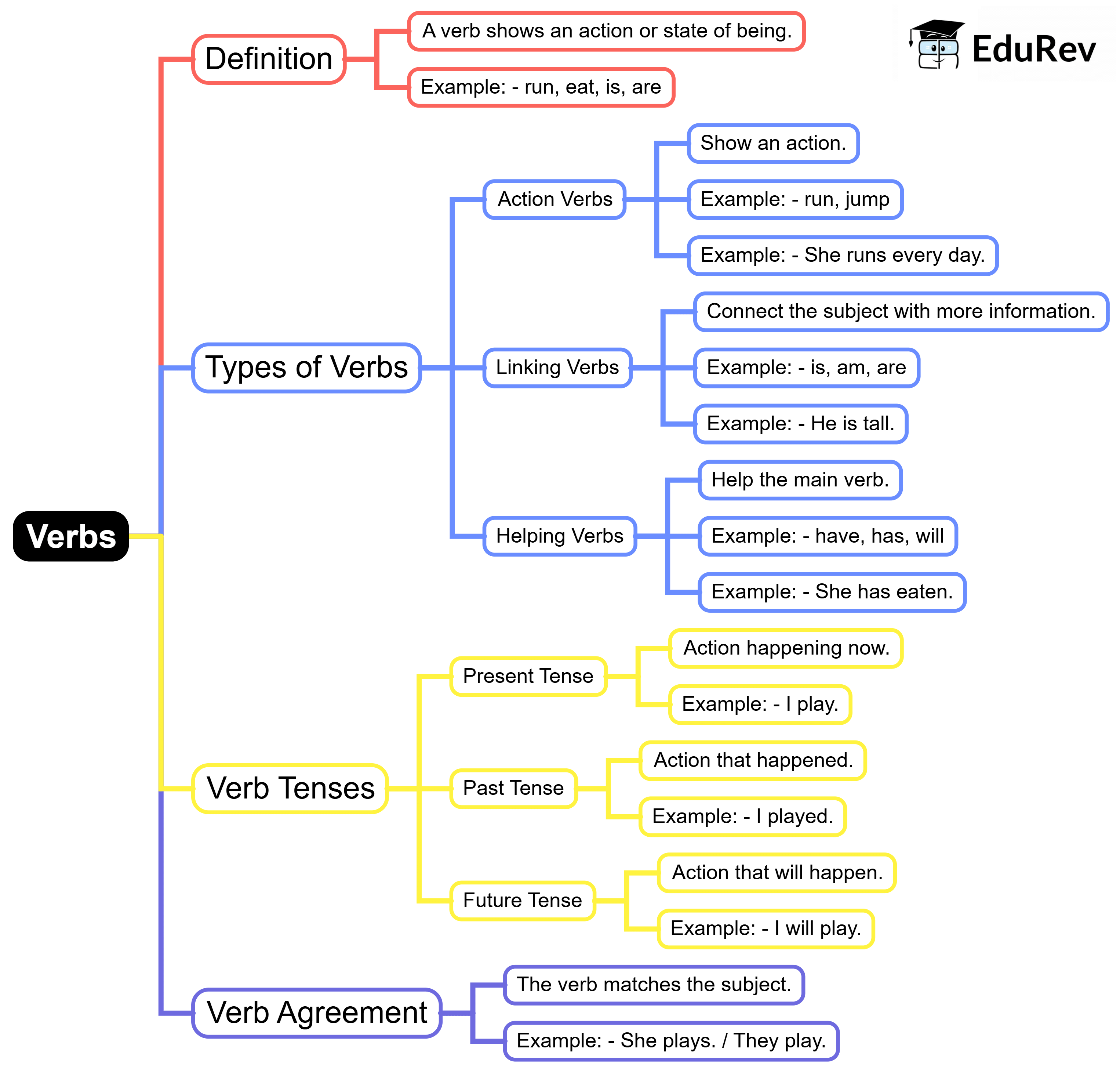
The document Mind Map: Verbs is a part of the Class 6 Course English Grammar for Class 6.
All you need of Class 6 at this link: Class 6
FAQs on Mind Map: Verbs
| 1. What are the main categories of verbs in English? |  |
Ans. The main categories of verbs in English include action verbs, linking verbs, and auxiliary (helping) verbs. Action verbs express physical or mental activities (e.g., run, think), linking verbs connect the subject to a subject complement (e.g., is, seem), and auxiliary verbs help to form tenses, moods, and voices of other verbs (e.g., have, will).
| 2. How can I identify action verbs in a sentence? | |
Ans. Action verbs can be identified by looking for words that convey an action or activity in a sentence. They typically describe what the subject is doing. For example, in the sentence "She runs every morning," the word "runs" is the action verb as it describes the action performed by the subject, "she."
| 3. What is the difference between transitive and intransitive verbs? | |
Ans. Transitive verbs require a direct object to complete their meaning, whereas intransitive verbs do not. For example, in the sentence "She reads a book," "reads" is a transitive verb because it has the direct object "book." In contrast, in "He sleeps," "sleeps" is intransitive as it does not take a direct object.
| 4. Can verbs change form, and if so, how? | |
Ans. Yes, verbs can change form to indicate tense, mood, or aspect. This includes changing from present to past tense (e.g., 'walk' to 'walked'), adding suffixes like -ing for present participles (e.g., 'running'), or using auxiliary verbs to form perfect tenses (e.g., 'has walked').
| 5. What are some common irregular verbs, and how do they differ from regular verbs? | |
Ans. Common irregular verbs include 'go' (went), 'have' (had), and 'be' (was/were). They differ from regular verbs in that they do not follow the standard pattern of adding -ed for the past tense. Instead, they have unique forms that must be memorized, as they do not follow a predictable pattern.
About this Document

4.92/5 Rating

Apr 29, 2026 Last updated
Document Description: Mind Map: Verbs for Class 6 2026 is part of English Grammar for Class 6 preparation. The notes and questions for Mind Map: Verbs have been prepared according to the Class 6 exam syllabus. Information about Mind Map: Verbs covers topics like and Mind Map: Verbs Example, for Class 6 2026 Exam. Find important definitions, questions, notes, meanings, examples, exercises and tests below for Mind Map: Verbs.
Introduction of Mind Map: Verbs in English is available as part of our English Grammar for Class 6 for Class 6 & Mind Map: Verbs in Hindi for English Grammar for Class 6 course. Download more important topics related with notes, lectures and mock test series for Class 6 Exam by signing up for free. Class 6: Mind Map: Verbs
Description
Mind Map: Verbs of English Grammar provides you one-page visual summary of the chapter covering all the important topics. Download the PDF from EduRev.
Information about Mind Map: Verbs
In this doc you can find the meaning of Mind Map: Verbs defined & explained in the simplest way possible. Besides explaining types of Mind Map: Verbs theory, EduRev gives you an ample number of questions to practice Mind Map: Verbs tests, examples and also practice Class 6 tests



Related Searches
mock tests for examination, past year papers, Mind Map: Verbs, Objective type Questions, Summary, ppt, Mind Map: Verbs, Exam, shortcuts and tricks, Free, MCQs, Extra Questions, study material, video lectures, Mind Map: Verbs, practice quizzes, Previous Year Questions with Solutions, Important questions, pdf , Sample Paper, Semester Notes, Viva Questions;