Unit Test (Solutions): Tribes, Nomads & Settled Communities

Time Limit: 1 Hour
Total Marks: 30
Attempt all questions.
- Question numbers 1 to 5 carry 1 mark each.
- Question numbers 6 to 8 carry 2 marks each.
- Question numbers 9 to 11 carry 3 marks each.
- Question numbers 12 & 13 carry 5 marks each.
Q1: Which of the following was a major tribal group in the North-East region of India? (1 Mark)
(a) Gonds
(b) Ahoms
(c) Bhils
(d) Cheros
Ans: (b) Ahoms
Q2: Fill in the blank: The Ahoms introduced a labor system known as ________, in which each village sent workers in rotation for military and construction duties. (1 Mark)
Ans: Paik system
Q3: What was the major source of income for the Garha Katanga kingdom? (1 Mark)
(a) Textile production
(b) Elephant trade
(c) Gold mining
(d) Salt manufacturing
Ans: (b) Elephant trade
Q4: Which term was used for a group of 84 villages in the Gond administrative system? (1 Mark)
(a) Khel
(b) Buranji
(c) Chaurasi
(d) Tanda
Ans: (c) Chaurasi
Q5: Name the queen of Garha Katanga who fought against the Mughals and chose death over surrender. (1 Mark)
Ans: Rani Durgawati
Q6: How did nomadic tribes contribute to the economy of medieval India? (2 Marks)
Ans:
- Nomadic tribes, like the Banjaras, played a crucial role in transporting goods such as grains, salt, and textiles between regions.
- They also provided essential services, such as selling cattle, horses, and other livestock needed by the army and wealthy individuals.
Q7: What was the role of Brahmanas in integrating tribal societies into the caste system? (2 Marks)
Ans:
- Brahmanas supported the inclusion of tribal leaders into the ruling class by granting them high status in society.
- Many tribal groups were absorbed into the caste system, with leaders becoming part of the Kshatriya (warrior) class, while ordinary members were assigned lower jatis.
Q8: Describe two major challenges faced by the Ahom kingdom. (2 Marks)
Ans:
- Mughal Invasions: Ahoms faced multiple attacks from the Mughal Empire, especially under Mir Jumla in 1662.
- Social and Economic Changes: The forced labor system (paik) and population redistribution disrupted traditional clan structures.
Q9: Explain the administrative structure of the Gond kingdom. (3 Marks)
Ans:
- The Gond kingdom was divided into multiple Garhs, each governed by a chief.
- A Garh was further divided into Chaurasi, which comprised 84 villages.
- Chaurasi was further subdivided into Barhots, which contained 12 villages each, ensuring an organized administrative system.
Q10: How did the Banjaras help in trade and transportation during the medieval period? (3 Marks)
Ans:
- Banjaras traveled in groups called tandas, carrying grains and goods across long distances.
- They supplied food to large cities and armies, playing a key role in trade networks.
- Sultan Alauddin Khalji and Emperor Jahangir relied on them to ensure grain supply in their kingdoms.
Q11: Discuss the social and economic impact of the Ahoms on Assam. (3 Marks)
Ans:
- Social: Ahoms reorganized Assam's society by introducing the khel system (clan-based administration). They also gradually adopted Hindu practices.
- Economic: They developed new agricultural techniques, introduced high-quality gunpowder, and promoted infrastructure projects.
- Military: Their strong army and firearms allowed them to resist the Mughal invasion successfully.
Q12: Compare the tribal societies of the Gonds and Ahoms in terms of their administration, economy, and cultural development. (5 Marks)
Ans: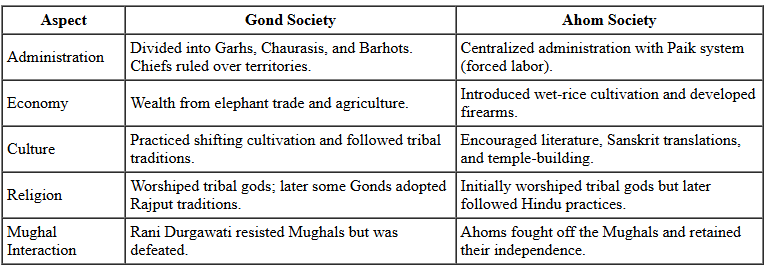
Q13: Analyze the impact of the integration of tribal societies into mainstream kingdoms and the caste system. (5 Marks)
Ans:
- Social Integration: Many tribal leaders were given high status (e.g., Rajputs), but ordinary members were often placed in lower jatis.
- Economic Changes: Tribal communities had to adapt to settled agriculture and taxation, reducing their independence.
- Political Impact: Some tribal groups, like the Ahoms and Gonds, established powerful states, influencing regional politics.
- Loss of Autonomy: Integration into caste-based society reduced tribal freedoms, as they had to follow Brahmanical traditions.
- Cultural Influence: Tribal traditions, languages, and arts influenced mainstream society, but many were also modified to fit Hindu traditions.
FAQs on Unit Test (Solutions): Tribes, Nomads & Settled Communities
| 1. What are the key differences between tribes, nomads, and settled communities? |  |
| 2. How did the transition from nomadic to settled communities occur? | |
| 3. What role did agriculture play in the development of settled communities? | |
| 4. What are the social structures commonly found in tribes? | |
| 5. How did interactions between nomadic and settled communities influence cultural exchange? | |