Unit Test (Solutions): Number Play

Time: 1 hour M.M. 20
Attempt all questions.
- Question numbers 1 to 5 carry 1 mark each.
- Question numbers 6 to 8 carry 2 marks each.
- Question numbers 9 to 11 carry 3 marks each.
Q1: What is the estimated sum of 645 + 876? (1 mark)
(a) 1300
(b) 1400
(c) 1500
(d) 1600
Ans: (c)
Sol: Since, 645 is closer to 600,
And, 876 is closer to 900.
Thus, Estimated sum = 600 + 900 = 1500.
Q2: What is the estimated difference of 812 - 493? (1 mark)
(a) 200
(b) 250
(c) 300
(d) 350
Ans: (c)
Sol: 812 - 493
Since, 812 is closer to 800,
And, 493 is closer to 500.
Thus, Estimated difference = 800 - 500 = 300.
Q3: Which of the following sets of numbers adds up to 24,539? (1 mark)
(a) 5-digit number = 21,000, 3-digit number = 539
(b) 5-digit number = 20,000, 3-digit number = 439
(c) 5-digit number = 24,000, 3-digit number = 539
(d) 5-digit number = 19,000, 3-digit number = 539
Ans: (c)
Sol: 24,000 + 539 = 24,539.
Q4: Which of the following is a 3-digit palindrome that can be formed using the digits 1, 2, and 3? (1 mark)
(a) 111
(b) 122
(c) 123
(d) 132
Ans: (a)
Sol: A 3-digit palindrome is a number that reads the same forwards and backwards. 111 is a palindrome, while the others are not.
Q5: Which of the following numbers has digits that add up to 14? (1 mark)
(a) 59
(b) 67
(c) 85
(d) 92
Ans: (a)
Sol: The sum of the digits of 59 is 5 + 9 = 14.
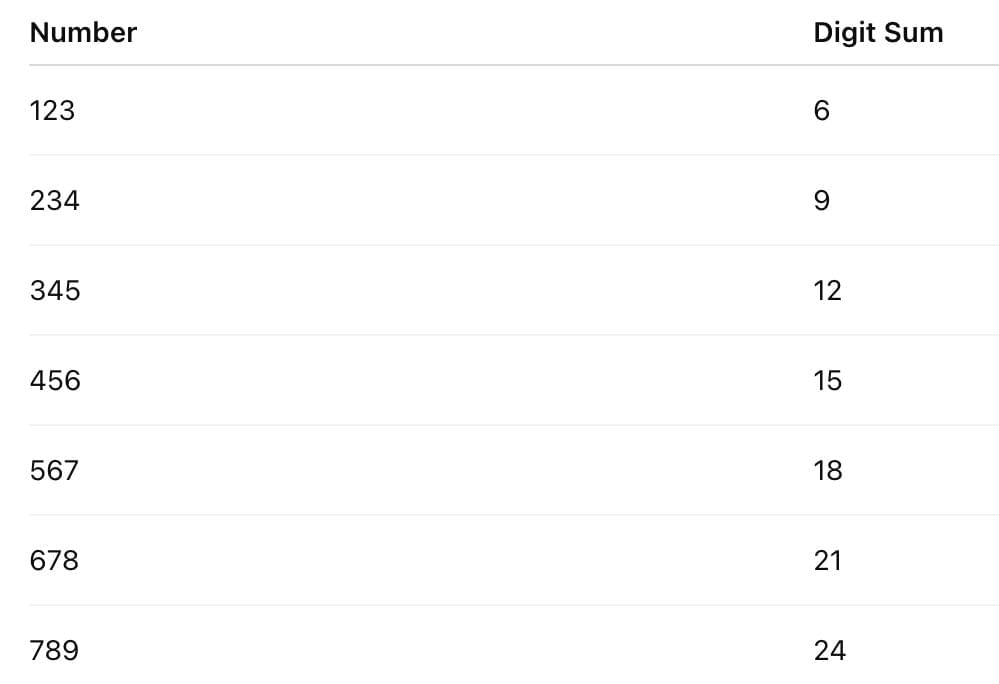
Q6: Calculate the digit sums of 3-digit numbers whose digits are consecutive (e.g., 123, 234). Do you see a pattern? Will this pattern continue? (2 marks)
Ans:
The digit sum increases by 3 each time.
Yes, the pattern continues as digits progress consecutively.
Q7: The time now is 02:15. How many minutes until the clock shows the next palindromic time? What about the one after that? (2 marks)
Ans: Time now - 02:15
Now, the next palindromic time is 02:20
Hence, 02:20 - 02:15 = 5 minutes.
The next one after that is 03:30.
Hence, 03:30 - 02:20 = 70 minutes.
Q8. We are the group of 5-digit numbers between 40,000 and 80,000 such that all of our digits are even. Who is the largest number in our group? Who is the smallest number in our group? (2 marks)
Ans:
Largest: 68,888.
(First digit must be even and ≤7 → choose 6; then choose the largest even digit 8 for the remaining places.)Smallest: 40,000.
(Smallest allowed leading digit is 4; smallest even digits for the rest are 0.)
Q9: What is the sum of the smallest and largest 5-digit palindromes? What is their difference?(3 marks)
Ans:
Smallest 5-digit palindrome = 10001
Largest 5-digit palindrome = 99999
Sum:
10001+99999=110000Difference:
99999-10001=89998Final Answer:
Sum = 110000
Difference = 89998
Q10. Digit sum 18. (3 marks)
(a) Write other numbers whose digits add up to 18.
(b) What is the smallest number whose digit sum is 18?
(c) What is the largest 5-digit number whose digit sum is 18?
(d) How big a number can you form having the digit sum 18? Can you make an even bigger number?
Ans: Some numbers are:
99, 189, 279, 369, 459, 558, 567, 666, 756, 765, 774, 783, 792, 891, 990, 1089, 1179, 1269, 1359, ...(b) What is the smallest number whose digit sum is 18?
Ans: The smallest number is 99 (9 + 9 = 18).(c) What is the largest 5-digit number whose digit sum is 18?
Ans: The largest 5-digit number is 99000 (9 + 9 + 0 + 0 + 0 = 18).(d) How big a number can you form having the digit sum 18? Can you make an even bigger number?
Ans: Yes. We can form very large numbers by placing zeros after digits that sum to 18. For example:
9900000000 → digit sum = 18
9000000000009 → digit sum = 18
Thus, we can make even bigger numbers (with any number of digits), as long as their digits add up to 18.
Q11. Will reversing and adding numbers repeatedly, starting with a 2-digit number, always give a palindrome? (3 marks)
Ans:
We test with examples:
Example 1: 23
Reverse = 32
23 + 32 = 55 → PalindromeExample 2: 56
Reverse = 65
56 + 65 = 121 → PalindromeObservation:
For all 2-digit numbers tested, a palindrome is obtained after one or more steps.Conclusion:
Yes, starting with any 2-digit number, repeated reversing and adding will always lead to a palindrome.
(Note: The unsolved case of 196, which may never form a palindrome, occurs with 3-digit numbers, not with 2-digit ones.)
FAQs on Unit Test (Solutions): Number Play
| 1. What are the key concepts covered in the Number Play unit for Class 6? |  |
| 2. How can I effectively prepare for the Number Play unit test in Class 6? | |
| 3. What types of questions can I expect on the Number Play test for Class 6? | |
| 4. Are there any specific strategies for solving number patterns in the Number Play unit? | |
| 5. How important is understanding factors and multiples in the Number Play unit? | |