CBSE Class 1 > Class 1 Notes > EVS > Printable Poster: Sensory Organs
Printable Poster: Sensory Organs

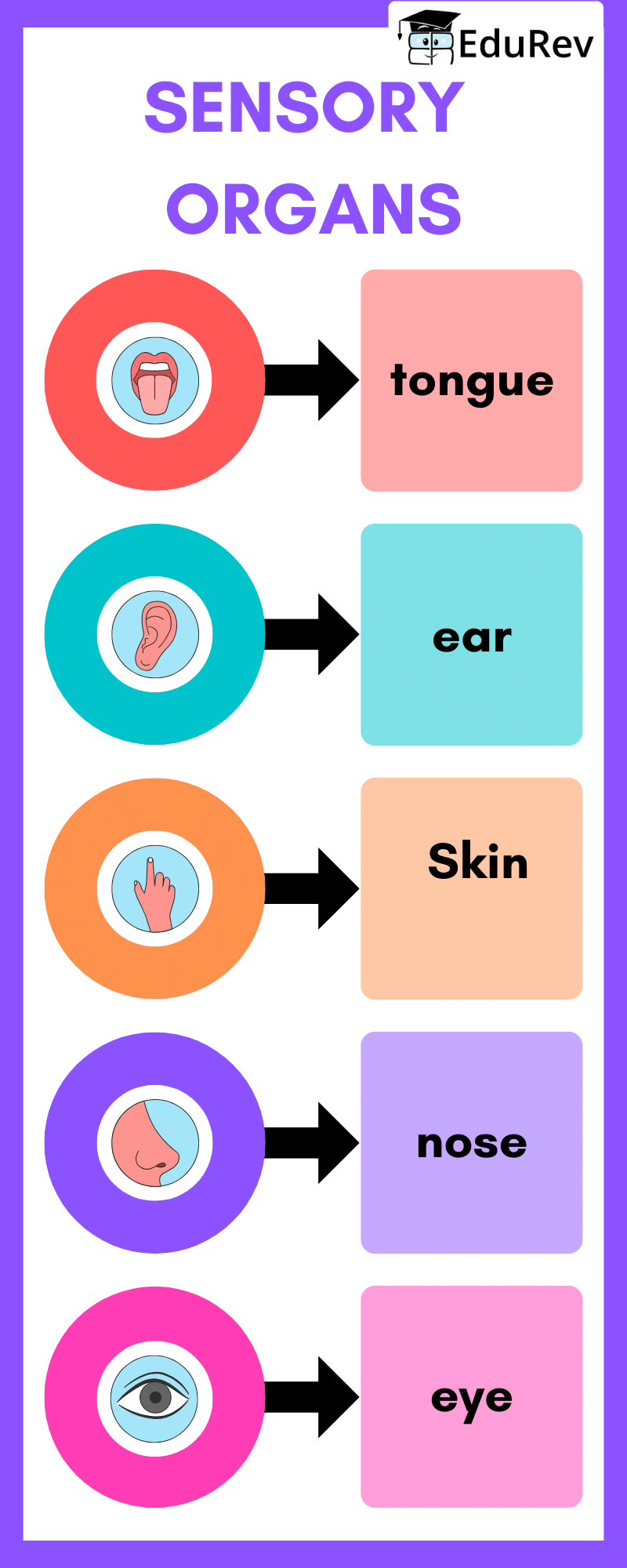
The document Printable Poster: Sensory Organs is a part of the Class 1 Course EVS for Class 1.
All you need of Class 1 at this link: Class 1
FAQs on Printable Poster: Sensory Organs
| 1. What are the five main sense organs in the human body? |  |
Ans. The five main sense organs in the human body are the eyes (sight), ears (hearing), nose (smell), tongue (taste), and skin (touch). Each of these organs plays a crucial role in how we perceive and interact with the world around us.
| 2. How do the sense organs function together to help us perceive our environment? | |
Ans. The sense organs work in conjunction to provide a comprehensive understanding of our surroundings. For example, sight helps us recognize objects visually, while hearing allows us to detect sounds. Smell can enhance our experience of taste, and touch provides tactile feedback. These senses communicate with the brain, integrating information to create a complete sensory experience.
| 3. What role do receptors in the sense organs play in sensation? | |
Ans. Receptors in the sense organs are specialized cells that detect specific stimuli, such as light, sound waves, chemicals, or pressure. When these receptors are activated, they convert the stimuli into electrical signals that are sent to the brain, where they are interpreted as sensations, allowing us to respond appropriately to our environment.
| 4. Why is it important to protect our sense organs? | |
Ans. Protecting our sense organs is important because they are vital for communication, navigation, and interaction with our environment. Damage to these organs can lead to sensory deficits that impact daily life and overall well-being. Simple measures, like wearing sunglasses, using ear protection, and maintaining good hygiene, can help preserve their function.
| 5. Can the sense organs adapt to changes in the environment? | |
Ans. Yes, sense organs can adapt to changes in the environment through a process known as sensory adaptation. For example, when exposed to a strong odor for a prolonged period, the sensitivity of smell receptors decreases, and the perception of the odor diminishes. This adaptation allows us to focus on new stimuli and helps prevent sensory overload.
About this Document

4.75/5 Rating

Apr 18, 2026 Last updated
Document Description: Printable Poster: Sensory Organs for Class 1 2026 is part of EVS for Class 1 preparation. The notes and questions for Printable Poster: Sensory Organs have been prepared according to the Class 1 exam syllabus. Information about Printable Poster: Sensory Organs covers topics like and Printable Poster: Sensory Organs Example, for Class 1 2026 Exam. Find important definitions, questions, notes, meanings, examples, exercises and tests below for Printable Poster: Sensory Organs.
Introduction of Printable Poster: Sensory Organs in English is available as part of our EVS for Class 1 for Class 1 & Printable Poster: Sensory Organs in Hindi for EVS for Class 1 course. Download more important topics related with notes, lectures and mock test series for Class 1 Exam by signing up for free. Class 1: Printable Poster: Sensory Organs
Description
Printable Poster: Sensory Organs of EVS covers all the important topics, helping you prepare for the Class 1 exam on EduRev. Start for free!
Information about Printable Poster: Sensory Organs
In this doc you can find the meaning of Printable Poster: Sensory Organs defined & explained in the simplest way possible. Besides explaining types of Printable Poster: Sensory Organs theory, EduRev gives you an ample number of questions to practice Printable Poster: Sensory Organs tests, examples and also practice Class 1 tests



Related Searches
study material, Printable Poster: Sensory Organs, shortcuts and tricks, video lectures, Sample Paper, Extra Questions, Summary, Free, Important questions, Objective type Questions, past year papers, practice quizzes, Semester Notes, Printable Poster: Sensory Organs, MCQs, Printable Poster: Sensory Organs, pdf , Exam, Viva Questions, mock tests for examination, Previous Year Questions with Solutions, ppt;