Class 6 English: Sample Paper Solutions- 5

General Instructions:
1. This paper consists of 4 sections :
- Section A: Reading: 20 marks
- Section B: Writing: 25 marks
- Section C: Grammar: 20 marks
- Section D: Literature: 25 marks
2. Attempt all the questions.
3. All the answers must be correctly numbered as in the question paper and answered in the answer sheet.
4. Ensure that questions for each section are answered together.
5. Read each question carefully and follow the instructions.
Section A (Reading)
Q1: Read the passage and answer the questions given below: [2 × 5 = 10 Marks]
The Rise of the Roman Empire
The Roman Empire, one of the largest empires in history, was founded in 27 BC by Augustus after the fall of the Roman Republic. At its peak, it stretched from Britain to the Middle East, covering vast areas of Europe, North Africa, and Asia Minor. Roman law, engineering, and culture had a profound impact on the development of Western civilization. The Romans are known for their advanced road systems, aqueducts, and monumental architecture, including the Colosseum. The empire was governed by a series of emperors, but over time, it faced internal and external challenges, such as political instability and invasions. In 476 AD, the Western Roman Empire officially fell, but the Eastern Roman Empire, known as the Byzantine Empire, continued to thrive for another thousand years.
(i) Who founded the Roman Empire?
(a) Julius Caesar
(b) Constantine
(c) Augustus
(d) Nero
Ans: (c)
Explanation: Augustus is credited with founding the Roman Empire in 27 BC after the fall of the Roman Republic. His rule marked the start of imperial government in Rome.
(ii) What was one of the key contributions of the Roman Empire to Western civilization?
(a) The invention of the printing press
(b) The development of Roman law, engineering, and culture
(c) The creation of the first democracy
(d) The discovery of electricity
Ans: (b)
Explanation: Roman law, engineering, and culture - for example, well-built roads, aqueducts and public buildings - shaped many institutions and practices in Western civilisation and influenced later societies.
(iii) What does the word "profound" mean in the context of the passage?
(a) Insignificant
(b) Deep and lasting
(c) Temporary
(d) Ordinary
Ans: (b)
Explanation: Here, "profound" means a deep and lasting influence - Roman achievements had effects that continued for many centuries in law, engineering and culture.
(iv) What challenges did the Roman Empire face in its later years?
(a) A shortage of resources
(b) Political instability and invasions
(c) A lack of military strength
(d) A decline in trade
Ans: (b)
Explanation: The empire suffered from internal political instability and repeated invasions by outside groups. These problems weakened Roman control and contributed to the fall of the Western Empire.
(v) When did the Western Roman Empire officially fall?
(a) 410 AD
(b) 476 AD
(c) 500 AD
(d) 600 AD
Ans: (b)
Explanation: The Western Roman Empire is usually dated to 476 AD when the last emperor in the West was deposed. The Eastern Roman Empire continued as the Byzantine Empire for many centuries.
Q2: Read the beautiful poem and answer the questions given below: [2 × 5 = 10 Marks]
A little dog ran through the park,
Its fur was shiny, and its tail was dark.
It barked at birds that flew so high,
And wagged its tail as it passed by.
It sniffed the flowers, smelled the trees,
Chased its shadow with the greatest ease.
The sun was shining, the sky was clear,
And the little dog was full of cheer.
It ran in circles, then sat to rest,
Tired but happy, feeling its best.
I watched it play in the sunny light,
And smiled, watching the dog take flight.
(i) The poem is talking about a
(a) cat
(b) bird
(c) dog
(d) rabbit
Ans: (c)
Explanation: The lines describe a little dog running, barking, wagging its tail and playing in the park, so the correct answer is dog.
(ii) What was the color of the dog's tail?
(a) White
(b) Brown
(c) Dark
(d) Red
Ans: (c)
Explanation: The poem explicitly says the dog's tail was dark, so (c) is correct.
(iii) What did the dog do when it saw birds?
(a) Ran away
(b) Barked at them
(c) Chased them
(d) Hid behind a tree
Ans: (b)
Explanation: The poem states, "It barked at birds that flew so high," so the dog barked at them.
(iv) What did the dog do after playing?
(a) Went to sleep
(b) Ate food
(c) Sat to rest
(d) Played more
Ans: (c) Sat to rest
Explanation: The poem says the dog "ran in circles, then sat to rest," showing it rested after playing.
(v) A pair of rhyming words is
(a) dark-park
(b) tail-mail
(c) light-flight
(d) best-rest
Ans: (a) dark-park
Explanation: "Dark" and "park" end with the same sound, so they form a rhyming pair in the poem.
Q3: Read the passage and answer the questions given below: [2 × 5 = 10 Marks]
Once there was a young girl named Lila who loved to explore the woods near her home. Every day after school, she would rush to the forest, eager to discover new things. One afternoon, she found a small, hidden path that led deeper into the woods than she had ever ventured before. She followed the path and came upon a beautiful clearing with a small pond at its center. The pond was surrounded by tall trees, their leaves creating a canopy that blocked out the sun, making the area feel cool and peaceful. Lila sat by the pond, dipping her feet into the water, when she noticed a group of small animals-rabbits, squirrels, and birds-gathering around the water. She felt like she had discovered a secret world.
As she sat quietly, she saw an elderly man walking down the path. He was wearing a long coat and had a cane with him. The man smiled at Lila and greeted her. "This is a special place," he said. "Not many people know about it." The man explained that the pond had magical properties-it could grant wishes, but only to those who truly believed in it. Lila, intrigued, asked him how the pond worked. "It listens to your heart," he explained. "You must be sincere and make your wish with a pure heart."
Lila thought for a moment and then made a wish for her family to always be happy and healthy. The man nodded and smiled, "Your wish is in good hands."
(i) Whom did Lila encounter in the woods?
Ans: Lila encountered an elderly man walking down the path.
(ii) What did Lila discover in the woods?
Ans: Lila discovered a hidden path that led to a beautiful clearing with a small pond at its centre.
(iii) What did the elderly man say about the pond?
Ans: The elderly man said the pond had magical properties and could grant wishes, but only to those who truly believed in it and made a sincere wish from the heart.
(iv) Write whether the statements are 'True' or 'False'.
(a) Lila went to the woods after school.
(b) The pond was surrounded by a garden.
(c) Lila made a wish for herself.
(d) The elderly man did not speak to Lila.
Ans:
(a) True
Explanation: The passage says she went to the forest every day after school.
(b) False
Explanation: The pond was surrounded by tall trees forming a canopy, not a garden.
(c) False
Explanation: Lila made a wish for her family to be happy and healthy, not for herself alone.
(d) False
Explanation: The elderly man smiled and greeted Lila, so he did speak to her.
(v) How did the elderly man describe the pond's ability to grant wishes?
Ans: He described the pond as able to grant wishes to those who truly believed in it and who made their wish with a pure, sincere heart.
(vi) What lesson can be drawn from Lila's experience in the woods?
Ans: A lesson is that sincere belief and kindness can bring about positive outcomes; approaching things with a pure heart is important.
(vii) Write the opposites of:
(a) young _______
(b) happy _______
Ans:
(a) old
(b) sad
(viii) Summarize the key message of the passage.
Ans: Belief and sincerity matter; when we wish or act from a pure heart, kind and sometimes surprising things can happen.
Section B (Writing)
Q4: Read the outlines given here and write an interesting story. [10 marks]
A thirsty bee goes to river to drink water -is carried away by the current of water - a tree on the bank of the river sitting a dove there - sees a drowning bee - plucks a leaf, drops near the drowning bee - bee climbs it __ dries wings, flies away. Some days later, hunter comes - sees dove, aims, bee sees danger, stings him, misses aim, dove flies away and saves.
Ans: One scorching hot day, a thirsty bee flew to a river to quench its thirst. When the bee drank near the bank, a strong current swept it away and it began to struggle in the water. A dove was sitting on a tree overhanging the river. Seeing the bee in trouble, the dove quickly plucked a large leaf and dropped it close to the drowning insect. The bee climbed onto the leaf, rested, dried its wings and, when it felt strong enough, flew away.
Several days later a hunter came to the same place and took aim at the dove. The bee, seeing the danger to its friend, flew straight at the hunter and stung his hand. Startled, the hunter missed his shot and the dove flew to safety. The dove and the bee rejoiced and became good friends. They learnt that small acts of kindness can be repaid in unexpected ways.
Moral: Do good, and good will come to you.
Q5: While going home you came across many children on the roads at crossroads with begging bowls in their hands. You are shocked and disgusted at this unflattering picture of a country that boasts of being a major economy in the world. Record your experience in your diary. [15 marks]
Agra
20th April, 20XX
Sunday, 6:00 pmAns:
Dear Diary,
Today I saw a painful sight on my way home - many children standing at crossroads with begging bowls in their hands. Though India is growing economically, it was heartbreaking to see so many children in need. They looked tired and poorly dressed, and some were crying for help. I felt shocked and ashamed that, in a country proud of its progress, so many little ones have no proper food, clothing or schooling.
I also heard that some children are forced to beg by dishonest people who make money from them, while others beg because their families have no work. This shows how important it is for society and the government to act. Every child deserves care, safety and education.
I hope for a time when no child has to beg and when every child can grow up healthy and happy.
Yours sadly,
Kit
Section C (Grammar)
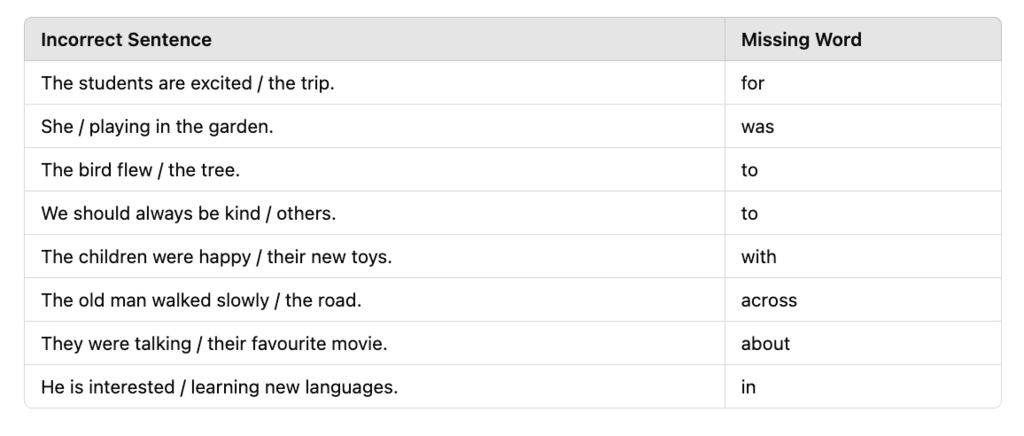
Q6: In the following passage, one word has been omitted in each line. A slash '/' has been inserted where the word is missing. Write the missing word. [½ × 8 = 4]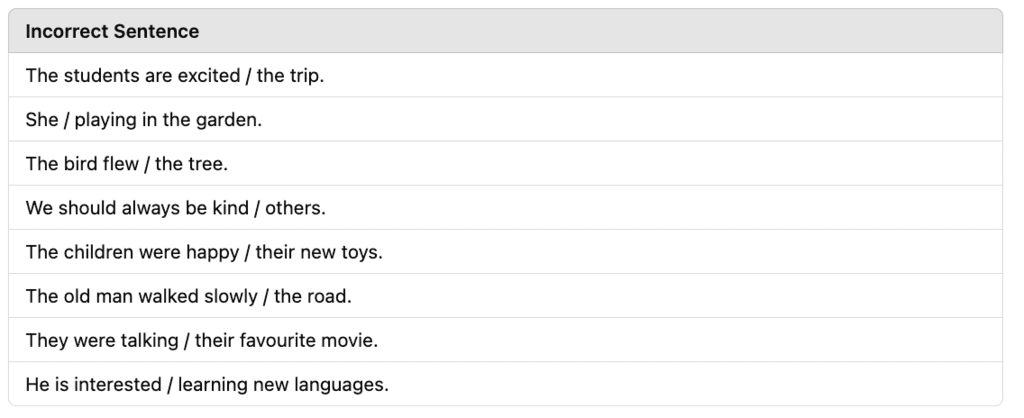
Ans:
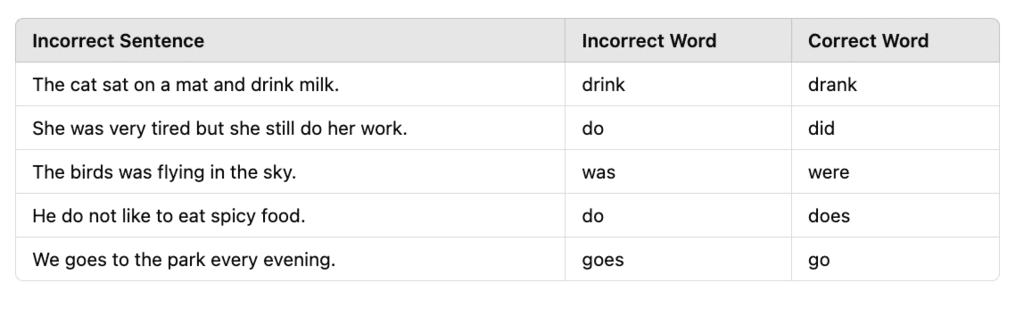
Q7: The following lines has not been edited. There is one error in each line. Write incorrect word and correction alongwith: [1 × 5 = 5 Marks] 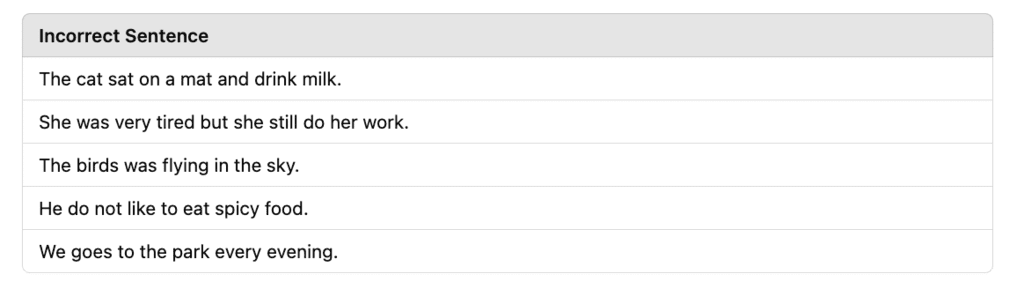
Ans:
Q8: Rearrange the jumbled words into a meaningful sentence. [½ × 2 = 1 Mark]
(a) book / I / read / like / this.
(b) are / students / in / my / school / many.
Ans:
(a) I like to read this book.
(b) There are many students in my school.
Q9: Change the voice of the following sentences: [½ × 2 = 1 Mark]
(i) The mechanic repairs the car.
(ii) The children read the storybook.
Ans:
(i) The car is repaired by the mechanic.
(ii) The storybook is read by the children.
Q10: Fill in the blanks with the correct form of the verbs given in the brackets: [½ × 2 = 1 Mark]
(i) When we __________ (reach) the airport, the flight __________ (already take) off.
(ii) I __________ (work) on my project every evening. Last night, I __________ (finish) it.
Ans:
(i) reached, had already taken off
(ii) work, finished
Q11: Do as directed. [8 Marks]
(a) Choose the correct verb and rewrite the sentences.
(i) The children (play/plays) outside every evening.
Ans: The children play outside every evening.
(ii) The teacher (teach/teaches) us new things every day.
Ans: The teacher teaches us new things every day.
(b) Complete these questions using Have you ever... or Did you ever...?
(i) __________ eat sushi before?
Ans: Have you ever eaten sushi before?
(ii) __________ travel to a different city last year?
Ans: Did you ever travel to a different city last year?
(c) Complete these words with 'ei' or 'ie'.
(i) f___ld
Ans: field
(ii) b___ve
Ans: believe
(iii) w___ght
Ans: weight
(iv) p___ce
Ans: piece
(d) Form complex sentences by joining the two sentences with the help of conjunctions.
(i) She forgot her umbrella. She got wet in the rain. (so)
Ans: She forgot her umbrella, so she got wet in the rain.
(ii) I studied hard. I couldn't answer all the questions. (but)
Ans: I studied hard, but I couldn't answer all the questions.
(e) Complete these sentences with correct collocations.
(i) Please __________ the book to the library after reading. (return/take)
Ans: Please return the book to the library after reading it.
(ii) She __________ a beautiful dress to the party. (wore/made)
Ans: She wore a beautiful dress to the party.
Section D (Literature)
Q12: Read the extract and choose the correct answer from the following: [1 x 3 = 3 marks]
Said the Fox, in admiring tones: "My word! Sir Raven, you are a handsome bird. Such feathers! If you would only sing, The birds of these woods would call you King."
(i) What was the motive behind Reynard's using sweet words to the Raven?
(a) to show respect
(b) to pay respects
(c) to flatter for snatching food
(d) all of the above
Ans: (c)
Explanation: Reynard used flattery to praise the Raven so that he could trick him into dropping the food. His sweet words were meant to deceive and gain the morsel.
(ii) 'Sir' used by Reynard's for the Raven shows
(a) respect to the Raven
(b) to praise
(c) to show pride
(d) to flatter for his morsel
Ans: (d)
Explanation: Calling the Raven "Sir" is a way for Reynard to flatter him and make him feel important so the Raven will open his beak and drop the food.
(iii) What did Reynard do to snatch the morsel from the Raven?
(a) he sang a song praising the Raven
(b) he tickled Raven's sense of pride
(c) to make him feel great
(d) to awaken his self-pride
Ans: (b) he tickled Raven's sense of pride
Explanation: Reynard praised the Raven's looks and suggested he should sing; by flattering the Raven's pride he made the bird open its beak, enabling Reynard to snatch the morsel.
Q13: Read the extract and answer the following: [1 x 3 = 3 marks]
Evenings, we play ball next to the creek in our neighbor's field.
We run so fast I can't even catch my breath. When blue dark turns to black, cold grass aches our feet, trees creep close- game's over. Night wins!
(A) Where do the children play ball in the evenings?
Ans: The children play ball next to the creek in their neighbour's field.
(B) What happens to the grass as the night falls?
Ans: The cold grass aches their feet as the night falls.
(C) How do the children feel while running?
Ans: They run so fast that they cannot even catch their breath.
Q14: Answer the following questions: [2 x 5 marks = 10 marks]
(i) Who is Ila Sachani and where is she from?
Ans: Ila Sachani is an artisan from Moti Vavdi village in Bhavnagar, Gujarat. She is known for creating colourful traditional works called Kathiawar embroidery.
(ii) How did Prabhat look at games?
Ans: Prabhat treated games competitively. If he thought he would lose, he avoided joining. Winning gave him a special feeling, so he preferred games he could win.
(iii) What did the fox tell the Raven in admiring tones?
Ans: The fox praised the Raven, calling him a handsome bird with shining black feathers and said that if the Raven would sing, the other birds would declare him king.
(iv) How will you control your blood sugar level and body weight?
Ans: I will soak some fenugreek seeds in water overnight and eat them next morning on an empty stomach. This practice may help gradually; continued use over several days may show results.
(v) Which part of the Neem tree is used to make kajal and how does it help?
Ans: Kajal is made from the flowers of the Neem tree. It is said to help reduce itching in the eyes.
Q15: Answer the following: [3 Marks]
In this poem, the poet describes different types of home of the baby bird. What is the difference between a house and a home? Which do you think is better?
Ans: A house is a building made of bricks, wood and glass - it is a physical structure without feelings. A home is where people and relationships make the place warm and caring; it includes family members who love and support one another. A home is better because it gives comfort, care and a sense of belonging.
Q16: Create a dialogue between two friends, one who laughed at Mario and one who didn't laugh. [6 Marks]
Ans:
- Characters:
- Vini (one who laughed at Mario)
- Guneet (one who didn't laugh at Mario)
- Vini: Did you see Mario trying to sit on that invisible chair? It was very silly of him!
- Guneet: Yes, I saw it, Vini. But I didn't find it only funny. He tried hard and felt embarrassed when he fell in front of everyone.
- Vini: Come on, it was really funny. He kept falling again and again. How could he believe in an invisible chair?
- Guneet: I agree it looked funny, but think how Mario must have felt. Laughing made him feel worse.
- Vini: I know, but he started the idea of an invisible chair. I thought it was fair to laugh.
- Guneet: He kept trying even after he failed. As friends, we helped him up - Asma, Deepa and I supported him in the end.
- Vini: I did not help. Do you think I should have?
- Guneet: Yes. Real friends help when someone falls; they do not add to their embarrassment by laughing too much.
- Vini: I understand that now. I am sorry I hurt him. I will apologise to Mario.
- Guneet: That is good. Next time we should be kinder and help instead of laugh.
- Vini: You're right. I promise to be more supportive.
FAQs on Class 6 English: Sample Paper Solutions- 5
| 1. What is the structure of the Sample Question Paper for Class 6? |  |
| 2. How can I prepare effectively for the exams based on the Sample Question Paper? | |
| 3. Are there any specific topics that are emphasized in the Sample Question Paper? | |
| 4. What types of questions can be expected in the Sample Question Paper? | |
| 5. How important is it to practice with the Sample Question Paper before the exam? | |