Class 6 Mathematics: Sample Paper -1

General Instructions
All questions are compulsory.
- Section A comprises 12 questions carrying 1 mark each.
- Section B comprises 10 questions carrying 2 marks each.
- Section C comprises 8 questions carrying 3 marks each.
- Section D comprises 2 questions carrying 5 marks each.
Q1: How many lines of symmetry does a regular hexagon have? (1 mark)
(a) 3
(b) 4
(c) 6
(d) 8
Q2: The perimeter of a square is 20 cm. What is the length of one side? (1 mark)
(a) 4 cm
(b) 5 cm
(c) 10 cm
(d) 8 cm
Q3: In the fraction 5/6, what is 5 called? (1 mark)
(a) Denominator
(b) Quotient
(c) Numerator
(d) Whole number
Q4: Convert the improper fraction 11/4 into a mixed fraction. (1 mark)
(a) 
(b) 
(c) 
(d) 
Q5: The temperature in a city is -5°C in the morning. By noon, it rises by 8°C. What is the temperature at noon? (1 mark)
(a) 3°C
(b) -3°C
(c) 5°C
(d) -13°C
Q6: Add the following fractions: (1 mark)
3/8 + 5/8
(a) 8/8
(b) 3/16
(c) 5/16
(d) 1/2
Q7: Which of the following pairs of numbers are co-prime? (1 mark)
(a) 8 and 12
(b) 15 and 35
(c) 9 and 16
(d) 10 and 20
Q8: What is a pictograph? (1 mark)
(a) A graph that uses pictures or objects to represent data
(b) A bar graph with horizontal bars
(c) A method to calculate frequencies
(d) A mathematical operation
Q9: A figure has rotational symmetry if it can be rotated by an angle less than __ and still look the same. (1 mark)
(a) 90°
(b) 180°
(c) 360°
(d) 270°
Q10: Where can fractions be represented visually? (1 mark)
(a) Number line
(b) Pie chart
(c) Only in decimal form
(d) In whole numbers
Q11: Find the missing number in the pattern: (1 mark)
100, 90, 80, __, 60
(a) 50
(b) 70
(c) 65
(d) 55
Q12: An obtuse angle is always: (1 mark)
(a) Less than 90°
(b) Equal to 90°
(c) More than 90° but less than 180°
(d) More than 180° but less than 360°
Q13: Aarav is arranging chairs in a triangular pattern. The first row has 2 chairs, the second row has 5 chairs, the third row has 9 chairs, and the fourth row has 14 chairs. If he continues this pattern, how many chairs will be in the fifth row? (2 marks)
Q14: Construct a rectangle having adjacent sides of 6 cm and 4 cm. (2 marks)
Q15: What is the sum of the smallest and largest 6-digit palindrome? What is their difference? (2 marks)
Q16: Subtract 3 from -4 using a number line. (2 marks)
Q17: Write two equivalent fractions for 3/7. (2 marks)
Q18: A square-shaped rug has a side length of 9 m. Find its area. (2 marks)
Q19: Below is a sequence of matchstick patterns. Observe the pattern carefully and continue it forward. also, give number pattern for the same : 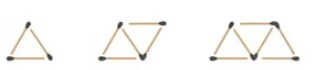
Number of matchsticks: 3, 5, 7, __ , __ (2 marks)
Q20: Do you see any Line of symmetry in the figures given below? (2 marks)
Q21: Can you find the pattern and fill in the missing numbers and justify your answer? (2 marks)
Q22: Is the first number divisible by the second? Use prime factorization. (2 marks)
(a) 180 and 45
(b) 784 and 14
Q23: Find the area of the shaded portion in the given figure . (3 marks)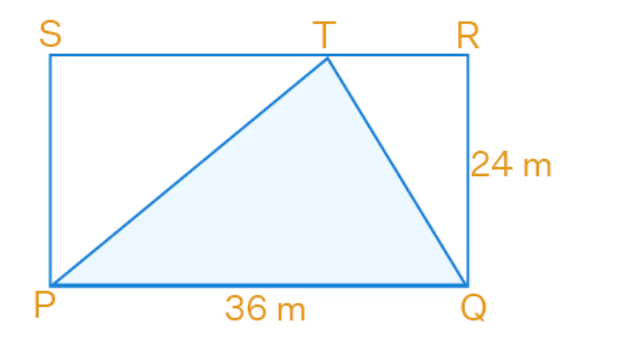
Q24: A rectangular parking lot is 500 m long and 200 m wide. If the cost of painting the parking lines is ₹8 per 100 sq. m, what is the total cost to paint the entire lot? (3 marks)
Q25: A strip of width 3 m is cut out all round from a sheet of paper with dimensions 50 m × 30 m. Find the area of the strip cut out and the area of the remaining sheet. (3 marks)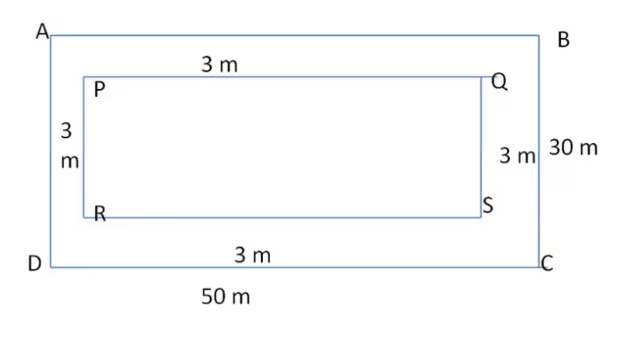
Q26: identify the type of angles made by clock's hands (3 marks)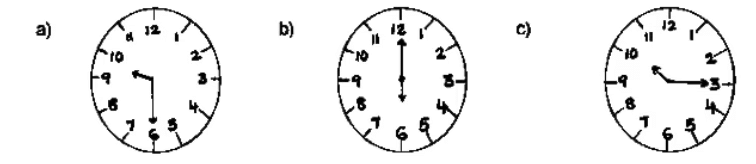
Q27: Identify the type of angle : (3 marks)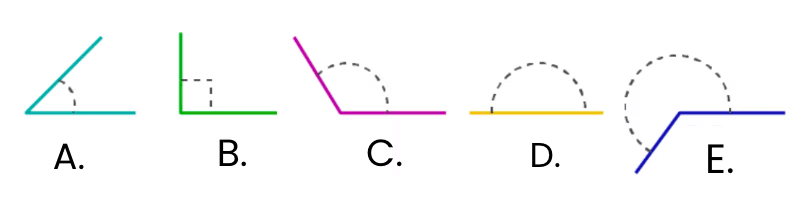
Q28: Draw a tally marks table for the following data:
A, B, A, B, C, D, E, D, C, B, A, E, C, D, B, E, A, E, C, D, B, E, C. (3 marks)
Q29: Find the area of the shape below: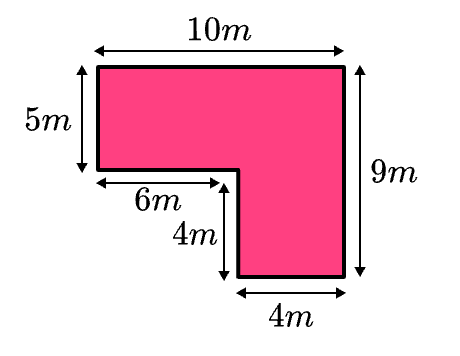
Q30: The temperature in a city at 6 AM was 3°C. Due to a cold wave, the temperature dropped by 7°C by 10 AM. Later in the afternoon, as the sun came out, the temperature rose by 5°C. By night, it again fell by 6°C. (3 marks)
(A) What was the temperature at 10 AM?
(B) What was the temperature in the afternoon?
(C) What was the temperature at night?
Q31: On the number line mark the following numbers : 5, 0, -3, -9 (5 marks)
Q32: Read and Answer the Pictograph Questions: (5 marks)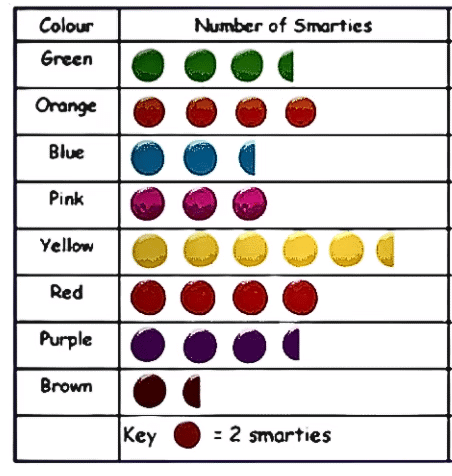
(i) How many green smarties are there? ______________________
(ii) How many brown smarties are there? ______________________
(iii) Which color is the most popular smartie? ______________________
(iv) Which color is the least favorite smartie? ______________________
(v) How many more yellow smarties are there than pink smarties? ______________________
(vi) How many more purple smarties are there than blue smarties? ______________________
(vii) How many more red smarties are there than brown smarties? ______________________
(viii) How many smarties are there altogether? ______________________
FAQs on Class 6 Mathematics: Sample Paper -1
| 1. What topics are covered in Class 6 Mathematics Sample Paper 1? |  |
| 2. How should I solve geometry problems in the Class 6 Maths sample paper without getting confused? | |
| 3. What's the difference between fractions and decimals that keeps appearing in Class 6 sample papers? | |
| 4. Why do I lose marks on integer and negative number questions in CBSE Class 6 Maths papers? | |
| 5. How do I tackle data handling and probability questions in the Class 6 Mathematics sample paper? | |