Worksheet Solutions: Methods of Separation in Everyday Life - 2

True or False
(i) The property used in separating a mixture of two solids by winnowing is the difference in weight.
Ans: True
Winnowing separates the lighter parts (like husk) from the heavier parts (like grains) using wind or a current of air.
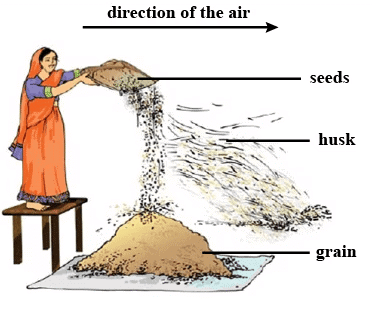 Winnowing
(ii) A mixture of milk and water can be separated by filtration.
Ans: False
Filtration cannot separate milk and water because both are liquids and the tiny particles in milk do not get trapped by ordinary filter paper.
(iii) A mixture of powdered salt and sugar can be separated by the process of winnowing.
Ans: False
Winnowing works when one component is much lighter than the other. Powdered salt and sugar have similar particle sizes and weights, so winnowing will not separate them.
(iv) Separation of sugar from tea can be done with filtration.
Ans: False
Sugar dissolves in tea, so filtration cannot separate it.
(v) Grain and husk can be separated with the process of decantation.
Ans: False
Decantation is used to separate a liquid from settled solids. Grain and husk are both solids and are separated by winnowing or threshing, not by decantation.
(vi) Sieving is used when the components of the mixture are of different sizes.
Ans: True
Sieving separates components based on size, like separating bran from flour.
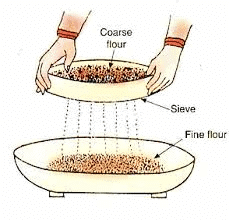 Seiving
(vii) The method of filtration is also used in the process of preparing cottage cheese in homes.
Ans: True
Filtration separates solid paneer from liquid whey during the preparation of cottage cheese.
(viii) Hand-picking can be used to separate cashew nuts from a mixture of almonds and cashew nuts.
Ans: True
Hand-picking is suitable when components are large and easily distinguishable by sight or touch.
Match the Following
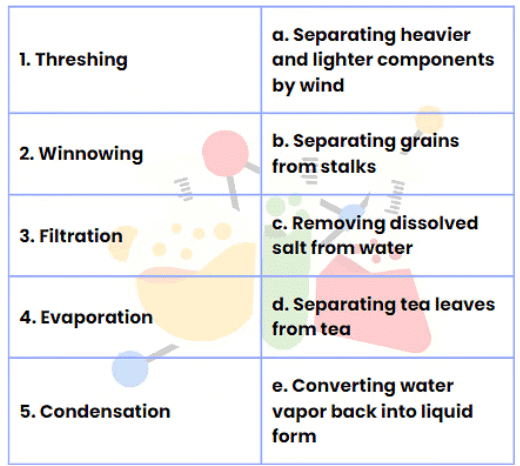
Ans: Here is the correct matching for the provided options:
- Threshing - b. Separating grains from stalks
- Winnowing - a. Separating heavier and lighter components by wind
- Filtration - d. Separating tea leaves from tea
- Evaporation - c. Removing dissolved salt from water
- Condensation - e. Converting water vapor back into liquid form
This matches the different separation techniques with their correct descriptions.
Fill in the Blanks
(i) The process of separating a liquid from solid sediment is called .
Ans: decantation
(ii) The method of separating seeds of paddy from its stalks is called .
Ans: threshing
(iii) When milk, cooled after boiling, is poured onto a piece of cloth, the cream (malai) is left behind on it. This process of separating cream from milk is an example of .
Ans: filtration
(iv) Salt is obtained from seawater by the process of .
Ans: evaporation
(v) is used to remove impurities and bran from the flour.
Ans: Sieving
(vi) We see water drops under the plate that has been used to cover a container containing milk that has just been boiled. This is due to the process of .
Ans: condensation
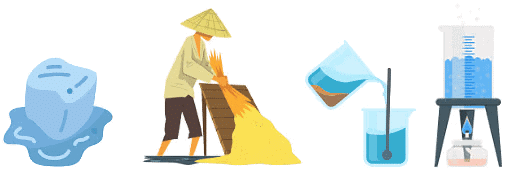
Assertion and Reason Questions
Q4: Assertion (A): The process of settling of heavier insoluble particles from a suspension of a substance in water known as decantation.
Reason (R): The Decantation process, along with sedimentation, is used to get clear water from muddy water.
(a) Both A and R are true, and R is the correct explanation of A.
(b) Both A and R are true, but R is not the correct explanation of A.
(c) A is true, but R is false.
(d) A is false, but R is true.
Ans. (d)
(i) Assertion: The assertion is false. The settling of heavier insoluble particles from a suspension is called sedimentation, not decantation.
(ii) Reason: The reason is true. Sedimentation followed by decantation is used to obtain clear water from muddy water.
(iii) Justification: Suspended particles first settle down by sedimentation. Decantation is the careful pouring off of the clear liquid after sedimentation. Therefore, A is false, and R is true, so option (d) is correct.
Answer the following
Q5: Write any two methods used for the separation of substances.
Ans: Hand-picking and Threshing.
Q6: How can we separate sand from water?
Ans: We can separate sand from water by using sedimentation to let the sand settle at the bottom, followed by decantation to pour off the clear water.
Q7: Which method would you prefer to separate a solid dissolved in a liquid?
Ans: Evaporation
Q8: The Filtration method is used to separate tea leaves from prepared tea. Which other method can be used?
Ans: Decantation
Q9: List various methods of separation of components from their mixtures.
Ans: Some of the methods are: handpicking, winnowing, threshing, sedimentation, decantation, filtration, evaporation and condensation.
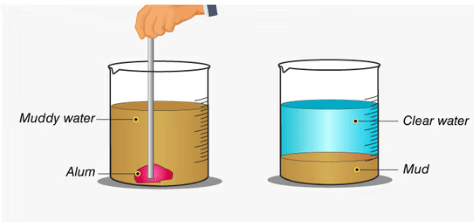
Q10: The process of adding alum to water to fasten sedimentation is called loading. Why has this name been given to the process
Ans: The term "loading" is used because adding alum makes the suspended particles heavier, causing them to settle faster.
Q11: Why is sieving not used to separate very small stones from rice grains?
Ans. Sieving is not used to separate very small stones from rice grains because both are of almost the same size and both will pass through the holes of the sieve.
Q12: What is winnowing? Where is it used?
Ans: Winnowing is a method of separating lighter and heavier parts of a mixture by using wind or air. It is used by farmers to separate husk, chaff and other light impurities from grains.
Q13: Why do we separate substances?
Ans: We need to separate the components of a mixture for the following reasons:
- To obtain useful components separately, for example, grains from their husk.
- To remove unwanted or harmful impurities from a mixture.
- To purify a substance so it can be used safely or effectively.
- To recover valuable substances present in a mixture.
Q14: How will you separate husk or dirt particles from a given sample of pulses before cooking?
Ans: Wash the pulses with water. The heavier pulses will sink to the bottom while lighter dirt or husk will float. Remove the dirty water by decantation after sedimentation. Repeat washing if needed, then dry the pulses before cooking.
FAQs on Worksheet Solutions: Methods of Separation in Everyday Life - 2
| 1. What are the different methods of separation used in everyday life? |  |
| 2. How does filtration work in separating mixtures? | |
| 3. What is the significance of evaporation in separation processes? | |
| 4. Can you explain how distillation is different from evaporation? | |
| 5. What role does magnetic separation play in everyday life? | |